Pre Transaction Checks Stop Crypto Fraud for Users and Merchants
Crypto fraud prevention comes down to three habits: verify before you sign, keep your seed phrase offline forever, and treat urgency as a red flag rather than a reason to act fast. Crypto transfers are functionally irreversible once confirmed, so recovery is rare. If you suspect an attack right now, stop all pending transfers, revoke wallet approvals, and change your passwords before doing anything else.
TL;DR:
- Most crypto scams exploit human behavior, application layer vulnerabilities, and wallet approvals rather than blockchain protocol flaws.
- Recognizing urgency, phishing links, clone domains, and requests to transfer funds to “safe” wallets are key warning signs of scams.
- Using hardware wallets, unique passwords, app-based MFA, manual address verification, and revoking approvals can prevent most individual fraud losses.
- Real-time transaction risk scoring, address reputation feeds, multi-signature wallets, and phishing training are crucial for business fraud prevention.
- After a scam, immediate actions like stopping transfers, revoking approvals, changing passwords, and reporting to authorities greatly improve recovery chances.
Table of Contents
What Are the Most Common Crypto Scams?
Most crypto fraud follows a handful of well worn scripts, and recognizing the pattern matters more than memorizing every variant. Scammers rarely need to break the blockchain. They just need you to sign something you shouldn’t.
Investment fraud and pig-butchering scams start slow. A stranger builds a relationship over weeks on a dating app or social media, eventually introduces a “can’t miss” trading platform, and lets you withdraw a small profit early to build trust. Then the deposits get bigger and the withdrawals stop. The FBI’s guidance on cryptocurrency investment fraud breaks down this exact progression, from initial contact through the final disappearance of funds.
Rug pulls work differently. Developers launch a token, hype it through paid influencers or fake community activity, then drain the liquidity pool the moment enough outside money flows in. The project’s social accounts often go dark within hours.
Other patterns to know:
- Phishing and fake support: cloned exchange login pages or DMs from accounts impersonating customer service, designed to harvest credentials or seed phrases.
- Impersonation scams: fake profiles posing as executives, celebrities, or even government agencies promoting giveaways that require an upfront “verification” payment.
- Wallet drainers: malicious smart contracts that request a token approval, then sweep every asset covered by that approval the moment you sign.
- Look-alike addresses: malware that swaps a copied wallet address on your clipboard for a visually similar one controlled by an attacker.
IBM’s security research notes that most crypto fraud exploits the application layer, wallets, smart contracts, and human behavior, not the underlying blockchain protocol itself. That’s why prevention has to cover the full stack, not just the ledger.
What Are the Warning Signs of a Crypto Scam?
Certain behaviors show up in almost every successful scam. Learning to spot them in the moment is the difference between a close call and a drained wallet.
- Urgency and pressure: any message insisting you act “right now” or “before the offer expires” is designed to shut down your critical thinking.
- Requests for your seed phrase, password, or MFA code: no legitimate exchange, wallet provider, or support agent will ever ask for these.
- Unsolicited links or QR codes: a message you didn’t request, containing a link or scan code, is one of the most common malware and phishing delivery methods.
- New “support” accounts sliding into your DMs: real support teams don’t cold-message users offering help.
- Cloned domains: a URL that’s off by one character (a swapped letter, an extra hyphen) is a classic phishing tactic.
- Requests to move funds to a “safe wallet”: this is almost always a request to send your assets directly to the scammer.
- Demands to pay a fee to “unlock” a withdrawal: legitimate platforms never charge a fee to release funds you already own.
Pro Tip: If someone asks you to move funds anywhere “for safety,” treat it as confirmation you’re being scammed. No legitimate custodian has ever protected your money by asking you to send it to a stranger’s address.
How Can Individuals Prevent Crypto Fraud?
Most individual losses trace back to a handful of preventable mistakes: reused passwords, SMS-based MFA, or a rushed approval signature on a malicious contract. Fixing these closes off the majority of attack paths scammers rely on.
Build these habits into your routine:
- Use a hardware wallet for anything beyond spending money, and store your seed phrase offline, written on paper or engraved on metal, never in a cloud note or photo.
- Never share your recovery phrase with anyone, for any reason, under any circumstance. There is no legitimate scenario where a service needs it.
- Set unique passwords for every exchange and wallet app, managed through a password manager rather than memory or reuse.
- Use app-based MFA (like an authenticator app) instead of SMS, since SIM-swapping attacks can intercept text-based codes.
- Verify addresses manually before sending funds, and use a transaction simulation tool to preview exactly what a contract signature will do before you approve it.
- Revoke token approvals you no longer need, especially after interacting with an unfamiliar dApp.
- Install wallet apps only from official sources, avoid scanning QR codes from unknown senders, and keep your device firmware and wallet firmware current.
Hardware wallets protect your private keys from remote theft, but they can’t stop you from approving a malicious contract. As Coin Bureau’s research on hardware wallet mistakes points out, the device only confirms what you sign. You still have to read and understand what you’re signing.
Illicit crypto addresses received roughly $40.9 billion in 2024 alone, a scale that underscores why individual habits matter as much as any platform-level defense. For account-level hardening beyond wallets, security practices for trading accounts cover many of the same principles applied to exchange logins.
What Security Measures Should Crypto Businesses Implement?
Businesses handling crypto payments face a different threat profile than individual holders. Fraud losses at scale usually stem from gaps in process and access control, not exotic attacks.
Priority measures, roughly in order of impact:
- Real-time pre-transaction decisioning: an API that returns an approve or deny recommendation before a withdrawal executes, catching fraudulent destinations before funds leave. Hypernative’s fraud prevention model is a working example of this approach in production.
- Address reputation and shared intelligence feeds: subscribing to databases that flag known scam addresses across chains, since no single organization sees the entire fraud landscape on its own.
- Key management system (KMS) best practices: hardware security modules or equivalent, paired with least-privilege access so no single employee can move treasury funds alone.
- Multi-signature wallets for treasury holdings: requiring multiple independent approvals for any transaction above a set threshold.
- Regular smart-contract audits and penetration testing: scheduled, not one-time, since new attack techniques emerge constantly.
- A tested incident response plan: documented and rehearsed, not just written and filed away.
No single organization sees the whole fraud landscape. Cross-jurisdiction data sharing and pooled intelligence catch scam wallets and mule networks faster than any one platform working alone.
That’s the core argument behind shared intelligence networks used across the fraud-detection industry: fraud rings move across chains and platforms, so detection has to move with them. Bitsight’s research on crypto fraud detection frames this as covering both on-chain and off-chain signals simultaneously, since scammers exploit whichever layer is weakest. For platforms building their own transaction flows, reliable webhook handling is a foundational piece of getting fraud signals to trigger the right response before settlement.
Speed matters more than almost anything else once you realize you’ve been scammed. Every minute a scammer holds uncontested access to your funds or accounts increases the odds of total loss.
- Stop all pending transfers and disconnect any wallet sessions still active on suspicious sites.
- Revoke token approvals granted to any contract you interacted with during the incident.
- Change passwords on every account tied to the compromised wallet or exchange, and rotate MFA where possible.
- Migrate remaining assets to a new, clean wallet if you suspect your seed phrase or private key was exposed.
- Contact exchanges and service providers immediately, providing transaction hashes and exact timestamps so they can flag or freeze linked accounts.
- Report the incident to IC3, the FTC, and your relevant financial regulator, along with the platform where the transaction occurred.
- Keep every record: screenshots, wallet addresses, communication threads, and transaction IDs, since investigators rely on this trail to trace funds.
Be honest with yourself about the odds. The FTC’s own guidance is blunt: money sent in crypto scams is almost never recovered, because transactions are decentralized and irreversible, and scammers typically launder funds through mixers and cross-chain bridges within hours. Rapid reporting occasionally lets exchanges freeze a scammer’s account before they cash out, but that outcome is the exception, not the expectation.
The strongest defense against irreversible crypto losses is stopping the transaction before it settles, not investigating it afterward. Evaluating destination-wallet risk in real time, before funds move, closes the exact gap that post-transaction monitoring can’t.
That’s the logic behind pre-transaction decisioning: a payment or withdrawal request gets scored against known scam addresses, wallet behavior patterns, and cross-chain exposure data, and returns an approve or deny signal in milliseconds. Businesses integrating this layer typically connect it at a few key points:
- Checkout and withdrawal webhooks that pause a transaction pending a risk score.
- Decisioning APIs that return a clear approve/deny response rather than a vague risk percentage.
- Continuous address reputation monitoring, flagging a previously clean wallet the moment it starts receiving funds from known scam addresses.
Cryptopayr builds fraud-awareness into its own security approach to protecting merchant funds and data, reflecting the same layered logic: no single check catches everything, so the checks have to work together.
Pro Tip: Ask any payment processor you’re evaluating exactly when their fraud check runs, before settlement or after. A “we monitor for fraud” answer that happens post-transaction is monitoring, not prevention.
Emerging Trends and Evolving Tactics in Crypto Fraud
Scam tactics shift roughly as fast as the defenses built to catch them, and a few trends stand out heading into 2026.
AI-generated deepfakes are showing up in romance scams and fake executive endorsements, making impersonation harder to spot by voice or video alone. Scammers increasingly use AI chatbots to run multiple pig-butchering conversations simultaneously, scaling a scam that used to require real human time investment per victim.
Cross-chain bridge exploitation has grown as a laundering technique, since moving stolen funds across multiple chains quickly complicates tracing efforts. Wallet drainer kits are now sold as a service on underground forums, letting low-skill attackers deploy sophisticated approval-phishing campaigns without writing a line of code themselves.
Fake job offers targeting crypto and tech workers have become a common vector for both credential theft and wallet-drainer installation disguised as a “skills test” application. QR code scams have also expanded beyond wallet approvals into fake parking meters, restaurant menus, and event check-ins, all designed to route a scan toward a malicious signing request.
The throughline across all of these: attackers are optimizing for scale and speed, using automation to run more scams simultaneously, and cross-chain movement to launder proceeds before anyone can react. Staying current means treating your prevention habits as a living practice, not a one-time setup.
What Is the Legal and Regulatory Landscape for Crypto Fraud?
Regulatory oversight of crypto fraud is fragmented across agencies and borders, which is exactly why reporting to multiple channels matters. In the United States, the SEC pursues cases involving unregistered securities offerings and fraudulent token sales, while the CFTC has jurisdiction over crypto derivatives and certain spot market manipulation cases. The FBI and IC3 handle criminal investigation and victim intake regardless of which agency ultimately has civil authority.
In the European Union, the Markets in Crypto-Assets (MiCA) regulation gives ESMA and national regulators a unified framework for licensing crypto service providers and enforcing consumer protection standards. Individual EU member states still handle criminal fraud prosecution locally, even under the shared MiCA framework.
No single global regulator governs crypto fraud, and enforcement capability varies widely by country. That gap is part of why cross-border scam operations persist: a scammer operating from a jurisdiction with weak enforcement can target victims anywhere with far less legal risk. Businesses operating internationally need to understand the licensing and reporting obligations in every market they serve, not just their home jurisdiction, since a compliance gap in one country can expose the whole platform to liability.
Why User Education Programs Actually Reduce Fraud
Technical controls stop a lot of fraud, but the remaining gap almost always comes down to a person clicking something they shouldn’t. Effective education programs treat this as a training problem, not a one-time disclaimer.
The strongest programs share a few traits. They run simulated phishing tests periodically rather than a single onboarding video, since retention of a one-time warning fades within weeks. They use real, recent scam examples instead of generic warnings, because a screenshot of an actual cloned exchange login page teaches faster than an abstract description of “phishing.” They make reporting suspicious activity frictionless, with a dedicated channel and no penalty for false alarms, since employees who fear looking foolish will stay quiet about a suspicious email instead of flagging it.
For businesses, this means training customer-facing staff to recognize social engineering attempts targeting the company itself, not just customers. Support agents are a common target for attackers trying to get account access reset or funds redirected. For consumer-facing platforms, in-product warnings at the exact moment of risk, right before a withdrawal to a new address, for instance, outperform static help-center articles that users never read until after they’ve already lost money.
Blockchain analytics platforms trace the flow of funds across wallets and chains, flagging addresses linked to known scams, mixers, or sanctioned entities before a business ever processes a transaction involving them. This kind of tracing is possible specifically because blockchain transactions are public and permanent, an anti-fraud advantage traditional banking rails don’t offer.

AI models add a layer on top of raw tracing by detecting behavioral anomalies: a wallet that suddenly receives funds from dozens of unrelated new addresses, or a transaction pattern that matches known mule-account behavior. These models get more accurate as they process more transaction history, which is part of why shared intelligence feeds outperform any single company’s isolated dataset.
For platforms and sophisticated investors, tracking wallet behavior tied to smart money movement illustrates the same underlying technique applied to a different use case: reading on-chain patterns to separate legitimate activity from coordinated manipulation. The core skill, reading wallet behavior rather than trusting a label, transfers directly to fraud detection.
The limitation worth naming honestly: analytics and AI tools are excellent at flagging known patterns and known bad actors, but a brand-new scam wallet with no transaction history yet can slip past pattern-based detection until it starts moving funds. That’s why address reputation monitoring works best paired with real-time behavioral rules, not as a standalone filter.
What Do Successful Crypto Fraud Prevention Efforts Look Like?
The clearest lesson from platforms that have meaningfully cut fraud losses is that layered defense outperforms any single control, no matter how sophisticated that one control is.
Exchanges that added mandatory withdrawal delays for new devices or newly added addresses saw fewer successful account-takeover losses, since the delay window gives account holders time to notice and cancel a fraudulent withdrawal before it clears. Platforms that paired real-time destination-address risk scoring with manual review for high-value transactions blocked withdrawal attempts to known scam addresses that pattern-matching alone would have missed, since a brand-new address with no history still needs a second layer of judgment.

On the individual side, wallets that added a plain-language transaction simulation before every signature, showing exactly what tokens and permissions a contract would receive, cut successful drainer-contract losses among their user bases. The improvement came from something simple: showing people what they were about to approve, in language they could actually understand, instead of a wall of hexadecimal contract code.
The pattern across every example that actually worked: friction placed at the exact moment of risk, not buried in a settings menu or a help article nobody reads until after the damage is done. Prevention that requires a user to go looking for it fails far more often than prevention built into the transaction flow itself.
An Editorial Take on Crypto Fraud Prevention
Most crypto fraud prevention advice treats individuals and businesses as separate problems with separate solutions. That split is a mistake. A merchant’s payment gateway and a customer’s wallet hygiene are two ends of the same transaction, and a scam that succeeds at either end drains the same funds. The businesses making real progress on fraud aren’t the ones with the flashiest security marketing. They’re the ones that built pre-transaction checks into the moment money actually moves, instead of writing a policy document and hoping customers read it.
The uncomfortable truth is that most individual victims already knew the general warning signs. They just didn’t recognize them in the specific moment they mattered, under pressure, mid-conversation, with a deadline attached. That’s a design problem as much as an education problem, and it’s one platforms are better positioned to solve than any awareness campaign.
— Dustin
How Cryptopayr Reduces Fraud Exposure for Merchants
Cryptopayr gives businesses a way to accept crypto payments without inheriting the compliance overhead of a traditional processor, while still building fraud awareness into the transaction flow itself.
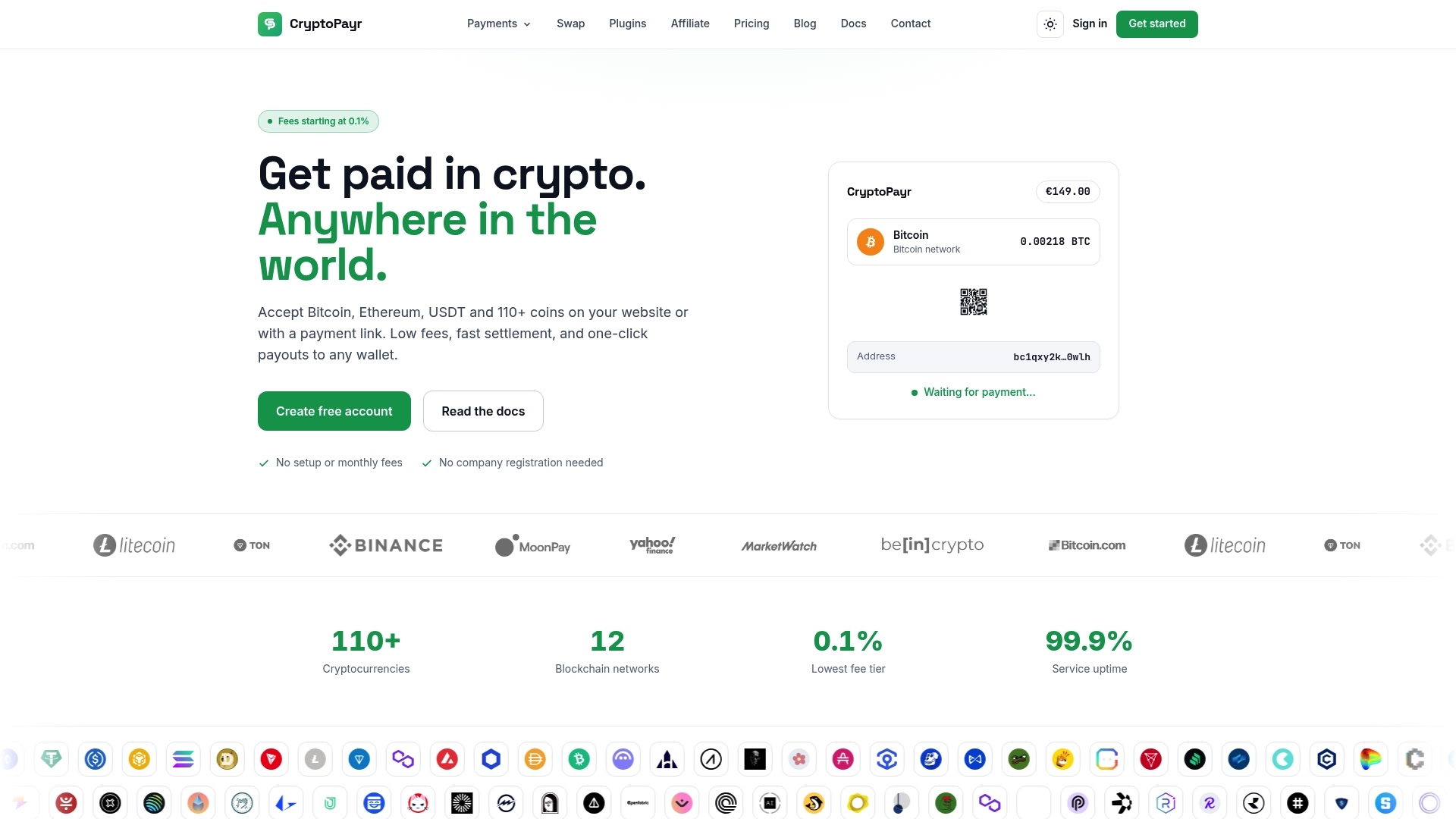
For businesses in categories that face elevated fraud attempts, from digital marketplaces to subscription platforms, the priority isn’t just accepting payments fast. It’s making sure the payments you accept are the ones you meant to receive. Auto-conversion to stablecoins reduces the window where volatile funds sit exposed, and webhook-based integration lets you build your own risk checks directly into the payment flow rather than bolting them on afterward. Platforms weighing in-house crypto acceptance against a specialized gateway should also consider how high-risk industries handle crypto payment integration, since the fraud exposure varies significantly by business model.
If you’re evaluating a gateway that fits fraud-conscious integration without the friction of a traditional processor, explore the Cryptopayr gateway and see how checkout, payment links, and API access fit your existing platform.
Where to Report Crypto Fraud and Get Help
File a report with IC3 for internet crime complaints, the FTC for consumer fraud alerts, and your national securities or derivatives regulator (SEC, CFTC, ESMA, or equivalent) if investment fraud is involved. Before filing, gather transaction hashes, exact timestamps, wallet addresses, and copies of any messages from the scammer.
Sources
Recommended


