Crypto Recurring Billing: How to Build or Buy It in 2026

Yes, recurring crypto billing works, and it works well when you match the technical approach to your actual volume and risk tolerance. For most SaaS platforms and e-commerce merchants, the fastest path is a hosted gateway with recurring-billing support. Only build a custom on-chain solution if you have specific business logic that a gateway can’t accommodate.
Here’s the quick decision path most teams should follow:
- Under 500 transactions a month or no in-house blockchain team? Start with a gateway. You’ll be live in days, not months.
- Need programmable, trustless automation baked into your protocol? Look at on-chain scheduling patterns built around standards like EIP-1337, Ethereum’s proposal for recurring payment authorization.
- Somewhere in between? Run a hybrid: gateway for checkout and customer experience, with settlement routed to your own treasury logic.
Recurring payments are a massive market opportunity. Industry market research places the global recurring-payment sector in the hundreds of billions of dollars, and crypto subscriptions are a growing slice of that pie as merchants look for lower fees and fewer failed-card headaches. A gateway like Cryptopayr lets you plug into that demand with a no-KYC checkout flow rather than spending months on smart contract audits.
Key Takeaways
Recurring crypto billing works reliably when businesses match settlement tokens to stablecoins, choose low-fee networks for small transactions, and start with a gateway before building custom on-chain logic.
| Point |
Details |
| Start with a gateway |
Most merchants launch faster and cheaper with a hosted gateway than a custom smart contract. |
| Default to stablecoins |
USDC, USDT, and DAI remove volatility risk from recurring subscription pricing. |
| Use Layer 2 for small transactions |
Networks like Polygon, Base, and Arbitrum keep gas costs from eating micro-subscription margins. |
| Plan compliance early |
KYC/AML triggers depend on custody and fiat conversion, so map your obligations before scaling volume. |
| Cryptopayr fits most merchants |
Its no-KYC hosted checkout, auto-conversion, and white-label option cover recurring billing without custom development. |
Table of Contents
What Is Crypto Recurring Billing?
Crypto recurring billing is the automated, scheduled transfer of cryptocurrency (or the programmatic release of pre-authorized funds) to collect payment on a repeating basis, typically monthly or annually, without the customer manually re-approving each charge. It solves the same problem as a saved credit card on file. Card networks store an authorization; crypto systems either store a signed permission, hold pre-deposited funds in escrow, or rely on a scheduler to trigger transfers at defined intervals.
A typical flow for a monthly SaaS subscription paid in stablecoin looks like this:
- The customer connects a wallet at checkout and approves a recurring authorization (or deposits a set amount into an escrow contract).
- The gateway or contract records the billing interval, amount, and destination address.
- On the billing date, the system triggers a transfer, usually in USDC or another stablecoin, from the customer’s wallet or the escrow balance to the merchant’s wallet.
- The merchant backend receives a webhook or on-chain event confirming payment, then extends the subscription.
- If the transfer fails (insufficient balance, revoked approval), the system flags the account and triggers a retry or dunning sequence.
Stablecoins dominate this model for a simple reason: a $29-a-month subscription billed in a volatile asset creates accounting chaos.
Pro Tip: If you’re testing recurring flows for the first time, run the entire cycle end-to-end in a sandbox using a stablecoin on a low-fee network before you touch a mainnet contract with real customer funds.

How Does Recurring Crypto Billing Actually Work Under the Hood?
There’s no single standard for automating crypto subscriptions. Instead, five patterns have emerged, each with real trade-offs.
On-chain scheduled contracts store billing logic directly on the blockchain. A smart contract holds the rules (amount, interval, recipient) and executes transfers when triggered, either by a keeper network or a manual call. This is the model formalized in proposals like EIP-1337, which defines a subscription interface for Ethereum. The upside is trustlessness. Nobody, including the merchant, can charge outside the agreed terms. The downside is gas cost volatility and the fact that someone still has to trigger execution, which means you need a keeper or relayer network running reliably.
Prepaid escrow and release has the customer deposit a lump sum upfront (say, three months’ worth) into a contract that releases scheduled portions to the merchant. It removes the “insufficient funds on billing day” problem entirely, but customers dislike prepaying, and refunding unused balances gets complicated fast.
Presigned off-chain authorizations work like a card-on-file model. The customer signs a message once, authorizing a specific spender to pull funds up to a limit. The actual pull happens later, off-chain, and gets broadcast when due. This is efficient but depends entirely on the signature remaining valid and the wallet maintaining sufficient balance.
Off-chain schedulers with relayers keep all scheduling logic in a centralized or semi-centralized backend that watches balances and initiates transfers through a relayer service. It’s flexible and easy to modify, but it reintroduces the trust assumption that on-chain purists try to avoid, and a scheduler outage means missed billing cycles.
Custodial or hosted gateway pull models hand the entire mechanic to a payment processor. The gateway manages authorization, retries, and settlement, and the merchant just receives webhooks. This is by far the fastest to implement.
| Approach |
Best for |
Main risk |
| On-chain scheduled contracts |
Protocols needing trustless automation |
Gas spikes, keeper reliability |
| Prepaid escrow |
Fixed-term memberships, low-trust customers |
Refund complexity, customer friction |
| Presigned authorizations |
Card-like recurring UX on-chain |
Signature revocation, balance gaps |
| Off-chain scheduler + relayer |
Teams wanting flexibility without full custody |
Centralized point of failure |
| Custodial/hosted gateway |
Most merchants, fastest launch |
Less protocol-level control |
Picture each pattern as a chain of four components: a wallet (holds funds), a trigger (contract logic, relayer, or scheduler), a settlement layer (where funds land), and a merchant backend (which records the payment). The pattern you choose just decides who owns the trigger and who owns the risk when it fails.
Which Implementation Path Fits Your Business?
Four decision factors determine which category makes sense: how fast you need to launch, how much control over funds you require, whether you need fiat settlement, and how sensitive you are to per-transaction cost.
- Time to market. A hosted gateway can go live in days. A custom on-chain scheduler realistically takes weeks of development plus an audit cycle.
- Custody model. Do you want to touch customer funds at any point, or should a processor handle that entirely?
- KYC/AML exposure. Custodial gateways that convert to fiat often carry more compliance overhead than non-custodial, crypto-to-crypto flows.
- Cost sensitivity. Gas fees on Ethereum mainnet can eat a micro-subscription’s margin; a gateway routing through a low-fee network avoids that math problem entirely.
| Implementation category |
Time to launch |
Fund custody |
Typical use case |
| Hosted gateway |
Days |
Processor-managed |
Most SaaS and e-commerce merchants |
| Hybrid gateway + on-chain settlement |
Weeks |
Shared |
Platforms wanting brand control with automated settlement |
| Fully on-chain scheduled contracts |
Weeks to months |
Self-custodied |
Protocols, DAOs, on-chain-native products |
| Custodial subscription service |
Days to weeks |
Third-party custodied |
Marketplaces needing payout splitting |
Most teams should start with a gateway and move to a custom on-chain flow only if a specific product requirement, like protocol-native streaming payments or trustless governance rules, actually demands it. Building the on-chain version first, before you know your churn rate or average transaction size, is how projects burn six months on infrastructure nobody uses.
Which Networks and Wallets Actually Matter for Subscriptions?
Network choice determines whether your recurring billing model is economically viable at small transaction sizes. Ethereum mainnet gas fees make $5 or $10 monthly subscriptions impractical unless you batch transactions or eat the cost yourself.
Networks commonly used for recurring flows include:
- Ethereum Layer 2 networks like Polygon, Base, and Arbitrum, which cut gas costs dramatically while keeping compatibility with Ethereum tooling.
- Other high-throughput chains where major stablecoins maintain deep liquidity, reducing slippage on conversion.
- Ethereum mainnet, reserved mostly for higher-value settlements where gas cost is a rounding error relative to the transaction size.
On tokens, prioritize USDC, USDT, and DAI. These stablecoins carry the deepest liquidity and the most predictable peg behavior, which matters enormously when you’re trying to reconcile recurring revenue against a fixed subscription price.
Wallet UX is where a lot of recurring billing projects quietly fail. Presigned authorizations require the customer’s wallet to remain accessible and funded on the billing date. Custodial wallets simplify this since the provider manages the keys, but you lose some of the self-custody appeal that draws certain crypto-native customers in the first place. MetaMask’s own gas documentation explains how fee estimation and network congestion affect transaction confirmation, which is essential reading if you’re designing any flow where a delayed confirmation could mean a missed billing cycle.
How Should You Handle Price Volatility and Settlement Timing?
Three settlement patterns cover almost every recurring crypto billing setup: immediate on-chain stablecoin receipt, auto-convert to fiat through the gateway, and a buffered treasury model where the merchant preconverts a reserve to smooth out timing gaps.

Immediate stablecoin receipt is the simplest. The customer pays in USDC or USDT, and the merchant holds that balance as-is. There’s minimal volatility risk since stablecoins are pegged, but the merchant still carries counterparty risk tied to whichever stablecoin issuer backs the token.
Auto-convert to fiat routes the payment through the gateway, which converts it to the merchant’s local currency at the time of receipt or on a daily batch. This removes crypto exposure entirely from the merchant’s books but introduces a conversion spread, usually a small percentage, that the merchant or the gateway absorbs depending on the pricing model.
Buffered treasury means the merchant preconverts a portion of expected revenue into a stable reserve ahead of time, insulating operations from any single day’s volatility or liquidity crunch. This is more relevant for merchants accepting volatile assets like Bitcoin or Ether directly rather than stablecoins.
The timing question, receive on demand versus daily batch versus periodic conversion, mostly comes down to who’s willing to hold conversion risk. A merchant converting daily locks in a rate once every 24 hours. One converting per-transaction locks in immediately but may pay slightly more in aggregate fees.
Pro Tip: Default to accepting stablecoins with optional auto-convert to your operating currency. It matches how most subscription pricing already works: a fixed number, billed on a fixed schedule, with no surprises for you or the customer.
How Do You Prevent Fraud and Handle Refunds?
Security in recurring crypto billing splits into two problems: protecting the infrastructure that triggers payments, and protecting customers from scams that exploit the recurring authorization model itself.
On the infrastructure side, a working security checklist includes:
- Multisig wallets for any treasury holding significant merchant funds, so no single compromised key can drain an account.
- Hardware key management for signing keys tied to scheduler or relayer operations.
- Active monitoring on schedulers, with alerts when a scheduled trigger fails to fire within its expected window.
- Failover relayers, so a single relayer outage doesn’t stall an entire billing cycle.
Refunds work differently in crypto than the chargeback system most merchants are used to. A credit card chargeback lets a customer dispute a charge with their bank, which can claw back funds from the merchant weeks later. On-chain payments settle immediately and irreversibly. There’s no equivalent claw-back mechanism built into the protocol itself. Gateways handle disputes by processing manual refunds from merchant balances rather than reversing the original transaction, which means merchants need clear, published refund policies since there’s no bank intermediary to fall back on.
The biggest security failure in recurring crypto billing isn’t a hacked contract. It’s a merchant who never noticed their scheduler stopped firing three weeks ago, and only found out when a customer complained their subscription never renewed.
Scam red flags worth logging and monitoring on your platform include:
- Unexpected wallet behavior, like an authorization being used to pull a larger amount than originally approved.
- Phishing signature requests disguised as routine renewal confirmations.
- Address spoofing, where a scammer sends a near-identical wallet address hoping a customer copies the wrong one.
- Any pressure from a “support agent” to move a conversation off-platform before resolving a payment issue. This is one of the most common precursors to a social-engineering scam.
What Compliance and Tax Rules Apply to Crypto Subscriptions?
KYC and AML obligations typically kick in at specific trigger points rather than applying uniformly to every crypto transaction. Custody of customer funds, conversion to fiat, and high-volume transaction screening are the three most common triggers that pull a business into formal compliance requirements. SWIFT’s guidance on Know Your Customer principles lays out the due-diligence controls that payment providers generally need to plan around, and it’s a useful baseline even for non-custodial flows, since regulatory expectations shift depending on jurisdiction and settlement method.
Action items worth putting in place before you scale:
- Keep detailed, timestamped ledgers of every transaction, including wallet addresses, amounts, and settlement currency.
- Consult local tax counsel in every jurisdiction where you have paying customers. Crypto tax treatment varies significantly by country and even by transaction type within the same country.
- Plan for KYC onboarding if your transaction volume or customer risk profile grows past whatever threshold your regulator or banking partner sets.
This is a global overview, not legal advice specific to your jurisdiction. Regulatory frameworks for crypto payments differ by country and change frequently, so confirm current requirements with local counsel before launching.
What Does Recurring Crypto Billing Actually Cost?
Four cost components show up in nearly every recurring crypto billing setup: network fees (gas), scheduler or relayer fees, gateway processing fees, and conversion spread if you’re settling to fiat or a different token.
| Cost component |
Typical range |
Who usually absorbs it |
| Network gas fee |
Cents to a few dollars, depending on chain |
Merchant or customer, depending on setup |
| Scheduler/relayer fee |
Small flat fee or percentage |
Merchant |
| Gateway processing fee |
A small percentage per transaction |
Merchant |
| Conversion spread |
A small percentage, if converting currencies |
Merchant or gateway, split varies |
For a low-value micro-subscription, say $5 a month, on a low-fee Layer 2 network routed through a gateway with auto-convert, the network fee itself is often negligible; the processing fee is the dominant cost, followed by a small conversion spread if you’re settling to fiat. For a mid-value subscription around $50 a month, the same fee structure applies, but the fixed-cost components (gas, relayer fees) shrink as a percentage of the total transaction, which is exactly why higher-value subscriptions tend to be more margin-friendly on-chain than micro-transactions.
The practical takeaway: don’t price a $3 subscription assuming Ethereum mainnet gas costs. Route small transactions through Layer 2 networks or a gateway that’s already optimized for low-value flows, and reserve any mainnet settlement for higher-ticket products.
What’s the Developer Checklist for Going Live?
A production-ready recurring crypto billing integration follows a fairly consistent sequence, regardless of which architecture you choose.
- Choose your settlement token. Default to a major stablecoin unless you have a specific reason to accept volatile assets directly.
- Pick your network. Match network fees to your average transaction size; use a Layer 2 for anything under roughly $20.
- Design retry logic. Define how many retries occur on a failed charge, and at what intervals, before the subscription lapses.
- Implement the scheduler. Whether it’s a smart contract keeper, a relayer service, or a gateway’s backend, confirm it fires reliably under load.
- Build webhook handling. Your backend needs to listen for renewal success, renewal failure, and cancellation events, then update subscription state accordingly.
- Add logging and monitoring. Every triggered payment attempt, successful or failed, needs a timestamped record for reconciliation and compliance.
- Test the full billing cycle end-to-end, from initial signup through at least two renewal cycles, in a sandbox before touching production.
Your testing plan should specifically inject failure scenarios: simulate insufficient customer balance, simulate a gas price spike mid-transaction, and simulate a webhook delivery failure to confirm your retry logic actually recovers instead of silently dropping the renewal. Developers integrating via API can find a practical starting point in a crypto payment API quickstart that walks through taking a first test payment before wiring up recurring logic.
Pro Tip: Set a balance-threshold alert that fires when a customer’s wallet balance drops below the next billing amount, three days before the renewal date. Catching it early gives you time to notify the customer instead of processing a failed charge and starting a dunning sequence.
How Does a Gateway Like Cryptopayr Handle Recurring Billing?
A hosted gateway sketch for recurring billing typically looks like this at a high level: you create a subscription object tied to a customer and a price, choose your settlement token and destination (stablecoin, auto-converted fiat, or original asset), and then listen for webhook events firing on each renewal, failure, or cancellation. No contract deployment, no keeper network to babysit.
Cryptopayr’s approach to this is built around removing the friction points covered throughout this guide:
- Hosted checkout and payment links for merchants who want recurring billing live without writing custom integration code.
- Auto-conversion to stablecoins or fiat, addressing the volatility problem directly at the settlement layer.
- No-KYC onboarding, which cuts the multi-week compliance review that traditional processors often require before a merchant can accept payments.
- E-commerce plugins for platforms already running on common storefront software, so recurring billing slots into an existing checkout flow.
- A white-label option for platforms and marketplaces that need to offer crypto subscriptions under their own brand rather than a third-party name.
For SaaS platforms specifically, moving even a portion of subscription revenue to crypto also solves a quieter problem: card decline rates that never show up in a pitch deck but show up constantly in churn reports. A closer look at how crypto payments help SaaS businesses avoid failed-card churn covers that angle directly.
If your business model is subscriptions and your biggest operational headache is chasing failed card payments, a no-KYC gateway with auto-conversion solves more of your actual problem than a custom smart contract ever will.
Cryptopayr fits best for e-commerce platforms, SaaS products, and digital marketplaces that want to accept recurring crypto payments without hiring blockchain engineers or waiting through a lengthy merchant-onboarding review.
What Mistakes Do Teams Make With Recurring Crypto Billing?
The same handful of mistakes show up across most failed or troubled recurring crypto billing implementations, and nearly all of them are avoidable with a bit of upfront planning.
Ignoring gas management is the most common. A team builds a scheduler that works perfectly in testing, then watches it fail in production the first time network congestion spikes gas prices past what the logic anticipated. The fix is automating gas-topup logic or routing through a network with more predictable fees.
Failing to log presigned authorizations properly means that when a customer disputes a charge or a signature expires unexpectedly, nobody can reconstruct what was actually authorized. Keep a timestamped audit trail for every authorization, not just every completed transaction.
Poor retry and reconciliation logic leads to duplicate charges or silently dropped renewals. Build idempotency into every payment trigger so a retried transaction never double-charges a customer.
An unclear refund policy creates support chaos the moment a customer requests money back on an irreversible on-chain payment. Publish your refund policy before launch, not after your first dispute.
A quick audit checklist for an existing implementation: confirm your scheduler has failover coverage, confirm every failed payment triggers a customer-facing notification, confirm your refund policy is published somewhere a customer can actually find it, and confirm your logs would let you reconstruct any single transaction six months from now if a regulator or auditor asked.
When Should You Build Custom Instead of Using a Gateway?
Most teams overestimate how much they need to build. If you’re processing under a few thousand transactions a month, a gateway will almost always be cheaper and faster than a custom on-chain solution, and the operational burden of running your own scheduler infrastructure rarely pays for itself at that scale.
The threshold for building custom tends to show up when a business has genuinely proprietary logic that a gateway can’t express, things like streaming payments tied to real-time usage metering, on-chain governance rules that require trustless execution, or a protocol-native product where crypto isn’t just a payment rail but the actual product. If none of that describes your situation, you’re probably building infrastructure to solve a problem you don’t have yet.
A hybrid approach works well for teams caught in the middle. Launch on a gateway to stabilize revenue and validate demand, then migrate specific flows to custom on-chain logic only once you’ve identified a concrete limitation the gateway can’t solve. This also buys you real production data, transaction volume, failure rates, customer behavior, that makes any later build decision far better informed than one made on assumptions alone.
One thing that’s easy to underestimate going in: a self-hosted recurring billing system isn’t a one-time build. It’s an ongoing operational commitment. Someone needs to monitor scheduler uptime, respond to gas price anomalies, and maintain the relayer infrastructure indefinitely. Factor that into any build-versus-buy math, not just the initial development timeline.
Ready to Add Recurring Crypto Billing to Your Business?
Everything covered here, gas management, scheduler reliability, stablecoin settlement, compliance triggers, is the exact set of problems Cryptopayr’s gateway is built to absorb so you don’t have to solve them yourself. Instead of spending weeks writing scheduler logic and auditing a contract, you get hosted checkout, payment links, and auto-conversion to stablecoins or fiat, live on a no-KYC onboarding flow that skips the weeks-long merchant review most traditional processors require.
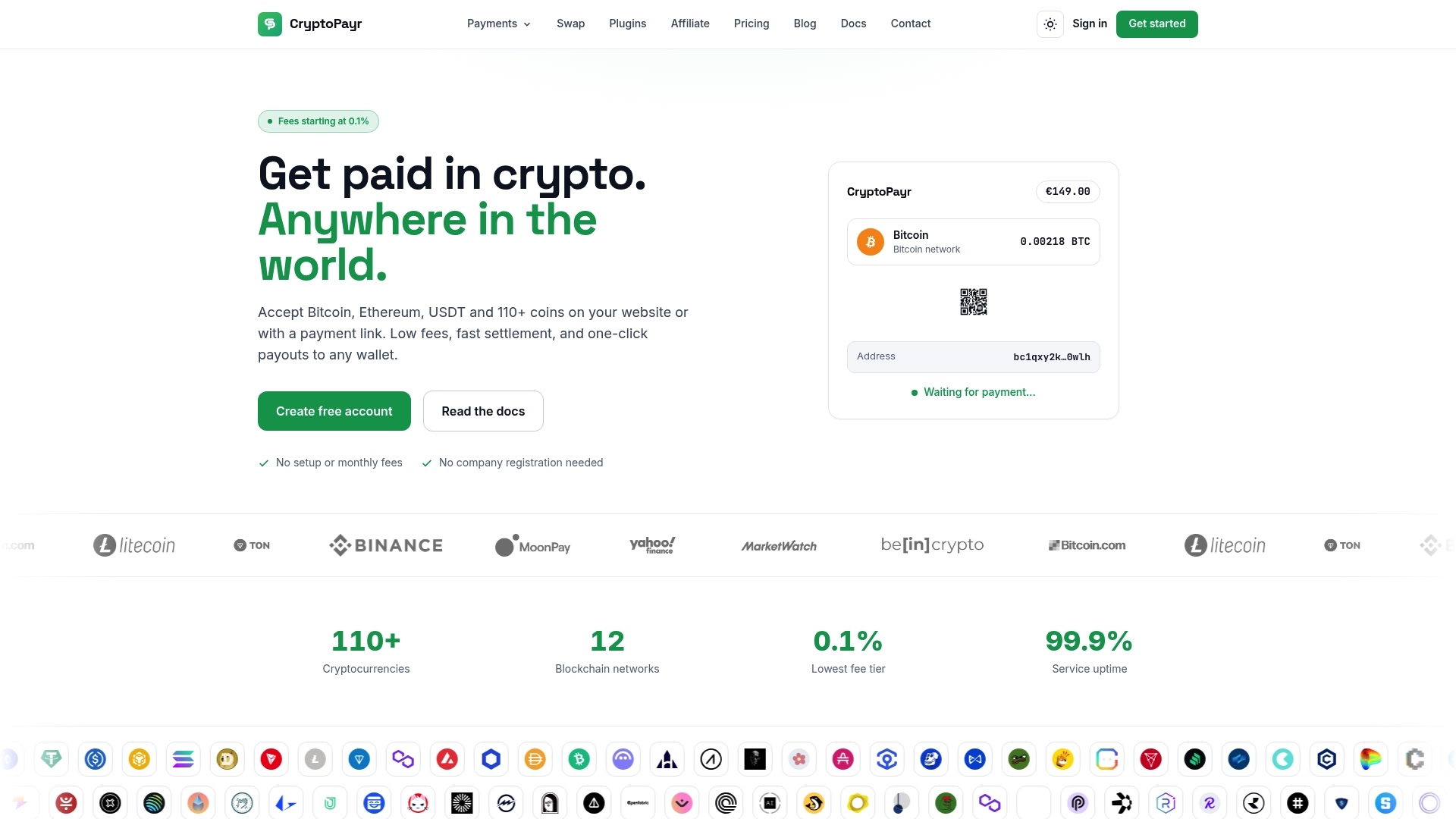
If you’re running a marketplace or platform that needs recurring billing under your own brand, the white-label gateway extends the same infrastructure with full branding control. For most merchants, the fastest starting point is the crypto payment gateway page, where you can review checkout options, payment links, and API access, then wire up your first subscription flow this week instead of next quarter.
Where to Go Next for Technical Details
- EIP-1337 documents the formal Ethereum standard for recurring payment authorization, the primary reference if you’re building on-chain scheduling logic.
- SWIFT’s KYC guidance outlines the due-diligence principles that shape compliance obligations for payment providers handling custody or fiat settlement.
- MetaMask’s gas documentation explains how wallets surface transaction fees, essential reading for designing a low-friction recurring payment UX.
- Recurring payment market research sizes the broader recurring-billing industry, useful context for building a business case internally.
- For automated agent-driven payment examples, the x402 payment session framework shows how autonomous systems execute crypto payments, a useful reference if your recurring model involves machine-to-machine billing.
Frequently Asked Questions
Is crypto recurring billing legal for my business?
Legality depends entirely on your jurisdiction and how you structure settlement. Accepting crypto payments is legal in most countries, but tax treatment and compliance obligations vary significantly. Confirm your specific requirements with local counsel before launching.
Do I need a smart contract to accept recurring crypto payments?
No. Most merchants use a hosted gateway that handles authorization and settlement without deploying any custom contract. Smart contracts become necessary only when you need trustless, protocol-level automation that a gateway can’t provide.
What happens if a customer’s crypto payment fails on the billing date?
A well-designed system triggers a retry sequence and notifies the customer, similar to a failed card charge. The specific retry logic (how many attempts, at what intervals) is something you configure, either in your own scheduler or through your gateway’s settings.
Can I avoid volatility risk with crypto subscriptions?
Yes, largely. Pricing subscriptions in a stablecoin like USDC removes most of the volatility exposure that comes with billing in Bitcoin or Ether directly. Auto-convert features at the gateway level add a further layer of protection by settling straight to fiat if you prefer.
Does accepting crypto subscriptions require KYC?
It depends on your settlement model. Custodial flows that convert to fiat often carry more compliance overhead, while non-custodial, crypto-to-crypto flows can sometimes operate with lighter requirements. Gateways like Cryptopayr offer no-KYC onboarding for merchants, though your own compliance obligations still depend on your jurisdiction and transaction volume.
This article is general information, not a substitute for advice from a qualified financial advisor. Consult a qualified financial professional about your own circumstances before acting on anything here.
Sources
Recommended


