Crypto Checkout for Merchants: 5 Fixes for Fees and Abandonment
Cut crypto checkout fees and reduce abandonment with five changes you can ship in a sprint, from fee visibility to gas sponsorship and payout routing.
CryptoPayrOct 10, 202610.00 min read
Crypto Checkout for Merchants: 5 Fixes for Fees and Abandonment
The fastest way to cut costs and keep buyers from abandoning cart is to route each payment by purpose, batch or sponsor gas wherever possible, and simplify the wallet handoff so fees and totals are obvious before the customer commits. Together, these three moves address the two biggest levers in crypto checkout: what a transaction actually costs to settle, and how much friction a buyer feels before they confirm.
TL;DR:
Recheck recent costs by token and network because congestion and protocol upgrades can make fixed routing rules send payments over more expensive rails.
Batch payouts to multiple recipients, use low cost stablecoin or layer two rails for small receipts, and reserve mainnet for liquidity or neutrality needs.
Before wallet handoff, show the fiat equivalent and estimated fee, offer QR codes and mobile wallet links, and explain recovery steps for underpayments or timeouts.
Hosted checkout or plugins suit small merchants, while API orchestration fits engineering teams needing custom routing; capture hashes, status, fiat value, and fees through webhooks.
Record timestamps, transaction hashes, wallet addresses, payment time fiat values, and fees; reporting duties vary by jurisdiction, business model, and transaction size.
Cryptopayr
Add Crypto Payments With Less Friction
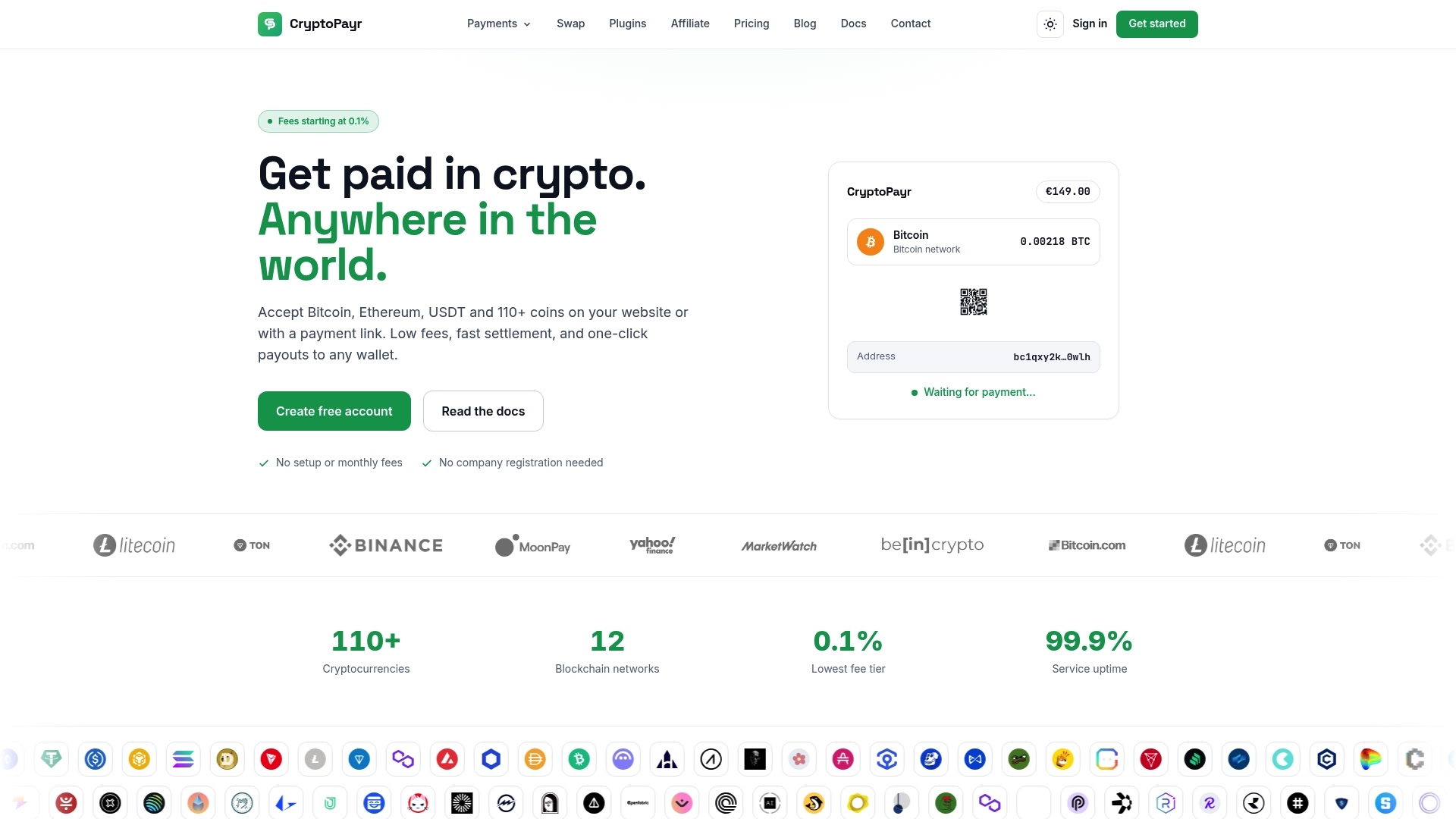
CryptoPayr helps merchants accept over 110 cryptocurrencies, with platform integration and fees starting at 0.1%.
A sprint-ready checklist for cutting checkout friction
Most of the cost and conversion gains come from a handful of changes that a small product and engineering team can ship in one sprint.
Pick one default coin and network for most buyers, and hide alternate chains behind an expand control.
Turn on batching for small, frequent payouts, and route stablecoin settlement through low-cost rails when the use case allows it.
Support gas sponsorship or meta-transactions, or give plain instructions to buyers who need to hold native gas themselves.
Show the final fiat amount and the estimated on-chain fee before the wallet handoff, and keep form inputs intact if an error occurs.
Connect webhooks that reconcile transaction status automatically and store the fields you will need later for tax reporting and refunds.
Pro Tip:Ship the default-coin and fee-display changes first. They touch the fewest systems and have the most direct effect on abandonment.
Where the real transaction costs come from and how to cut them
Before applying any routing rule, pull your recent on-chain costs by token and by network. Fees move with congestion, and a rule built on last quarter’s numbers can route payments the wrong way today.
A few levers do most of the work:
Batch payouts and group-sends whenever you are paying out to several recipients at once, since combining transfers into one on-chain action spreads the fixed cost across many payments.
Route by purpose: send small, frequent receipts over low-cost stablecoin rails or layer-2 networks, and reserve mainnet settlement for cases where shared liquidity or counterparty neutrality actually matters.
Sponsor gas or use meta-transactions so buyers without native gas tokens can still complete a purchase without an extra funding step.
Keep fee-estimation logic configurable, not hardcoded, since protocol upgrades change what counts as cheap.
Ethereum’s own 2026 developer guidance frames this as routing by transaction need rather than assuming mainnet is always expensive, and it points to EIP-7702 and ERC-4337 as the tools that make batching, gas sponsorship, and programmable wallet UX practical at checkout. That same guidance recommends storing recent cost windows per chain and token so your routing rules stay accurate as fees shift. For a deeper breakdown of what a “total cost of acceptance” actually includes beyond the headline gas number, see our guide to crypto payment gateway fees.
Gas costs are not static. Ethereum’s current guidance treats fee-estimation as a setting to revisit after protocol changes, not a number you fix once and forget.
Choosing between hosted checkout, plugins, and API orchestration
The integration path you pick determines how much control you get over routing and reconciliation, and how much engineering time it costs to get there.
Hosted checkout launches fastest and needs the least development work, at the cost of less control over routing decisions, though upgrades arrive automatically.
Plugins for platforms like WooCommerce or OpenCart strike a middle ground: a short setup with minimal custom code for merchants already running those platforms. Our OpenCart setup guide walks through the installation steps.
API and custom orchestration give you full control over routing, batching, and ledger reconciliation, but require real engineering investment to build and maintain. Teams accepting Ethereum directly can also review ERC-4337 account abstraction options for sponsored gas and smoother wallet flows.
Whichever path you choose, your reconciliation layer needs to capture the transaction hash, final status, fiat equivalence at time of payment, and fees paid, because webhooks are what keep that data accurate without manual lookups.
Checkout UX patterns that stop crypto-specific drop-off
Crypto checkout fails in different places than card checkout, usually at the wallet handoff or the moment a buyer sees a fee they did not expect.
Default to one recommended coin and network, and progressively disclose advanced options only for buyers who want them.
Show the exact payment amount, the estimated on-chain fee, and the USD equivalent before handing off to the wallet, with clear call-to-action copy like “Pay with Wallet.”
Offer a QR code for desktop-to-mobile flows and a deeplink for mobile wallets, with a visible fallback if either fails.
Handle underpayments and timeouts by surfacing clear status messages, explaining next steps in plain language, and offering automated retries or refunds.
Baymard’s checkout UX research finds that early cost disclosure and minimizing form friction both lift conversion meaningfully, and the same principle holds at the wallet handoff: a buyer who sees the full cost upfront is far less likely to abandon mid-payment. For guidance on building the QR and deeplink flow itself, see our QR crypto payments guide.
Pro Tip:Never show a bare crypto amount without its fiat equivalent right next to it. Buyers hesitate when they have to do the conversion math themselves.
What to record for compliance and tax reporting
Keep transaction-level records for every payment: timestamp, transaction hash, sender and recipient addresses, the fiat equivalent at time of payment, and the fee paid. This data serves two purposes beyond your own books.
In the United States, brokers and processors handling certain digital asset transactions must follow IRS reporting guidance, including the Form 1099-DA instructions, which specify required fields like date sold, proceeds, and basis, along with de minimis thresholds for certain transactions.
Under FATF’s risk-based guidance, virtual asset service providers apply customer due diligence and Travel Rule obligations that vary by jurisdiction and transaction size, which affects which counterparties you can transact with and what data you need to capture at checkout.
Merchants handling US tax filing obligations around digital asset reporting may find practical 1099-DA filing guidance useful for reconciling processor reports against what gets filed.
None of this is tax or legal advice. The rules differ by jurisdiction and by business model, so confirm your specific obligations with a qualified advisor.
How CryptoPayr maps to this checklist
A hosted checkout, a set of e-commerce plugins, and webhook-based reconciliation cover most of what this guide recommends without a custom build. We support a wide range of cryptocurrencies, allowing a single integration to offer buyers a default coin while still accepting alternatives behind an expand control, matching the multi-cryptocurrency playbook above.
A practical rollout order: install a plugin for a fast launch, test the checkout UX with hosted checkout, then move to API orchestration once you need custom routing or batching logic. Webhooks handle status updates and reconciliation at every stage, so the data you need for tax recordkeeping and refunds is captured automatically rather than reconstructed later.
A prioritization roadmap by team size
Small merchants get the most value from hosted checkout or a plugin paired with one recommended token, with early energy spent on clear fee display and reliable reconciliation rather than custom routing. Engineering-heavy platforms should invest earlier in orchestration, batching, and sponsored gas, since the payoff compounds at volume. Either way, instrument the same funnel: invoice creation, wallet handoff, transaction observed, confirmation, and webhook reconciliation. Those five events reveal whether a conversion problem is UX or blockchain-related, which is exactly what Baymard’s funnel research recommends tracking.
— Dustin
Start with hosted checkout, scale into full API control
Various options, from default-coin selection to webhook reconciliation to fee display, are available through hosted checkout, e-commerce plugins, or API, depending on how much control your team needs.
If you want to see the fee display and default-coin pattern in action before committing engineering time, our crypto payments for e-commerce page walks through the checkout experience directly. Merchants running marketplaces or multi-vendor platforms can review commission splitting and payout automation on our marketplace payments page. When you are ready to move past testing, book a walkthrough of hosted checkout or talk to our team about API integration at Cryptopayr.
FAQ
Can tax authorities see your crypto wallet activity?
Tax authorities can trace wallet activity through blockchain analysis and through reporting obligations placed on exchanges and processors. In the United States, brokers and processors must follow IRS digital asset reporting rules, including new Form 1099-DA requirements for certain transactions.
What should merchants check before choosing a crypto payment gateway?
Look at published fee tiers, supported coins and networks, whether KYC is required for onboarding, and how quickly you can go live with a hosted checkout or plugin. Also confirm how the gateway handles webhooks and reconciliation, since that data matters for both refunds and tax recordkeeping.
How can checkout UX reduce crypto payment abandonment?
Defaulting to one recommended coin, disclosing the fiat-equivalent amount and fee before wallet handoff, and offering both QR and deeplink options all reduce drop-off. Baymard’s checkout research shows that early cost disclosure and reduced form friction materially improve conversion in checkout flows generally, and the same logic applies at the crypto wallet handoff step.
Do fee-sponsorship tools like ERC-4337 actually lower costs for buyers?
Gas sponsorship and meta-transaction standards like ERC-4337 do not eliminate network fees, but they let a merchant cover or batch that cost so the buyer does not need to hold a separate gas token. Ethereum’s 2026 developer guidance highlights these standards as the practical path to removing that friction from checkout.