Accepting Multiple Cryptocurrencies: A Merchant’s Playbook
The fastest way to accept multiple cryptocurrencies is to route payments through a vetted multi-coin gateway that handles checkout, on-chain confirmation, and settlement in one flow, rather than stitching together separate wallets for Bitcoin, Ethereum, and every stablecoin your customers want to use. That single decision solves most of the friction merchants hit first.
Here’s what it buys you:
- Revenue expansion from customers who only pay in crypto
- Lower checkout friction with one integration instead of five wallet connections
- Settlement flexibility to hold crypto, convert to stablecoins, or cash out to fiat
Pro Tip: Open a sandbox account with your chosen gateway before touching production. You’ll catch configuration mistakes with test funds instead of a customer’s real payment.
Key Takeaways
Accepting multiple cryptocurrencies successfully requires a vetted gateway, a curated starting coin set, clear settlement rules, and documented refund and compliance processes before launch.
| Point |
Details |
| Start with core assets |
Launch with BTC, ETH, and a major stablecoin before expanding your coin list. |
| Match integration to resources |
Pick hosted checkout for speed, API for control, plugins for e-commerce platforms. |
| Plan refunds before launch |
Decide whether refunds pay out in original crypto or fiat-equivalent value upfront. |
| Verify security posture |
Confirm audits, multi-sig controls, and incident-response SLAs before signing with any gateway. |
| CryptoPayr as the practical route |
Supports 110+ coins with no-KYC onboarding, hosted checkout, API, plugins, and white-label options. |
Table of Contents
How Does Multi-Cryptocurrency Payment Processing Work?
A multi-crypto payment moves through four stages: checkout, on-chain confirmation, gateway processing, and settlement to your account. The customer picks a coin at checkout, sends it to a generated address, and the network confirms the transaction before the gateway credits your merchant balance.
Confirmation times vary sharply by chain. Bitcoin typically needs one to six confirmations, which can take 10 to 60 minutes depending on network congestion. Ethereum and most Layer 2 networks confirm in under a minute to a few minutes. Stablecoins on faster chains often settle checkout-side almost instantly, while final withdrawal to your bank or wallet depends on your gateway’s payout schedule.
What to expect at each stage:
- Checkout: customer selects a coin, gateway locks in an exchange rate for a short window
- On-chain payment: funds move to a gateway-controlled or merchant-controlled address
- Confirmation: the network validates the transaction based on that chain’s block time
- Settlement: the gateway converts (if configured) and credits your account, often within the same business day
Finality also differs. Bitcoin transactions are considered irreversible after enough confirmations accumulate, while some faster chains reach practical finality within seconds. A CryptoPayr checkout that includes 86+ supported coins has to account for all of these timelines simultaneously, which is exactly why gateway-level abstraction matters more than trying to track each chain yourself.
Which Integration Method Fits Your Business?
Most merchants choose between hosted checkout, direct API access, e-commerce plugins, payment links, or point-of-sale terminals, and the right pick depends entirely on your technical bandwidth. Hosted checkout is the fastest path to live payments. You redirect customers to a gateway-hosted page and get back a confirmation webhook, with almost no development work.
API integration gives you full control over the payment experience inside your own app, but it requires an engineering team to build and maintain it. Plugins split the difference for platforms like WooCommerce or OpenCart, where a pre-built module handles the heavy lifting.
- Hosted checkout: launch in a day, less customization, minimal maintenance
- API: full control, higher build cost, ongoing upkeep
- Plugins: fast setup on supported platforms, limited to what the plugin exposes
- Payment links: ideal for invoices, freelancers, or one-off sales with zero code
Pro Tip: If you’re running a SaaS product with recurring billing, start with the API. Plugins rarely handle subscription logic well, and hosted checkout alone won’t cover renewal cycles.
Which Cryptocurrencies Should You Accept?
Bitcoin, Ethereum, and one or two major stablecoins like USDC or USDT cover the overwhelming majority of customer demand, and everything past that core set is optional volume. Bitcoin still carries the most brand recognition among crypto payers. Ethereum brings a large base of DeFi-native users. Stablecoins solve the volatility problem entirely, since a $50 invoice stays $50 regardless of market swings that day.
Beyond the core three, niche assets like Monero or Chainlink appeal to privacy-focused or developer-heavy audiences respectively, but they add support complexity for a smaller slice of customers.
Your settlement choice matters as much as your asset list:
- Auto-convert to fiat: zero volatility exposure, but you lose any upside and pay conversion spread
- Settle to stablecoin: avoids bank rails, keeps you in crypto, sidesteps most volatility
- Keep native crypto: maximum upside potential, full exposure to price swings, best for merchants comfortable holding assets
What Security and Custody Model Should You Choose?
Unless you run an experienced blockchain operations team, pick a gateway with audited custody, multi-signature wallet controls, and a documented incident-response process rather than managing private keys yourself. Custody mistakes are unrecoverable in a way credit card fraud rarely is.
Custodial versus non-custodial is the first fork in the road. Custodial gateways hold funds briefly during conversion and take on the security burden; non-custodial setups route funds directly to your own wallet but put key management entirely on you. Hot wallets stay connected for fast payouts and carry more exposure; cold storage protects larger balances but slows withdrawal.
Before signing with any provider, verify:
- Independent security audits on the platform’s smart contracts or custody infrastructure
- Multi-signature approval requirements for large withdrawals
- Encryption standards for stored transaction data
- A published incident-response SLA, not just a vague promise
Pro Tip: Ask any gateway directly what happens to funds mid-transaction if their systems go down. A vague answer is a red flag.
What Compliance and KYC Rules Apply to Merchants?
Compliance requirements are jurisdiction-specific, so confirm your local rules, but most merchants end up implementing the same baseline controls regardless of location. Transaction monitoring, AML screening above certain thresholds, and clean tax records are the common denominators across most regulatory frameworks, including elements that echo MiCA style requirements now spreading beyond the EU.
Tasks merchants typically own:
- Monitoring for unusual transaction patterns or structuring
- Setting internal KYC thresholds for high-value transactions, even on no-KYC platforms
- Running AML checks proportional to transaction size and customer risk
- Keeping detailed records for tax reporting, since crypto sales are taxable events in most jurisdictions
Regulatory frameworks around crypto payments shift faster than most other payment methods, and what qualifies as adequate compliance in one country can fall short in another.
Consult local counsel before finalizing your compliance program. This isn’t a place to guess.
How Do You Reconcile Crypto Sales for Accounting?
Three fields make or break reconciliation: the order ID, the on-chain transaction hash, and the final settled amount in fiat or stablecoin terms. Without all three tied together, matching a blockchain payment back to a specific customer order becomes a manual nightmare.
Request these reports from your gateway:
- Settlement CSV exports with timestamps
- Fee breakdown separating processing fees from network fees
- Transaction hash for every payment, for audit trails
- Exchange rate locked at time of payment
Map these fields directly into your ERP or bookkeeping software rather than re-entering them by hand.
What Do Fees and Conversion Spreads Actually Cost?
Landed cost per transaction comes from three layers stacked together: the gateway’s processing fee, on-chain network fees, and any conversion spread applied during settlement. Processing fees range widely across the industry, so ask for the exact percentage before committing, not a marketing headline number.
Where costs hide:
- Settlement lag that ties up funds for a day or more before payout
- Minimum payout thresholds that delay small merchants from withdrawing
- Gas fee spikes during network congestion, especially on Ethereum
- Wide conversion spreads baked into “free” auto-conversion features
Pro Tip: Request historical payout data from any gateway before signing up. A sample month of real transactions tells you more about actual cost than any published fee schedule.
Should You Accept Every Coin or a Curated Set?
Start with a curated set, Bitcoin, Ethereum, and a stablecoin or two, and expand only after real customer demand shows up in your data. Supporting every available token from day one adds support tickets, accounting complexity, and security surface area for assets almost nobody actually uses to pay you.
Trade-offs to weigh:
- More coins capture edge-case demand but multiply reconciliation and support work
- Fewer coins simplify operations but risk losing customers who only hold niche assets
- Stablecoins cut volatility risk regardless of how many other assets you support
A practical rollout:
- Launch with BTC, ETH, and one major stablecoin
- Monitor transaction volume and dispute rates for 30 to 60 days
- Add assets your analytics show real demand for, not ones that just sound impressive
Getting Live: Your Implementation Checklist
Following an ordered checklist is the fastest, safest route from decision to production, faster than improvising integration order on the fly. Skipping steps here is where most merchants introduce avoidable bugs.
- Create a developer sandbox account and generate test API keys
- Choose your settlement option: fiat, stablecoin, or native crypto
- Configure accounting export formats to match your ERP
- Select your integration path: hosted checkout, API, or plugin
- Test a full refund flow before processing a single live transaction
- Go live with a small transaction limit for the first 24 hours
Pro Tip: Send yourself a tiny real payment, a few dollars in stablecoin, before opening checkout to customers. It confirms the entire chain works end to end.
Pro Tip: Watch your first 24 hours of live transactions closely. Confirmation delays or webhook failures show up fast if something’s misconfigured.
Why CryptoPayr Fits Merchants Accepting Multiple Cryptocurrencies
CryptoPayr is built specifically for merchants who want broad coin support without a lengthy onboarding process, combining 110+ supported cryptocurrencies with a no-KYC integration path that removes the identity-verification bottleneck many gateways impose.
What you get:
- Hosted checkout, API access, plugins, and payment links, so you pick the integration that matches your technical resources
- Auto-conversion to stablecoins for merchants who want to sidestep volatility
- White-label branding options for platforms and marketplaces that need a checkout matching their own brand
- Mass payout support for marketplaces splitting commissions across sellers
E-commerce stores, SaaS platforms, and digital marketplaces tend to benefit most, since they process high transaction volume where fee percentage and settlement speed compound quickly.
| Point |
Details |
| Core assets first |
Launch with BTC, ETH, and a stablecoin before expanding your coin list. |
| Integration matches resources |
Choose hosted checkout for speed, API for control, plugins for e-commerce platforms. |
| CryptoPayr fit |
Supports 110+ coins with no-KYC onboarding, API, plugins, and white-label checkout options. |
How Do You Handle Refunds and Disputes Across Multiple Coins?
Refunds in crypto work differently than credit card chargebacks, and merchants who don’t plan for this get caught off guard fast. There’s no automatic reversal mechanism on most blockchains, so a refund means sending a new transaction back to the customer’s wallet, not clawing back the original payment.
Volatility complicates this further. If a customer paid $100 in Bitcoin and the price moved 8% by the time you process the refund, do you refund the original crypto amount or the original dollar value? Decide this policy before your first sale, not after a customer complaint. Most merchants settle on refunding the fiat-equivalent value at time of purchase, paid out in whatever asset makes reconciliation simplest.
Chargebacks, in the traditional card-network sense, don’t exist for crypto payments. That’s a double-edged sword: you avoid the chargeback fraud that plagues card processors, but customers also lose the dispute protections they’re used to. Some merchants offset this by offering a clear, generous refund policy upfront to build trust with crypto-paying customers who might otherwise hesitate.
Build a documented dispute process before launch:
- Define your refund window and eligible circumstances in writing
- Decide whether refunds go out in the original crypto or a stablecoin equivalent
- Keep the transaction hash and order ID linked so support staff can verify claims fast
- Set a maximum processing time and communicate it at checkout
What UX Choices Make Crypto Checkout Feel Normal?
Customers abandon crypto checkouts far more often than card checkouts when the experience feels unfamiliar, so the goal is making crypto payment feel as routine as any other payment button. Show the price in your local currency first, with the crypto equivalent calculated automatically, rather than forcing customers to do mental math.
A visible countdown timer on the payment window matters more than most merchants realize. Crypto prices move, and gateways lock in an exchange rate for a short window, typically 10 to 15 minutes. Customers need to see that clock so they don’t submit a payment after the rate expired and wonder why their transaction failed.
QR codes matter for mobile wallet users, who often prefer scanning over copying a long wallet address by hand. A copy-to-clipboard button for the address itself is a small detail that prevents costly typos, since a single wrong character in a crypto address can send funds somewhere unrecoverable.
Confirmation messaging should set clear expectations: tell the customer their payment is detected, then confirmed, then complete, rather than leaving them staring at a spinner with no status update. A brief explainer, even a single line like “confirmations typically take 10 to 30 minutes,” reduces support tickets dramatically compared to silence during the wait.
How Fast Do Different Cryptocurrencies Actually Settle?
Transaction speed varies enormously across chains, and that variance directly shapes what customers experience at checkout. Bitcoin remains the slowest major asset, with block times around 10 minutes and multiple confirmations often required for larger payments, meaning a customer might wait 30 to 60 minutes for full finality on a big-ticket purchase.

Ethereum and most Layer 2 scaling solutions confirm dramatically faster, often within seconds to a couple of minutes. Stablecoins issued on these faster networks inherit that speed, which is part of why stablecoin payments feel closer to instant card payments than a raw Bitcoin transaction does.
Scalability under load is a separate concern from raw speed. Some networks slow down and get more expensive during congestion, with fees spiking when demand surges. A gateway that supports multiple chains for the same stablecoin, letting a customer pay USDC on whichever network is cheapest and fastest at that moment, insulates your checkout from any single chain’s bad day.
For high-volume merchants, this matters operationally too. Batch processing hundreds of transactions on a congested network can create real settlement delays, while spreading volume across faster chains keeps payout timelines predictable. When evaluating any gateway, ask specifically which networks they support for each stablecoin, not just which coins appear on a logo wall.
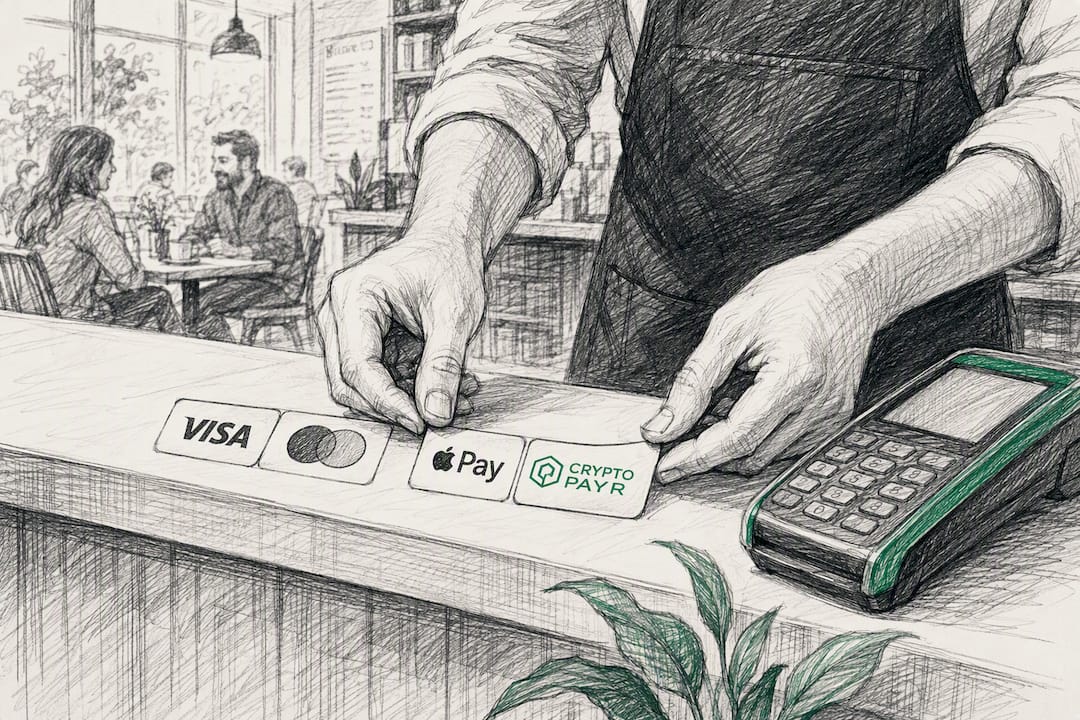
Simply accepting crypto does nothing if customers never find out, so treat this as a visible feature, not a background technical decision. A small payment-method badge at checkout, alongside your card and PayPal icons, is the single most effective signal, since customers scanning payment options will notice crypto logos they recognize.
Email your existing customer base once the feature goes live, especially if you serve any audience overlapping with tech, gaming, or finance communities where crypto adoption runs higher. A short announcement explaining which coins you accept and why, faster settlement, lower fees passed on as savings, tends to land better than generic “we now accept crypto” messaging.
Consider a modest incentive for early adoption, like a small discount for crypto payments during launch month. This nudges hesitant customers to try the new payment method once, and habit does the rest. Update your FAQ page and checkout help text to answer the two questions crypto-curious customers always ask: which wallets work, and how long confirmation takes.
Don’t overlook your social channels and community forums. Crypto-native audiences actively search for merchants who accept their preferred assets, and a public announcement often gets organic reach in spaces where traditional payment updates would go unnoticed.
A Practical Mindset for Merchants Going Multi-Coin
The merchants who succeed here aren’t the ones chasing every available token. They’re the ones treating this like any other operational decision: start small, measure real demand, and expand deliberately instead of all at once. Pilot a curated coin list, watch your dispute rate and volume for a month, then decide what’s actually worth adding.
Accept Multiple Cryptocurrencies Without the Onboarding Slog
Cryptopayr is the direct route to accepting 110+ cryptocurrencies without the identity-verification delays that slow down most competing gateways. Where many providers make merchants wait days for KYC approval before processing a single transaction, Cryptopayr’s no-KYC path gets you from signup to live checkout in far less time, with fees starting at just 0.1%.
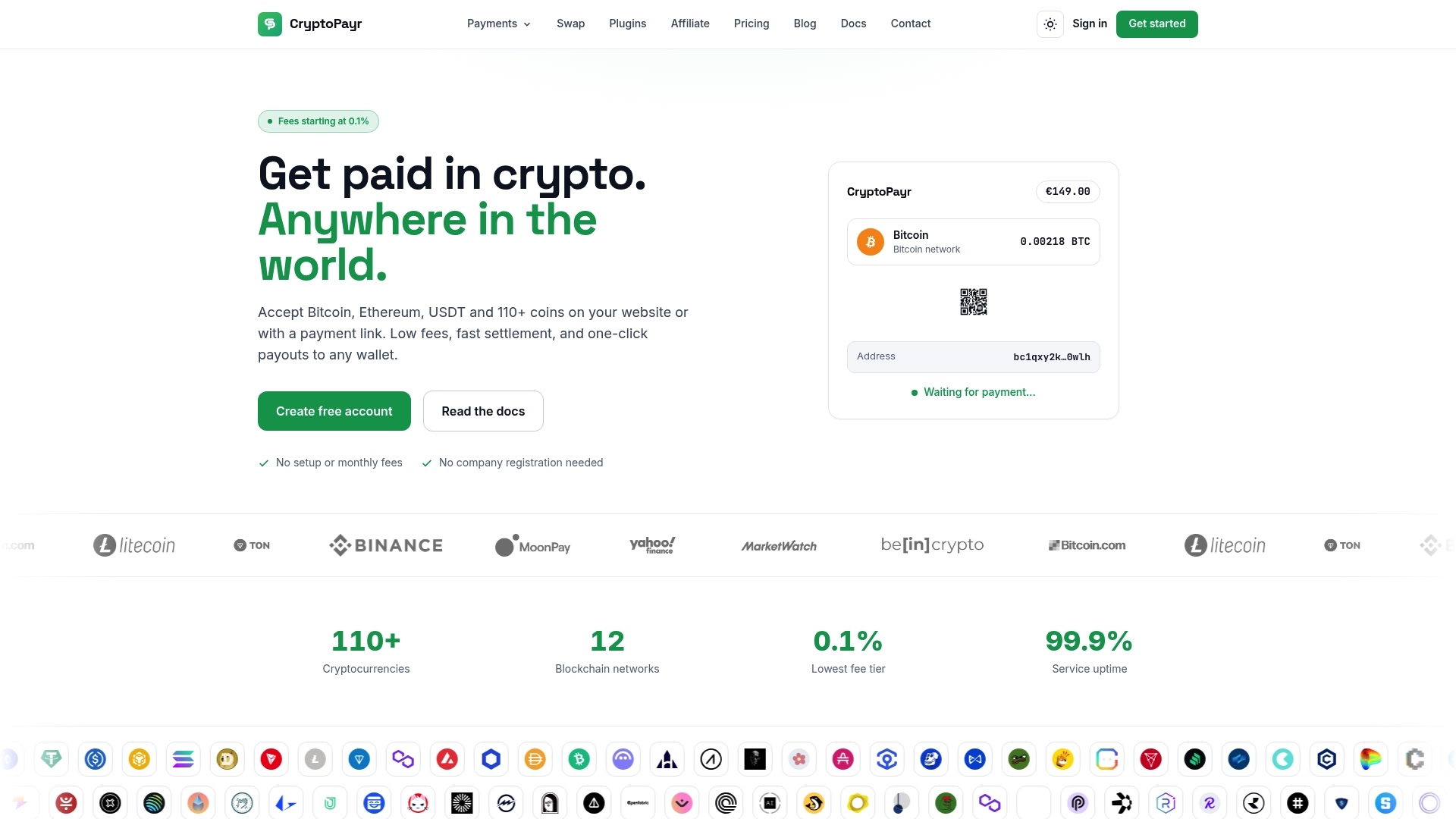
If you run an e-commerce store, a SaaS platform, or a digital marketplace, you can choose exactly the integration this article walked through: hosted checkout for a same-day launch, API access if your team wants full control, or a plugin if you’re already running WooCommerce or OpenCart. Marketplaces splitting revenue across sellers get mass payout support built in, and platforms wanting a fully branded experience can license the white-label gateway instead of sending customers to a generic checkout page.
Open a sandbox account and test a real transaction with your own store setup before deciding on a settlement strategy. Seeing the confirmation and payout flow with your own products is the clearest way to know if it fits.
Frequently Asked Questions
Do I need to accept every cryptocurrency to compete with other merchants?
No. A curated set of Bitcoin, Ethereum, and one or two major stablecoins covers most customer demand. Expanding beyond that should follow evidence of real requests, not a race to match a competitor’s coin count.
What happens if a customer sends the wrong amount of crypto?
Most gateways flag underpayments and overpayments automatically and either credit a partial order or hold funds pending manual review. Confirm your specific gateway’s policy before launch, since handling varies by provider.
Can I accept multiple cryptocurrencies without holding any crypto myself?
Yes. Auto-conversion settles incoming payments to fiat or stablecoins automatically, so you never carry price exposure on volatile assets like Bitcoin or Ethereum unless you choose to.
Is accepting cryptocurrency payments legal for my business?
Legality depends entirely on your jurisdiction and industry. Confirm local regulations, including AML and tax reporting obligations, with qualified local counsel before processing crypto payments commercially.
How long does it take to integrate a multi-crypto payment gateway?
Hosted checkout can go live within a day for many merchants. API integrations take longer since they require development work, while e-commerce plugins usually fall somewhere in between depending on platform complexity.
Recommended


