Start Accepting USDT Payments in an Hour for Merchants, Avoid Chain Pitfalls
The fastest reliable way to accept USDT is through a crypto payment gateway that supports TRC-20 as the default network. Pick a gateway that offers a payment link or plugin for your store, and you can be taking USDT within an hour. Self-custody wallets work too, but only if you’re comfortable reconciling transactions by hand.
TL;DR:
- Using a crypto payment gateway with TRC-20 support allows accepting USDT quickly and scales with automation, unlike manual reconciliation required with self-custody wallets.
- Starting with a payment link or hosted checkout takes only minutes to go live and provides real transaction data for future API or plugin integration.
- Supporting TRC-20 as the default chain minimizes fees and confirmation times, while adding Ethereum or other networks should be reserved for specific customer needs.
- Auto-converting USDT to fiat through the gateway simplifies bookkeeping and reduces exposure to market volatility for most merchants.
- Confirm local AML and KYC rules before launching, log transaction details accurately, and conduct small test payments on every chain supported to prevent issues.
Cryptopayr
Add Crypto Payments Without Complexity
CryptoPayr helps e-commerce, SaaS, gaming, and marketplace businesses accept over 110 cryptocurrencies with minimal fees and easy integration.
Table of Contents
What Are the Real Ways to Accept USDT Payments?
Every merchant accepting USDT ends up choosing between three setups, and the right one depends almost entirely on your volume and how much manual work you’re willing to tolerate.
- Self-custody wallet. You generate a wallet address, share it with customers, and confirm receipt yourself. There are no processor fees, but reconciliation is entirely manual, which gets messy fast once you’re past a handful of orders a week. This suits freelancers, consultants, and anyone invoicing occasionally.
- Crypto payment gateway. A processor generates addresses, watches the blockchain for confirmations, and can auto-convert USDT to fiat on receipt. This is the standard path for e-commerce stores, SaaS platforms, and any business processing regular volume, because gateways automate the parts that break at scale.
- Exchange merchant tools. Some exchanges offer closed-loop payment tools that work fine if your customers already hold accounts on that same exchange, but the convenience disappears the moment a buyer is on a different platform.
Most stores land on the gateway option because it’s the only one of the three that scales without adding a full-time bookkeeping job.
How Do You Set Up USDT Payment Links, Plugins, and API Integration?
Each integration path has a different setup curve, and matching the right one to your resources saves weeks of back and forth with a developer.
- Payment link or hosted checkout. Create an account with your chosen gateway, enable USDT as an accepted asset, select which chains to support, then either share the generated link directly or embed the hosted checkout page on your site. This is the quickest route to live: payment links and hosted checkouts can go live very quickly, with no code required.
- E-commerce plugin. Install the plugin for your platform, map your product prices to USDT (either fixed pricing or dynamic fiat-to-USDT conversion at checkout), and run a test order to confirm the webhook fires and the order marks as paid.
- API integration. Generate a unique address or one-time invoice per order, wire up webhooks for payment confirmation, and reconcile against your order database automatically. Full API builds take longer, typically hours to days depending on your engineering team’s bandwidth.
- POS or QR for in-person sales. Print chain-specific QR codes for each supported network and train staff to confirm which chain a customer intends to use before they scan.
Pro Tip: Start with a payment link even if you eventually want full API integration. It gets you accepting USDT today and gives you real transaction data to test your webhook logic against later.
Which USDT Network Should You Accept: TRC-20, ERC-20, or Something Else?
Tron’s TRC-20 network should be your default. It settles fast and keeps fees low enough that most merchants use it as their primary chain due to low fees and fast settlement, which matters a lot when you’re processing dozens of small transactions a day rather than a handful of large ones.
- Tron (TRC-20): the practical default for most merchants, thanks to low fees and quick confirmation times.
- Ethereum (ERC-20): higher gas costs, but wider compatibility with DeFi wallets and institutional customers who may only hold USDT on this chain.
- Solana, BNB Chain, and Polygon: low-fee alternatives worth adding if a specific customer segment already transacts there.
A sound approach is supporting one low-fee default chain for everyday checkout and adding a second chain only when institutional or DeFi-native customers actually need it. Whatever you choose, label every invoice with the exact chain and address format. A TRC-20 address and an ERC-20 address can look similar at a glance, and a payment sent on the wrong network can be difficult or impossible to recover.
Should You Keep USDT or Convert It to Cash?
You have three real options once a payment lands, and each one shifts risk somewhere different.
- Hold USDT. You keep stable-dollar exposure without cashing out, which works well if you’re paying suppliers or contractors in crypto anyway.
- Auto-convert to fiat. The gateway handles the conversion and payout timing for you, removing volatility exposure and simplifying your books. Most retail merchants pick this by default.
- Convert manually. You control the timing and might catch a slightly better rate, but you’re now managing conversion timing yourself, which adds operational overhead and a small window of price risk.
The tradeoff is fundamentally about control versus convenience. Custodial processors that auto-convert take on more of the operational burden, while self-custody keeps you in full control at the cost of doing the reconciliation and conversion yourself. Check auto-conversion fees before committing. Some gateways bake conversion costs into the transaction fee, others charge separately, and the difference matters once your volume grows.
What Compliance and Tax Rules Apply to Accepting USDT?
Rules vary a lot by country, so confirm your local AML and KYC obligations before you launch rather than after. There’s no single global standard here.
- Many established processors require business verification (KYB) to open a merchant account, even when the end customer paying you isn’t required to verify anything.
- No-KYC self-custody setups shift that compliance responsibility onto you as the merchant. The regulatory requirement doesn’t disappear just because the platform doesn’t ask for it.
- Bookkeeping is simpler than it sounds: log the USD-equivalent value at the moment of receipt, the date, the sender’s address, and the transaction hash for every payment. USDT functions as a stable-dollar receivable in most accounting treatments, so treat it the way you’d treat any other cash receipt.
- If you serve customers in the EU, note that some providers have limited USDT support under the MiCA framework and may steer EU transactions toward MiCA-authorized stablecoins like USDC instead. Verify this with your provider before assuming full USDT support across every region you serve.
Our stablecoin payment guide covers the bookkeeping side in more depth if you want a template for tracking receipts.
What’s Your Pre-Launch Checklist Before Going Live?
Run through this before you tell a single customer that USDT is an accepted payment method.
- Send one small test payment on every chain you plan to support, and confirm it shows up correctly in your ledger.
- Verify webhooks fire properly and that order fulfillment or status updates trigger automatically on confirmation.
- Publish exact payment instructions on your checkout page, spelling out the chain name and address format so customers can’t accidentally send funds on the wrong network.
- Write down your refund and dispute procedure in advance. On-chain refunds require manual steps since there’s no automatic reversal like a card chargeback.
Skipping the small test transaction is the single most common mistake. It costs you a few dollars and ten minutes, and it catches configuration errors before a real customer’s payment goes missing into a webhook that never fired.
When Does CryptoPayr’s Gateway Make Sense for Your Business?
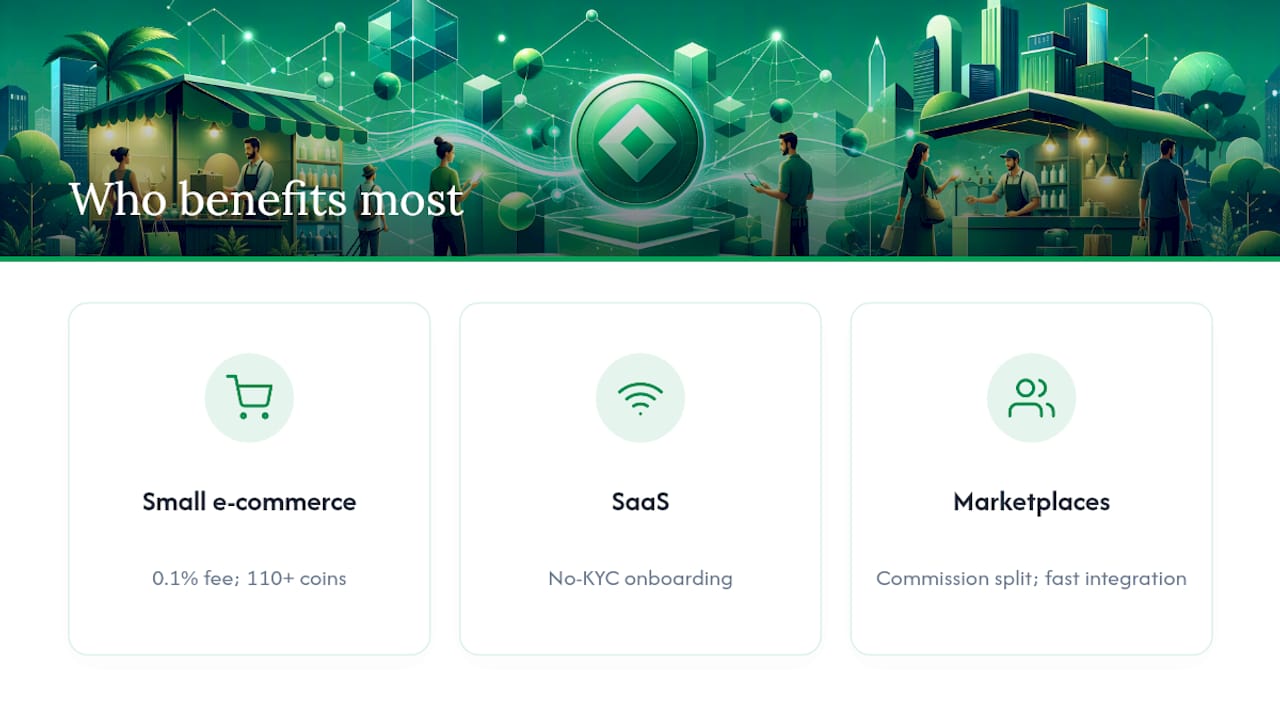
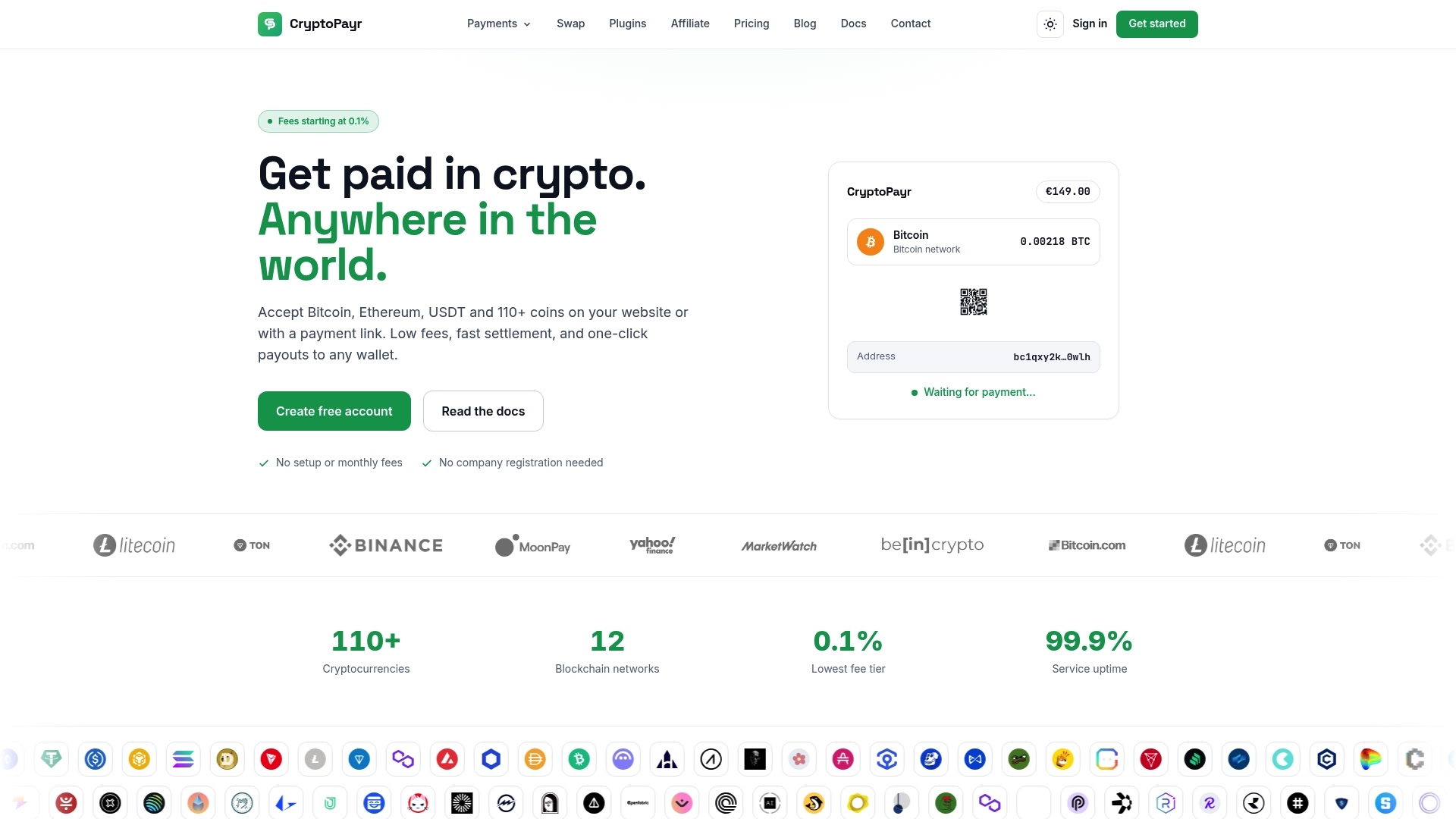
CryptoPayr supports over 110 cryptocurrencies, including USDT, with fees starting at 0.1% and a no-KYC onboarding flow for merchants who want to skip lengthy verification. That combination tends to fit small e-commerce stores and SaaS platforms that want to start accepting USDT without weeks of onboarding paperwork.
Marketplaces benefit particularly, since commission splitting and fast integration matter more than deep enterprise features when you’re trying to launch quickly. If your priority is getting a payment link live this week rather than negotiating a lengthy processor contract, a no-KYC gateway removes the biggest bottleneck in that timeline.
Read our no-KYC gateway breakdown for the regulatory nuance behind that approach.
Why Most Merchants Overcomplicate USDT Adoption
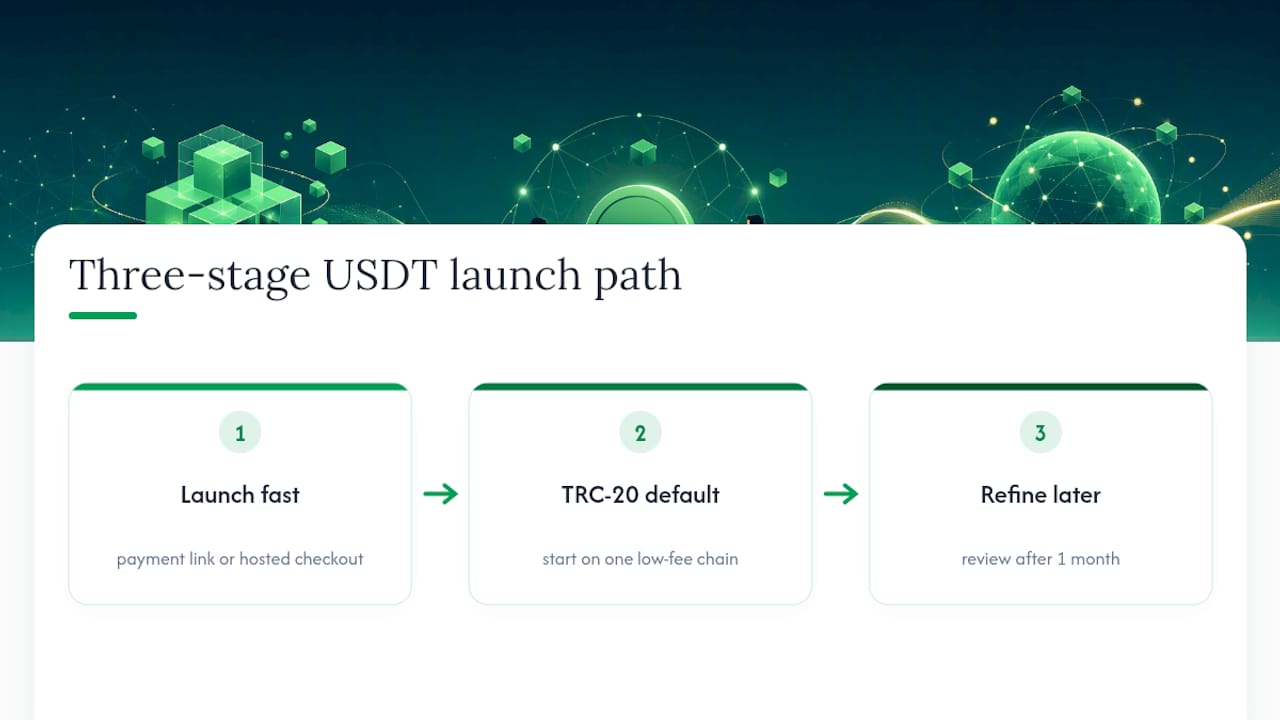
The conventional advice on this topic buries merchants in chain comparisons and security checklists before they’ve even accepted their first payment. That’s backwards. The research is clear that payment links and hosted checkouts can go live very quickly, so the right move is to launch fast on one chain, TRC-20 by default, and refine from there.
Where most merchants actually get burned isn’t fees. It’s chain confusion: a customer sends USDT on Ethereum to an address the merchant only configured for Tron, and the funds sit unclaimed or vanish entirely. That single labeling mistake causes more support tickets than volatility ever will.
My take: don’t wait for a perfect multi-chain setup before you start. Launch with one low-fee chain, watch your actual transaction patterns for a month, then decide if a second chain earns its complexity. No-KYC gateways are the right call when speed to market matters more than deep enterprise integrations. If you’re a large regulated institution, a fuller KYB relationship probably serves you better.
— Dustin
Start Accepting USDT Without the Onboarding Delay
CryptoPayr gives you a working USDT gateway, not a weeks-long compliance queue. You get hosted checkout, payment links, plugins, and a direct API, plus optional auto-conversion to fiat, all with no-KYC onboarding and fees starting at 0.1%. For a merchant who just read through chain selection, webhook setup, and reconciliation steps and wants to skip straight to a working checkout, that’s the entire pitch: less setup friction, lower fees than most traditional processors, and a payment link you can share today.
Visit the CryptoPayr gateway page to enable USDT on your store, or start with a payment link if you want to test the waters before touching any code.
Where to Verify These Details Yourself
Cross-check the integration and compliance points above against primary sources before you launch. Stripe’s crypto payment guide covers gateway mechanics and AML basics. The complete USDT acceptance guide breaks down network choice and MiCA implications for EU-facing merchants. VaultNow’s USDT payment walkthrough is useful for comparing self-custody against processor-based reconciliation.
Sources
FAQ
How Do I Receive USDT Payments?
Sign up with a payment gateway, enable USDT, choose your network (TRC-20 is the common default), and share the generated payment link or embed a hosted checkout. Self-custody wallets work too, but require you to manually confirm and reconcile each transaction.
Is USDT Allowed in the USA?
USDT itself isn’t banned for merchant use in the United States, but you’re still responsible for AML and KYC compliance depending on how your business is structured and which processor you use. Regulatory treatment varies by state and business type, so confirm requirements with your provider or a compliance professional before scaling volume.
Crypto payment gateways, e-commerce plugins, and self-custody wallets can all be configured to accept USDT. CryptoPayr is one option that supports USDT alongside 110+ other cryptocurrencies, with no-KYC onboarding for merchants who want a fast setup.
What Payment Gateway Can Accept USDT Payments?
Any gateway built to support stablecoins on networks like TRC-20 or ERC-20 can accept USDT, typically through a payment link, plugin, or API. Look for one that lets you choose which chains to support and offers auto-conversion to fiat if you want to avoid holding volatile crypto balances.
Recommended