Where Funds Actually Settle: Crypto Gateway vs Exchange for Merchants
A crypto payment gateway processes payments for merchants. An exchange trades assets for buyers and sellers. If you sell products or services and want customers to pay in crypto, you need a gateway. If you’re acquiring, holding, or actively trading digital assets, you need an exchange. The catch: several providers bundle both roles, so always confirm where the money actually settles before signing up.
TL;DR:
- Most providers bundle both gateway and exchange functions, so confirm where the funds actually settle to avoid misunderstandings.
- Confirmation processes vary by network, and relying on early or low-confirmation signals can expose merchants to reversal risks.
- Custody models differ, with self-custody offering full control and third-party custody introducing counterparty risk, so verify reserve transparency and past insolvency history.
- Total transaction costs include processing fees, network fees, conversion spreads, and withdrawal charges, which can significantly impact the overall expense.
- For merchants not actively trading, self-custody in a controlled wallet reduces risk, while exchanges are better suited for liquidity and on-platform trading.
Cryptopayr
Accept Crypto Without Exchange Complexity
Cryptopayr helps businesses accept over 110 cryptocurrencies through a user-friendly payment gateway with minimal fees starting at 0.1%.
Table of Contents
Crypto Gateway vs Exchange: The Core Difference
A crypto payment gateway is a merchant-processing layer. It generates a checkout or invoice, watches the blockchain for the customer’s payment, and often converts and settles the proceeds into stablecoins or fiat. An exchange is a trading marketplace built around an order book or automated market maker, where users buy, sell, or swap assets against each other.
The labels get blurry because functional roles overlap. The FATF’s virtual asset guidance treats “exchange,” “transfer,” and “custody” as separate functions a single provider can perform simultaneously. That’s why judging a platform by its name is a mistake. Instead, ask what it actually does:
- Does it create a checkout page or invoice for a customer to pay?
- Does it hold an order book where two parties trade against each other?
- Does it convert your crypto to stablecoins or fiat, and if so, when?
- Does it custody your funds, or send them straight to your own wallet?
When to Use a Gateway vs an Exchange
Your job-to-be-done decides the tool. Here’s how the split usually plays out:
- Checkout and invoicing. A merchant selling goods or subscriptions needs a gateway to generate payment requests and confirm receipt.
- Recurring billing. SaaS platforms and subscription services need a gateway that can trigger repeat charges without re-running the entire onboarding flow each cycle.
- Payouts and marketplace settlement. Platforms paying out freelancers, affiliates, or sellers need mass-payout tooling, which is a gateway function, not a trading one.
- Acquiring inventory or actively trading. A business converting treasury cash into Bitcoin, or a trader managing positions, needs an exchange with liquidity and order execution.
- Mixed workflows. Many merchants front their checkout with a gateway, then rely on an exchange behind the scenes for the actual conversion and liquidity that fund the payout.
That last pattern is more common than most guides admit. A gateway rarely holds enough of every asset to convert on its own. Instead, it quietly routes through an exchange partner during settlement.
How Settlement Actually Happens Behind the Checkout
“Paid” doesn’t mean one single moment. It’s a sequence of distinct events, and treating them as interchangeable is where reconciliation breaks.
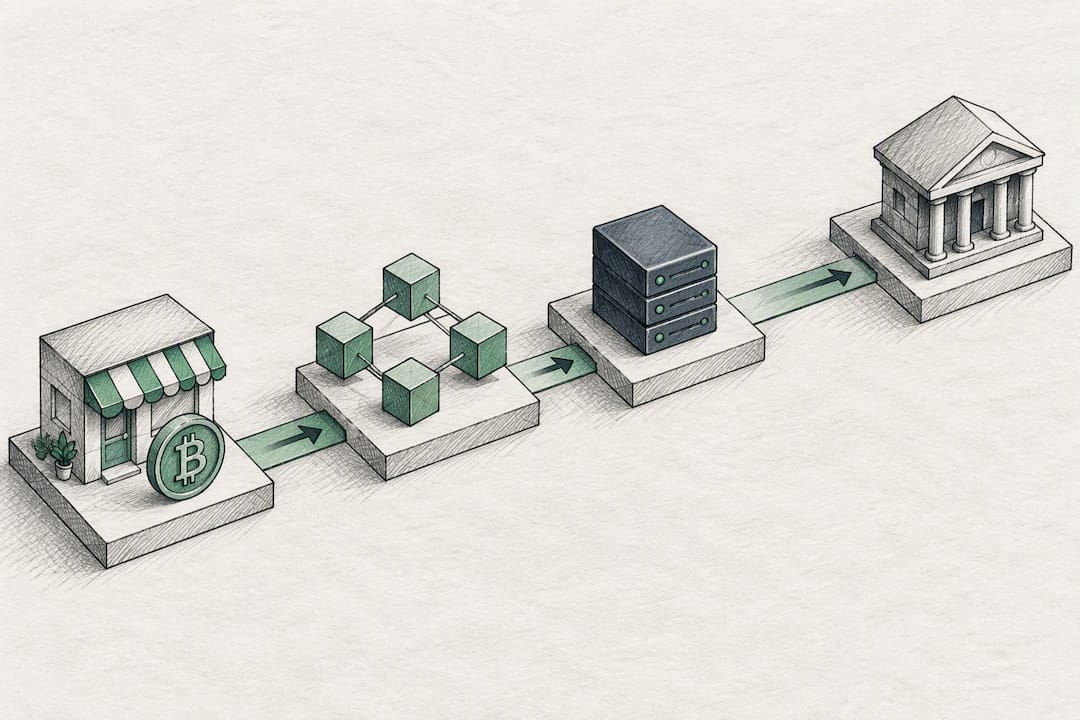
Here’s the typical flow:
- The customer gets a checkout or invoice with an amount and address.
- The customer broadcasts a transaction to the network.
- The network confirms the transaction a set number of times, depending on the asset.
- The gateway observes those confirmations and credits an internal ledger balance.
- The gateway may convert the asset to a stablecoin or fiat currency.
- Funds settle to the merchant’s wallet or bank account.
Pro Tip: Ask any provider exactly which of these six steps triggers their “paid” webhook. A gateway that marks an order paid on broadcast, before confirmation, is taking on risk on your behalf, and you should know that’s happening.
Confirmation depth varies by network and asset, and a low-confirmation policy trades speed for reversal risk. Internal ledger credit is not the same as an on-chain settlement, and bank credit can lag both by days depending on the off-ramp partner’s processing window. Reconciliation systems that collapse broadcast, confirmation, ledger credit, and bank settlement into a single “paid” flag will eventually produce numbers that don’t match your bank statement.
Custody Models and the Risk You’re Actually Taking
Custody is the question that decides who can lose your money if something goes wrong. In self-custody, you or your business controls the private keys and carries full operational responsibility. In third-party custody, a gateway or exchange holds the keys, which adds counterparty exposure if that provider fails, gets hacked, or becomes insolvent.
Most sound business patterns split the difference: keep an operating float in a hot wallet for day-to-day liquidity, and move reserves into cold storage the provider (or you) rarely touches. Before trusting any custodial arrangement, check the following:
- Does the provider publish proof-of-reserves, and do they disclose its limits? These reports are not the same as an audited financial statement.
- Has the provider or its executives had any insolvency or regulatory action in the past?
- Are customer funds segregated from operating capital?
- Have withdrawals ever been paused, delayed, or capped during market stress?
Learn more about how custodial versus non-custodial gateways affect your operational responsibilities before choosing one over the other.
The Full Fee Path You Need to Compare
Sticker-price processing fees rarely tell the whole story. There’s no universal standard for how providers structure crypto fees, so you have to assemble the total cost yourself, component by component.
- Processing fee: the percentage the gateway or exchange charges per transaction.
- Network fee: the cost of moving the asset on-chain, which fluctuates with congestion.
- Conversion spread: the markup baked into converting crypto to stablecoin or fiat.
- Off-ramp or withdrawal charge: what it costs to move settled funds into your bank.
Timing risk matters just as much as the fee percentages. A quoted conversion rate and the rate actually executed can differ if the market moves between invoice creation and settlement, and someone bears that gap. Ask providers directly: who absorbs volatility between quote and execution? What’s the all-in cost on a $1,000 transaction, fees and spread included? Are refunds and chargebacks even possible, and at what cost? For a deeper breakdown of how these pieces stack up, see this full accounting of gateway fees.
How to Evaluate and Choose a Provider
Before integrating anything, run through this checklist:
- Settlement architecture. Where does the money actually land, an on-chain wallet you control, an internal ledger balance, or your bank account? Who owns custody at each step?
- Confirmation policy. How many confirmations does each supported network require before a payment counts as final, and what do the webhook statuses for broadcast, confirmed, and settled actually mean?
- Compliance posture. What KYC and licensing does the provider carry, how do they handle sanctions screening and travel-rule data, and how long does onboarding take?
- Operational mechanics. How are refunds and disputes handled, and does the reconciliation feed map cleanly to your accounting system?
| Evaluation area |
What to confirm |
| Settlement |
Exact destination of funds and who holds custody at each stage |
| Confirmation policy |
Confirmations required per network, and webhook semantics |
| Compliance |
KYC/licensing scope, sanctions screening, travel-rule handling |
| Operations |
Refund mechanics, dispute process, reconciliation report format |
How CryptoPayr Approaches the Gateway Side
CryptoPayr is built specifically as a merchant-facing gateway, not a trading venue. It supports over 110 cryptocurrencies, including Bitcoin and Ethereum, and its fee tiers start as low as one-tenth of one percent for higher-volume merchants, according to CryptoPayr’s own published pricing. Onboarding runs without a KYC requirement, removing friction that traditional processors typically impose.
Integration options include:
- Hosted checkout pages for fast setup
- Direct API integration for custom platforms
- E-commerce plugins for existing storefronts
- Payment links for invoicing without a full storefront
CryptoPayr acts purely as a gateway for merchants who want funds to move straight to their own wallets, and it offers optional auto-conversion to stablecoins for merchants who prefer settlement without holding volatile assets. Where a business needs on-platform conversion beyond simple settlement, that function sits separately from the core payment-processing role.
What Merchants Should Actually Do Next
If you’re choosing between a gateway and an exchange, map your own workflow first: are you getting paid, or are you trading? Test any candidate provider in a sandbox before going live, and confirm in writing what event they treat as “settled.” Everything else, fees, confirmation depth, custody, follows from that one answer.
— Dustin
Accept Crypto Payments Without the Exchange Complexity
If you run an online store, a SaaS product, or a marketplace, you don’t need an exchange account. You need a gateway that gets customer payments into your hands without weeks of onboarding paperwork. CryptoPayr skips the KYC requirement most processors demand, supports over 110 coins including Bitcoin and Ethereum, and offers tiered pricing that becomes more competitive as volume increases.
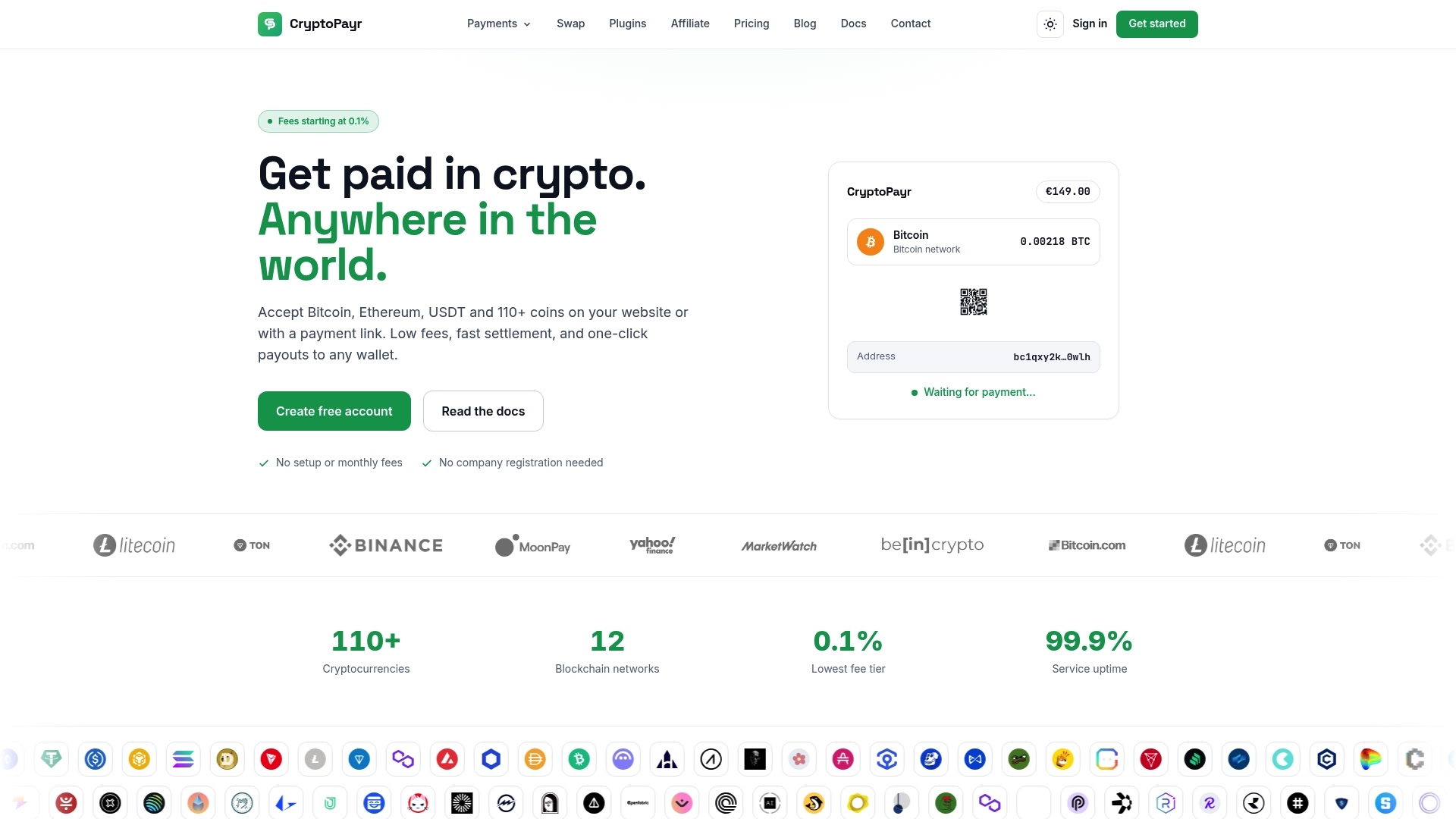
Whether you’re building a checkout for an e-commerce storefront or setting up commission splits for a marketplace platform, integration runs through hosted checkout, a direct API, or existing plugins, whichever fits your current stack. Merchants who need to pay out sellers or affiliates can also use CryptoPayr’s mass payout tools instead of running conversions manually.
Check current fee tiers and start integration at Cryptopayr.
Sources
FAQ
What’s the difference between a crypto gateway and an exchange?
A gateway processes merchant payments, generating checkouts, watching for on-chain confirmations, and settling proceeds. An exchange is a trading marketplace for buying, selling, or swapping assets. Some providers bundle both functions, so check settlement architecture rather than trusting the label alone.
Which crypto payment gateway is the best?
There’s no single best option; it depends on coin support, fee structure, and onboarding requirements. CryptoPayr supports over 110 cryptocurrencies with no-KYC onboarding and fee tiers starting at 0.1%, which suits merchants who want fast setup without a lengthy verification process.
Is it better to keep crypto in a wallet or on an exchange?
For funds you’re not actively trading, self-custody in your own wallet removes counterparty risk from an exchange’s potential insolvency or hack. Exchanges make sense for active trading balances, but reserves are usually safer moved to a wallet you control.
Can the IRS see your crypto wallet?
The IRS can trace on-chain activity and increasingly requires exchanges to report transactions through forms like 1099-DA. Merchants and traders should keep their own complete transaction records rather than relying solely on a platform’s tax forms.
What’s the most trusted crypto exchange?
Trust depends on regulatory standing, custody transparency, and insolvency history rather than brand recognition alone. Check for proof-of-reserves disclosures, licensing status, and past withdrawal behavior during market stress before treating any exchange as fully trustworthy.
Recommended