Merchant-facing crypto settlement typically lands somewhere between a few seconds and about an hour, depending on the asset and rail. Stablecoins on fast chains often clear in seconds to minutes; Ethereum usually takes minutes but gateways commonly set 15 to 30 minute windows; Bitcoin, with deeper confirmation requirements, can stretch toward an hour. Before assuming a delay is a problem, check your gateway’s confirmation threshold, its settlement SLA, and whether it pushes real-time status through webhooks.
TL;DR:
- Settlement times vary significantly by asset and network conditions, from seconds on fast Layer 2s to nearly an hour on Bitcoin due to confirmation requirements.
- Gateway policies, including confirmation thresholds, batching schedules, and conversion processes, add delays that can exceed blockchain confirmation times.
- Network congestion and gas price spikes can cause confirmation delays, especially for on-chain transactions on Ethereum and Bitcoin.
- Using stablecoins on fast chains provides quicker settlement, but merchant policies and fallback procedures are critical to handle occasional slow confirmations.
- Proper treasury management, real-time balance visibility, and operational procedures are essential for predictable settlement and reducing checkout failures.
Cryptopayr
Accept Crypto Payments With Less Friction
CryptoPayr helps e-commerce, SaaS, and digital businesses accept over 110 cryptocurrencies with minimal fees and no KYC.
Explore CryptoPayrTable of Contents
What Affects Crypto Settlement Times
The gap between “the customer paid” and “the merchant can spend it” comes down to five forces working together, not one single bottleneck.
Finality model is the biggest lever. Bitcoin uses probabilistic finality, meaning each additional block makes reversal less likely but never impossible, which is why merchant policies often wait for multiple confirmations. Deterministic or BFT chains settle differently. As one technical breakdown of gateway architecture notes, some modern chains reach finality in seconds rather than requiring a confirmation count at all.
Network congestion is the second variable, and it’s the one merchants underestimate most. When mempools back up, gas prices spike and confirmation times that normally take minutes can stretch far past a gateway’s timeout window.
Asset type matters too. Native token transfers on congested chains behave differently than stablecoin transfers on purpose-built payment rails, which is one reason stablecoin settlement often outpaces legacy blockchain transfers.
Gateway-side policy adds its own latency: confirmation thresholds, timeout windows, and batching schedules are all business decisions layered on top of the blockchain.
Fiat off-ramp friction closes the list. Banking cutoff times, correspondent banking hops, and compliance holds can add hours even after a payment is fully settled on the gateway’s books.
- Blockchain finality model (probabilistic vs. deterministic)
- Network congestion and gas price spikes
- Asset choice (native token vs. stablecoin)
- Gateway confirmation thresholds and batching cadence
- Banking rails and compliance holds on the fiat side
Most gateways set a confirmation window between 15 and 30 minutes, and transactions that confirm after that window can be marked as failed by the checkout flow even though the funds eventually arrive.
Pro Tip: Ask any gateway you’re evaluating for their exact confirmation threshold per asset, not just an average settlement time. Averages hide the tail risk that actually breaks your checkout.
How Long Does Crypto Settlement Actually Take?
Timelines vary enormously by rail, and treating “crypto payment” as one speed category is the fastest way to misconfigure your checkout.
- Stablecoins on fast Layer 2s and BFT chains: seconds to a few minutes. This is fast enough for instant checkout confirmation and micropayment use cases where a customer expects an immediate receipt.
- Ethereum mainnet: usually a few minutes for reasonable confirmation depth, but gateways frequently apply a 15 to 30 minute timeout to absorb congestion spikes. That gap between “usually fast” and “sometimes slow” is exactly where checkout UX breaks if you don’t design for it.
- Bitcoin: probabilistic finality means higher-value orders often wait for multiple confirmations, which can extend merchant settlement times substantially.
A payment that confirms on-chain 40 minutes after checkout, past a 30-minute gateway timeout, has technically succeeded on the blockchain but failed at the checkout layer. The customer sees an error. Your fulfillment system sees nothing. That mismatch, not the raw block time, is the actual UX risk most merchants overlook, and it explains why gas price spikes and mempool congestion show up so often in merchant complaint logs.
What Happens Between Confirmation and Settlement?
On-chain confirmation and merchant settlement are two different clocks. A confirmed transaction is evidence a payment happened; it isn’t automatically a credit on your books. Gateways exist specifically to bridge that gap between blockchain proof and contractual settlement.
The lifecycle usually runs: payment initiation, on-chain confirmation, gateway internal mark, optional conversion to stablecoin or fiat, batching into a settlement run, then credit to your merchant balance or fiat off-ramp. Each step can add delay independent of the blockchain itself. A gateway that treats ledger records as the source of truth rather than raw chain data tends to give merchants a cleaner settlement picture, since orchestration logic, not block time, determines when funds actually move.
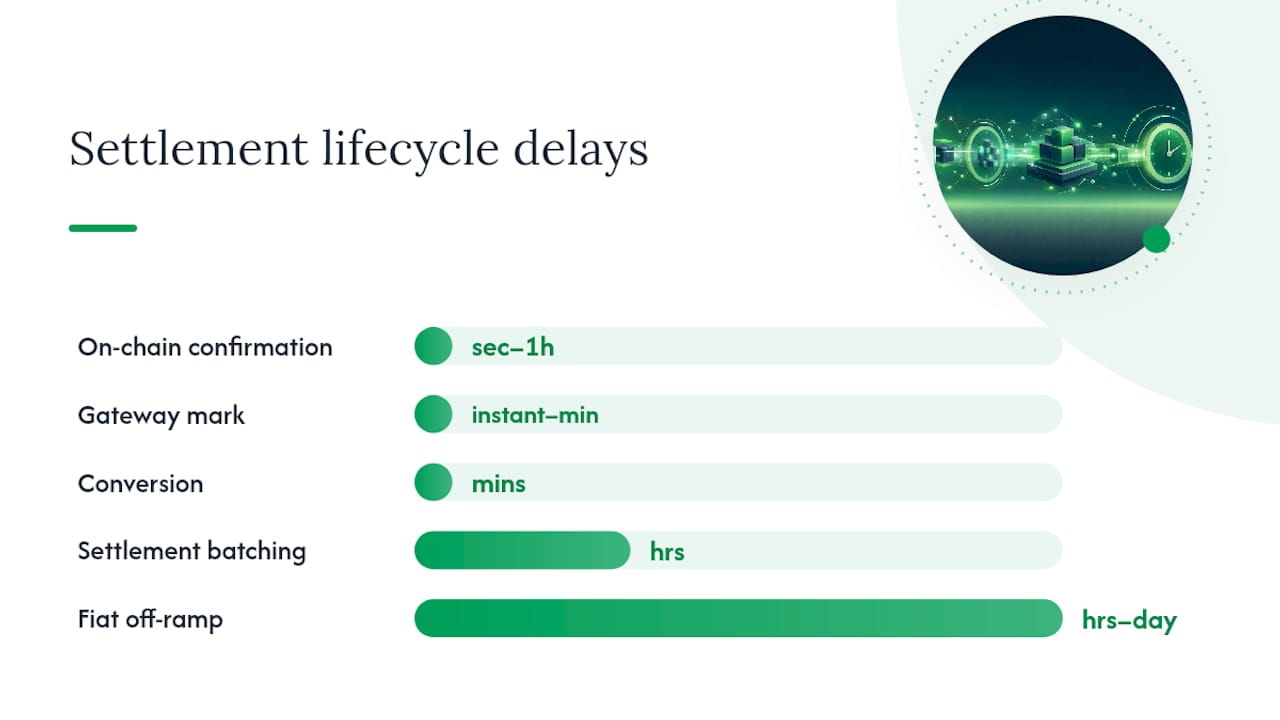
Batching is the quiet delay nobody mentions in marketing copy. A gateway that confirms your payment in two minutes but only runs settlement batches every six hours has effectively imposed a six-hour wait regardless of chain speed.
When evaluating an SLA, ask for these specifics:
- Settlement time targets, stated per asset, not as a blanket average
- Required confirmation counts before a payment is marked settled
- Outage and delay procedures, including communication timelines
- Available settlement currencies (native crypto, stablecoin, or fiat)
| Lifecycle stage |
Typical time added |
| On-chain confirmation |
Seconds to ~1 hour (asset-dependent) |
| Gateway internal processing mark |
Near-instant to a few minutes |
| Conversion to stablecoin/fiat |
Minutes, subject to liquidity |
| Batching into settlement run |
Up to several hours, gateway-dependent |
| Fiat off-ramp to bank |
Hours to next banking day |
Fees and conversion spreads also affect usable timing. A settled balance sitting in a wallet you can’t withdraw from until a batch clears isn’t functionally available, even if your dashboard shows a credit. Understanding how gateway fees and conversion spreads eat into the settled amount matters as much as the timing itself.
Building Predictable Settlement: Liquidity and Funding Strategies
Merchants who treat settlement speed as purely a blockchain problem miss the bigger lever: treasury design. Three funding models dominate, each with a different risk profile.
- Pre-funded buffer: You hold a working balance sized to cover typical daily payout volume, so payouts execute instantly regardless of on-chain timing. It’s capital-inefficient if oversized, but it’s the simplest way to avoid first-week failures.
- Just-in-time funding: You fund payouts as they’re needed, which is capital-efficient but can reintroduce latency, especially if the funding leg runs through fiat banking rails rather than crypto.
- Hybrid: A modest buffer covers baseline volume, with just-in-time funding absorbing spikes. This is the pragmatic default for most platforms because it balances instant execution against idle capital, and it scales more gracefully as transaction volume grows unevenly.
None of these models work without visibility. Gateways that expose real-time balance APIs materially reduce reconciliation friction, because treasury teams can size buffers against actual usage instead of guesswork. Platforms managing high payout volume tend to lean on structured liquidity buffers built for scale rather than manual top-ups.
Beyond the funding model itself, a handful of operational pieces determine whether the strategy holds up under load: payout quotes with clear expiry windows, a defined idempotency key lifecycle so retries don’t duplicate payments, automated top-up triggers when the buffer dips below a threshold, and monitoring that flags funding gaps before they become customer-facing failures.
Pro Tip: Start your buffer sizing at roughly 1.5x your busiest historical day, not your average day. Averages will leave you short exactly when volume spikes.
Integration Checklist for Reliable Settlement
Getting settlement timing right in production comes down to a handful of engineering habits, most of which get skipped under launch deadlines.
- Set up webhook listeners and log timestamps on every event; correlate gateway status against on-chain confirmations during reconciliation rather than trusting either source blindly.
- Retain idempotency keys for at least as long as your slowest expected confirmation window. For Bitcoin, that’s commonly a time long enough to outlast any possible confirmation delay, often about a day, since reorgs and rebroadcasts can create long tails.
- Keep network fees and platform fees in separate accounting entries, and make sure gas spent on failed transactions still gets reconciled somewhere.
- Design checkout timeouts and retry logic so a late confirmation doesn’t trigger a duplicate order or a confused customer support ticket.
- Run scheduled reconciliation tests comparing gateway logs, a block explorer, and your balance API, catching drift before it becomes a finance problem.
For commerce flows specifically, lean on gateway-confirmed status rather than polling a block explorer directly; explorers are good for forensic audits, not live order state.
Pro Tip: Log the raw webhook payload, not just a parsed status field. When something breaks at 2 a.m., the raw event is what actually tells you what the gateway saw.
Handling Late Confirmations, Timeouts, and Refunds
Settlement exceptions fall into a small number of predictable patterns, and each one needs its own handling rule rather than a single generic “payment failed” response.
- Late confirmation after timeout: treat as a manual review case, not an automatic failure, since funds may still arrive.
- Underpayment or overpayment: route to a reconciliation queue; most gateways credit the difference or request a top-up rather than reversing the transaction.
- Dropped or replaced transaction (RBF): wait for chain confirmation of the replacement before updating order status.
- Refunds: typically flow back to merchant balance first, then out to the customer, with timing dependent on the asset’s own settlement speed.
Build a runbook that maps each webhook signal to a specific finance and operations action, plus a customer communication template. Push your gateway for SLA language covering failure handling and dispute timelines specifically, since generic uptime guarantees rarely address settlement disputes.
Centralized vs. Decentralized Settlement: Timing Trade-Offs
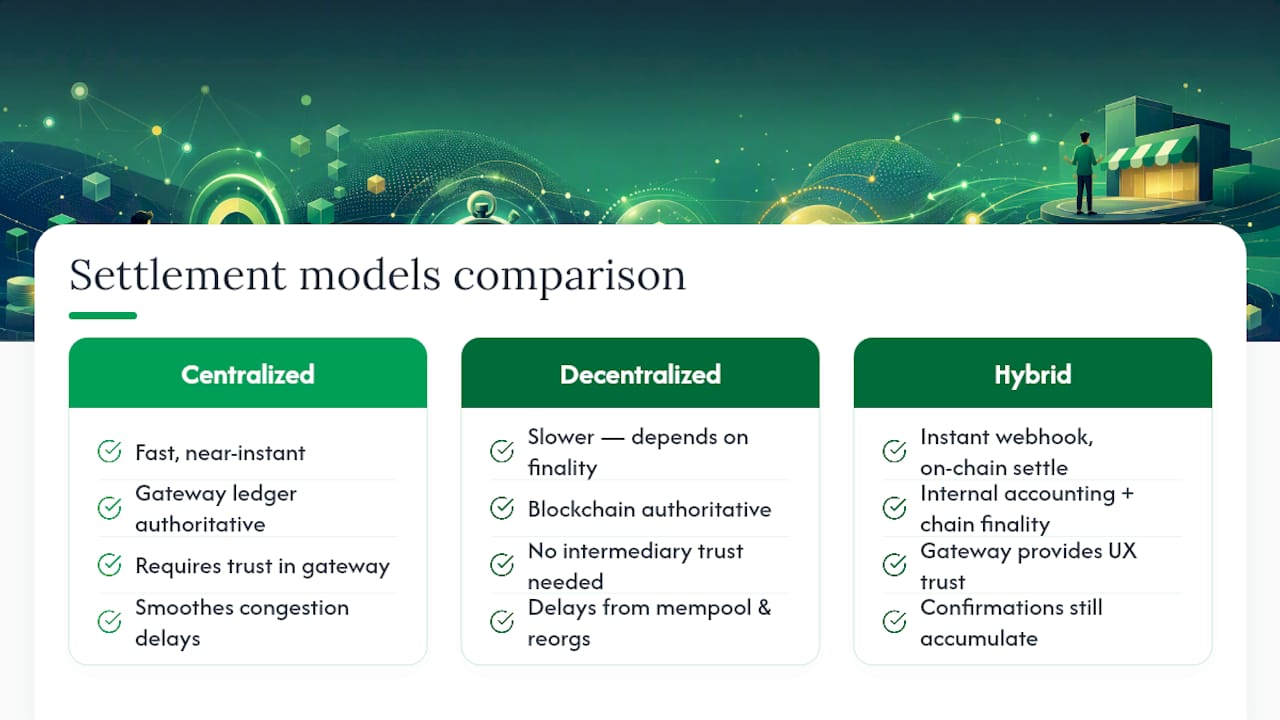
Centralized settlement, where a gateway or custodian holds funds and credits merchants internally, tends to be faster because it doesn’t wait on blockchain confirmation depth for every internal transfer. The gateway’s own ledger, not the chain, is authoritative, so it can mark a payment settled the moment its internal risk threshold is met.
Decentralized settlement, where funds move peer-to-peer with no intermediary custodian, is slower by design because it depends entirely on chain finality. There’s no internal ledger to smooth over congestion or delay a marked status; you’re waiting on the network itself.
The practical trade-off is control versus trust assumptions. Centralized settlement gives merchants predictable timing but requires trusting the intermediary’s solvency and internal processes. Decentralized settlement removes that counterparty risk but inherits every delay the underlying chain experiences, from mempool congestion to reorg risk.
Most merchant-grade gateways run a hybrid: settlement happens on-chain, but the gateway’s internal accounting and webhook layer give merchants a centralized-feeling experience with decentralized settlement finality underneath. That’s effectively what lets a merchant get an instant “payment received” webhook while the underlying transaction is still accumulating confirmations. Understanding how coins, networks, and confirmation requirements interact helps clarify which model a given gateway is actually running.
How Layer 2 Networks Are Cutting Settlement Times
Layer 2 networks and other fast-finality chains exist specifically to solve the confirmation-depth problem that makes base-layer Bitcoin and Ethereum settlement slow for commerce. By batching transactions off the main chain or using different consensus mechanisms, these networks can finalize payments in seconds rather than minutes or hours.
The practical effect for merchants: a stablecoin payment routed through a fast L2 can reach a settlement-ready state before a customer finishes reading a confirmation page, compared to native-chain transfers that might still be accumulating confirmations. This matters most for high-frequency, lower-value transactions like digital subscriptions or in-app purchases, where waiting even five minutes for confirmation would tank conversion rates.
The trade-off isn’t free. Faster finality layers sometimes carry different trust assumptions than base-layer chains, and gateway operators have to decide how much confirmation depth they still require even on a fast chain to protect against edge-case reorgs. That’s a policy decision, not a technical limitation, and it’s exactly the kind of setting merchants should ask about when comparing gateways rather than assuming “Layer 2” automatically means “instant and final.”
If you’re building a crypto checkout, sequence matters more than perfection. Get real-time balance APIs and reliable webhooks working first; chain selection is a secondary optimization once your status pipeline is trustworthy. Start with a modest pre-funded buffer, even an imperfect one, rather than waiting for a fully modeled hybrid system. You’ll learn more from a week of real volume than from another planning cycle.
Then measure what settlement delay actually costs you, cart abandonment, failed fulfillment, support tickets, and tune your timeout windows against that data instead of a generic industry number.
— Dustin
Test Your Own Settlement Times With CryptoPayr
Some crypto payment gateways offer support for a wide range of cryptocurrencies, auto-conversion to stablecoins, webhook-driven status updates, and real-time balance visibility to ease reconciliation. Some enable onboarding processes that skip traditional KYC friction, potentially allowing merchants to get live and test transactions more quickly than with conventional processors.
If you want to see your own settlement behavior instead of relying on industry averages, run a sandbox transaction through the CryptoPayr gateway and watch the confirmation, conversion, and balance-credit steps happen in real time. Platforms that need the same settlement infrastructure under their own brand can look at the white-label gateway option as well. Either way, request a demo and measure your actual settlement window before committing to any vendor’s advertised numbers.
Sources
Recommended


