How to Accept Crypto Payments for Your US Business

The fastest route for most US merchants are a hosted checkout or payment links that auto-convert incoming crypto to USD at settlement. That single choice eliminates volatility exposure during the payment window, keeps your books in dollars, and removes the need to manage private keys or a crypto wallet. You can be live in hours, not weeks.
Here is what you need to start today:
- Hosted checkout: embed a payment page your gateway hosts; zero front-end dev required.
- Payment links: generate a shareable URL per order; works for invoices, social commerce, and email campaigns.
- E-commerce plugins: one-click installations for WooCommerce, OpenCart, and Easy Digital Downloads.
- API integration: full control for custom storefronts and high-volume platforms.
For production, Cryptopayr is the recommended option. It supports 110+ coins including Bitcoin and Ethereum, requires no KYC to onboard, settles in USD or stablecoins, and ships plugins for the most common e-commerce stacks.
Pro Tip: Start with payment links or hosted checkout to validate demand before committing engineering time to an API integration. You can migrate to the API later without changing your settlement account.
Key Takeaways
Hosted checkout with auto-conversion to USD is the fastest, lowest-risk way for a US business to accept crypto payments, with IRS recordkeeping required from the first transaction.
| Point |
Details |
| Start with hosted checkout |
Payment links or hosted checkout go live same day; no developer required. |
| Choose USD or stablecoin settlement |
Auto-conversion eliminates volatility and collapses IRS reporting to a single USD line item per sale. |
| Log every transaction for the IRS |
Record transaction ID, timestamp, coin, quantity, and USD fair market value at receipt. |
| Watch the full fee stack |
Processor fee, network fee, and conversion spread all apply; low-fee chains reduce the network cost. |
| Cryptopayr for production |
110+ coins, no KYC to onboard, and platform plugins make it the recommended starting point. |
Table of Contents
Why should your business accept crypto payments?
The commercial case comes down to four things: lower chargebacks, access to global buyers, reduced payment routing costs on certain transaction types, and a clear brand signal to tech-forward customers.

Crypto transactions are irreversible on-chain. That means chargebacks are structurally eliminated for merchants, which matters most in digital goods, gaming, and subscription software where fraud-driven chargebacks can run a few percentage points of revenue. The U.S. Chamber of Commerce frames crypto acceptance as a strategic trade-off: new customer access and lower dispute costs on one side, tax complexity and operational overhead on the other.
The customer segments most likely to pay with crypto are global buyers who face card friction or currency conversion fees, gaming and digital-goods communities, cross-border B2B clients, and privacy-conscious shoppers. For SaaS companies, crypto is increasingly a fallback when cards fail internationally.
The Federal Reserve’s Report on the Economic Well-Being of U.S. Households tracks household-level digital asset ownership and adoption trends, providing useful context for estimating how many of your existing customers may already hold crypto. Adoption remains uneven across demographics, so the ROI case is strongest for merchants with a global, tech-savvy, or niche customer base.
Crypto makes less sense when your average order value is under $10 (network fees can eat margin), when your customer base skews older and card-comfortable, or when your legal team flags specific regulatory friction in your vertical.
How does a crypto payment actually flow?
A crypto payment routes through either a gateway handling on-chain transactions or off-chain custodial rails. The merchant’s integration choice determines which model applies.
The typical flow looks like this:
- Customer selects “Pay with crypto” at checkout.
- The gateway generates a unique deposit address and displays a QR code or wallet-connect prompt.
- The customer’s wallet broadcasts the transaction to the blockchain.
- The gateway detects confirmation(s) and triggers settlement.
- The merchant receives USD, a stablecoin, or raw crypto depending on their settlement setting.
Hosted checkout with automatic fiat conversion is the lowest-friction approach for most merchants. It reduces volatility exposure during the confirmation window and collapses bookkeeping to a single USD line item per transaction, the same as a card payment.
Essential terms for non-blockchain engineers:
| Term |
Plain-English definition |
| On-chain |
Transaction recorded directly on the public blockchain; irreversible once confirmed. |
| Off-chain |
Transaction settled through a custodial intermediary without a direct blockchain write; faster, lower fees. |
| Wallet |
Software or hardware that holds private keys and signs transactions. |
| Stablecoin |
A crypto token pegged to a fiat currency (e.g., USDC pegged 1:1 to USD). |
| Settlement |
The moment funds move from the gateway to the merchant’s account. |
| Custody |
Who holds the private keys — and therefore controls the funds. |
Wallet connection methods vary by gateway. Browser wallets like MetaMask connect via WalletConnect or injected providers. Mobile wallets typically use QR-code scanning. Custodial providers redirect the buyer to a hosted page, then settle on the merchant’s behalf. For a deeper walkthrough of the mechanics, this plain-English guide for merchants covers each model without assuming blockchain experience.
Which integration option fits your stack?
Hosted checkout and payment links are fastest to launch. Plugins are the next step for merchants on supported platforms. The API is the right call for custom storefronts or high-volume flows that need programmatic control.
Integration options at a glance:
- Hosted checkout: the gateway serves the payment page; no front-end code required. Best for merchants who want to go live today.
- Payment links: generate a URL per transaction or product; paste it anywhere. Ideal for freelancers, invoicing, and social commerce.
- E-commerce plugins: pre-built modules for WooCommerce, OpenCart, and Easy Digital Downloads. Install in minutes; no custom code.
- API: full programmatic control over checkout UI, settlement triggers, and webhook handling. Best for engineering teams building custom flows.
- POS: some gateways support QR-code-based in-person checkout for retail or events.
- Invoicing: generate crypto-denominated invoices with a payment link embedded; useful for B2B and service businesses.
Pro Tip: If you run Easy Digital Downloads or WooCommerce, install the plugin first and test a live transaction before touching the API. Many merchants never need the API at all.
For marketplace operators splitting commissions across multiple sellers, the marketplace payout guide covers how to structure payouts without building custom disbursement logic.
Settlement options, volatility, and US tax basics
Choose auto-conversion to USD or stablecoin settlement. Holding raw crypto in your business account creates a taxable event every time you spend or convert it, and exposes your revenue to price swings between receipt and payout.
Your three settlement choices are:
- Instant USD conversion: the gateway converts crypto to dollars at the moment of payment confirmation. Simplest for accounting; one line item per sale.
- Stablecoin settlement (USDC/PYUSD): you receive a dollar-pegged token instead of raw crypto. Useful if you want to stay in the crypto ecosystem but avoid volatility.
- Direct crypto payout: you receive the exact coin the customer sent. Maximum control; maximum accounting complexity.
On the tax side, the IRS treats digital assets as property, not currency. Every time your business receives crypto as payment, that receipt is a taxable event at the fair market value in USD on the date received. If you later sell or convert that crypto, you realize a capital gain or loss on the difference. The IRS FAQ on virtual currency transactions answers the most common merchant questions, including how to calculate basis and what counts as a disposition.
Recordkeeping is non-negotiable. Log the transaction ID, timestamp, coin received, quantity, and USD fair market value at the moment of receipt for every payment. If you hold crypto and later convert it, log the disposal date and proceeds too. Most accounting software (QuickBooks, Xero) can import CSV exports from your gateway; some crypto-specific tools like Koinly or CoinTracker automate the gain/loss calculation.
Pro Tip: Auto-conversion to USD at settlement collapses your IRS reporting to a single line: “received $X for goods/services.” No basis tracking, no capital gains math. For most merchants, that alone justifies the small conversion spread.
What fees will you actually pay?
Three cost components stack on every crypto transaction: the processor fee, the on-chain network fee, and the conversion spread when you auto-convert to fiat.
Example fee breakdown on a $100 sale:
Network fees are the wildcard. Bitcoin and Ethereum mainnet fees spike during congestion. Coins on faster chains (Solana, Polygon, BNB Chain) typically cost fractions of a cent per transaction. Choosing which coins to accept affects your effective cost per transaction as much as the processor fee does.
Pricing shapes vary by gateway. Most charge a flat percentage per transaction; some add a fixed per-transaction fee on top. Volume discounts and tiered pricing kick in at higher monthly volumes, so the rate you see at signup is often not the rate you pay at scale.
Hidden fees to watch for:
- Withdrawal or payout fees charged per bank transfer
- Failed-settlement recovery fees if a transaction under-confirms
- Currency conversion fees billed separately from the processor fee
- Minimum payout thresholds that hold your funds until a balance is reached
No KYC onboarding means no identity-verification delay before your first transaction.
Security, custody, and how crypto handles fraud
Your custody model determines your security surface. A custodial gateway holds crypto on your behalf until settlement; you bear less operational risk but depend on the gateway’s security practices. A non-custodial or direct-to-wallet setup gives you full control of funds but requires you to manage key security.
Custody model options:
- Custodial gateway: the processor holds funds during the settlement window. Lower merchant burden; counterparty risk on the gateway.
- Non-custodial/direct-to-wallet: funds go straight to a wallet you control. No counterparty risk; you manage key security and reconciliation.
- Hybrid: the gateway handles conversion and routing, then pushes settled USD or stablecoin to your bank or wallet. Most merchants land here.
Practical fraud controls:
- Set minimum confirmation thresholds (typically 1–3 confirmations for most coins before fulfilling an order).
- Use webhook signature verification to confirm that settlement notifications come from your gateway, not a spoofed request.
- Monitor on-chain analytics for flagged addresses if your vertical carries elevated fraud risk.
- For high-risk verticals, review the crypto payments for high-risk industries guide for vertical-specific controls.
Crypto payments are irreversible once confirmed on-chain. That eliminates chargebacks, but it also means your refund policy must be explicit. If a customer overpays or pays the wrong address, you cannot reverse the transaction. Publish a clear refund policy before you go live: state whether refunds are issued in crypto or USD equivalent, and at which exchange rate.
Pro Tip: Never fulfill a digital order on zero confirmations. Wait for at least one confirmation on Bitcoin and Ethereum; faster chains with finality guarantees (Solana, Avalanche) can often settle in seconds.
How to choose a crypto payment provider
Prioritize providers that offer USD or stablecoin settlement, clear developer documentation, platform plugins for your stack, transparent fee schedules, and a defined compliance posture. Everything else is secondary.
Checklist: what to confirm before signing up:
- Supported coins and wallet connection methods
- Settlement currencies (USD bank deposit, USDC, raw crypto) and payout timing
- KYC/AML requirements and onboarding friction
- Processor fee, network fee pass-through policy, and conversion spread
- Plugin or SDK availability for your platform (WooCommerce, OpenCart, Shopify, etc.)
- SLAs for payouts and customer support response times
- Dispute and refund handling policy
Questions to ask during vendor evaluation:
- What is the exact fee structure, including any withdrawal or payout fees?
- How quickly does USD settlement hit my bank account after a confirmed transaction?
- What happens if a transaction under-confirms or a customer sends the wrong coin?
- Do you publish your security practices and custody model publicly?
- Is there a sandbox or testnet environment for integration testing?
- What developer support is available (docs, Slack, dedicated account manager)?
Red flags to walk away from:
- Opaque or bundled fees with no line-item breakdown
- No developer documentation or a docs site that hasn’t been updated in over a year
- No sandbox or testnet for pre-production testing
- Settlement only in raw crypto with no fiat conversion option
- No published compliance or KYC/AML policy
Trust signals worth verifying: public developer docs with working code examples, plugin listings in platform marketplaces, a published security page describing custody practices, and clear settlement terms with stated payout timelines.
Step-by-step checklist to get crypto payments live
A typical hosted checkout or plugin integration goes live in one to two days. A custom API integration takes one to two weeks depending on team size and testing depth.
Go-live checklist:
- Create your gateway account and configure settlement preferences (USD, stablecoin, or crypto).
- Set up your settlement bank account or wallet address.
- Install the plugin for your platform (WooCommerce, OpenCart, Easy Digital Downloads) or generate your first payment link.
- Configure webhook endpoints and verify signature validation in your backend.
- Run test transactions in the sandbox/testnet environment; confirm order fulfillment triggers correctly.
- Force a settlement scenario and verify the USD amount lands in your account as expected.
- Map each transaction to your accounting ledger (date, amount received, USD equivalent, transaction ID).
- Publish your crypto refund policy on your checkout and FAQ pages.
- Enable live mode and process a real transaction end-to-end.
- Set up monitoring alerts for failed webhooks or under-confirmed transactions.
Testing tips before going live:
- Simulate a payment with a small real amount on mainnet after testnet passes.
- Test with at least two different wallets (MetaMask and a mobile wallet) to catch connection edge cases.
- Reconcile the on-chain transaction ID against your gateway dashboard and your accounting export.
For WHMCS merchants, the WHMCS integration guide walks through the module install and configuration step by step.
Timeline estimates:
- Hosted checkout or payment links: live same day.
- Plugin install (WooCommerce, OpenCart): live within 1–4 hours.
- Custom API integration: 1–2 weeks including testing.
What Cryptopayr offers US merchants
Cryptopayr is built for merchants who want to accept cryptocurrency payments without a lengthy onboarding process or a complex technical lift. No KYC is required to start, which means your first transaction can happen the same day you sign up.
Core features:
- 110+ supported coins including Bitcoin, Ethereum, USDC, and dozens of altcoins.
- Settlement options: auto-convert to USD, settle in USDC/PYUSD, or receive raw crypto.
- Platform plugins: OpenCart, WooCommerce, Easy Digital Downloads, and more.
- Payment links and hosted checkout: shareable URLs and embeddable checkout pages with no front-end code.
- API and SDKs: full programmatic control for custom storefronts and high-volume platforms.
- Mass payouts: pay multiple recipients in crypto from a single dashboard; useful for marketplaces and affiliate programs.
- White-label gateway: brand the entire payment experience under your own domain and logo via the white-label solution.
- Recurring billing: subscription and installment payment support for SaaS and membership platforms.
- Marketplace commission splitting: automatic payout routing for multi-vendor platforms.
For SaaS businesses where card payments fail internationally, Cryptopayr’s no-KYC gateway removes the onboarding friction that causes drop-off on traditional processors.
Pro Tip: If you run a multi-vendor marketplace, use Cryptopayr’s commission-splitting feature to automate seller payouts rather than building a manual disbursement workflow. It handles the routing; you handle the policy.
The part most merchants get wrong about crypto payments
Most merchants treat crypto payment adoption as a technical decision. It isn’t. The technical part, installing a plugin or generating a payment link, takes hours. The part that trips businesses up is the operational layer: what happens after the payment confirms.
Refund policy, tax recordkeeping, and settlement account setup are the three areas where merchants consistently underestimate the work. A merchant who goes live with a hosted checkout but has no documented refund policy for crypto will face a customer dispute within weeks. A merchant who holds raw crypto instead of auto-converting to USD will face a capital gains calculation at year-end that their accountant wasn’t expecting.
The merchants who get the most value from crypto payments are the ones who treat it like any other payment method from day one: clear policy, clean books, and a settlement model that matches their accounting workflow. For most US businesses, that means USD auto-conversion and a gateway that exports transaction data in a format their accounting software can import.
One more thing worth saying plainly: crypto payments are not a fit for every business. If your margins are thin and your average order is under $20, network fees on Bitcoin or Ethereum mainnet can eat a meaningful percentage of revenue. Stick to low-fee chains or stablecoins in that case, or evaluate whether the customer demand actually justifies the operational overhead.
Consult a CPA familiar with digital assets before your first tax filing that includes crypto receipts. The IRS guidance is clear on the obligations; the math is straightforward once you have clean records.
Cryptopayr gets you live without the usual friction
Most crypto payment setups involve a tradeoff: either you accept the KYC delay and limited coin support of a traditional processor, or you build a custom integration that takes weeks. Cryptopayr removes that tradeoff.
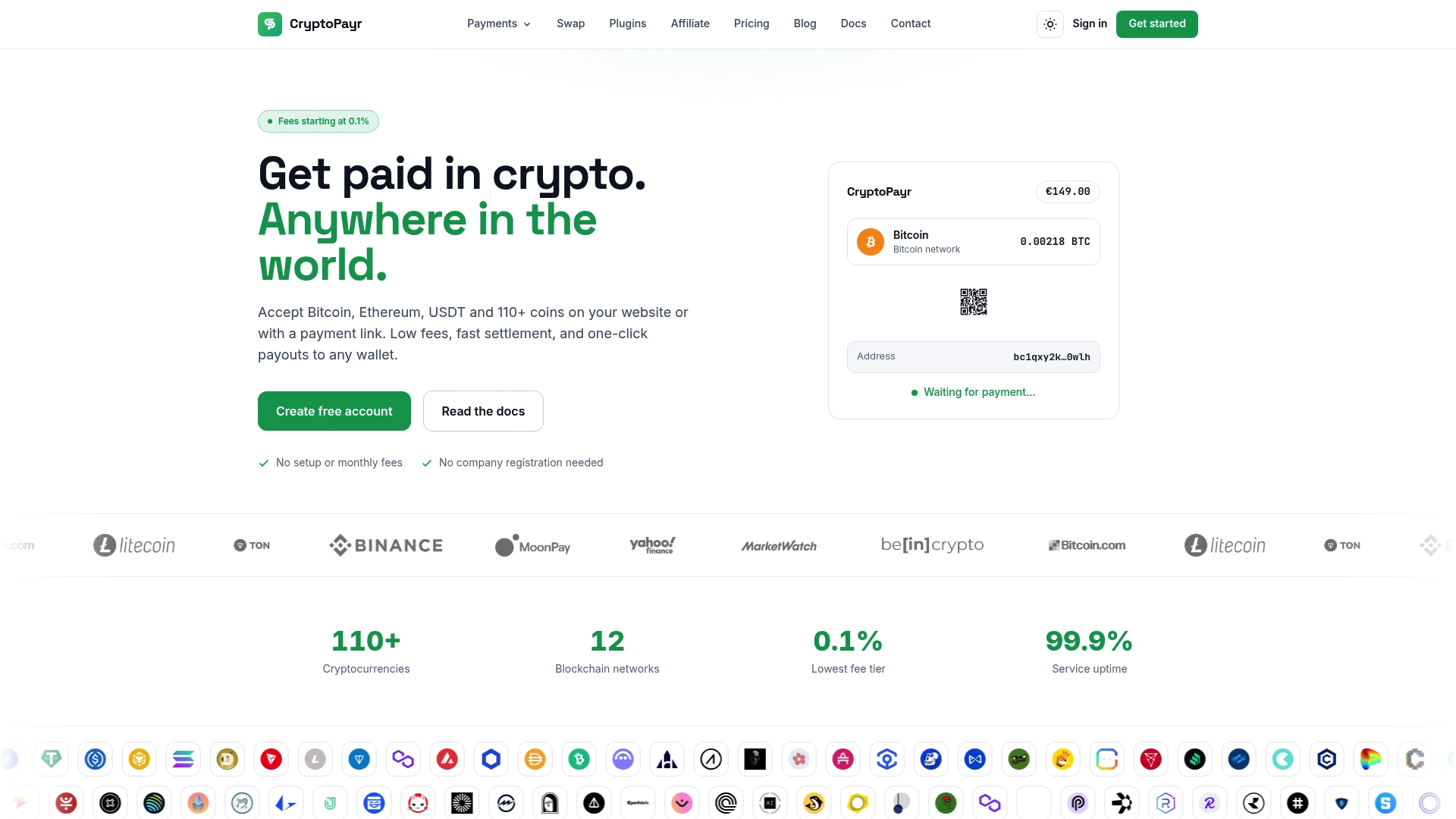
USD and stablecoin auto-conversion are built in, so your books stay clean from day one. Whether you’re running an e-commerce store, a SaaS platform, or a digital marketplace, the Cryptopayr gateway gives you a production-ready crypto checkout in hours. Sign up today and process your first transaction before end of day.
Sources
For tax and compliance:
For adoption context:
For engineering and integration:
This article provides general information about accepting cryptocurrency payments and is not a substitute for professional tax, legal, or financial advice. Confirm current IRS rules and your specific compliance obligations with a qualified CPA or attorney before processing crypto transactions.
Recommended