Crypto Payments for Game Servers: A 2026 Setup Guide
How game servers, indie studios and mobile game teams can accept crypto for ranks, subscriptions and in-game items: setup steps, fees, refunds and tax basics.
CryptoPayrNov 22, 202613.00 min read
Crypto Payments for Game Servers: A 2026 Setup Guide
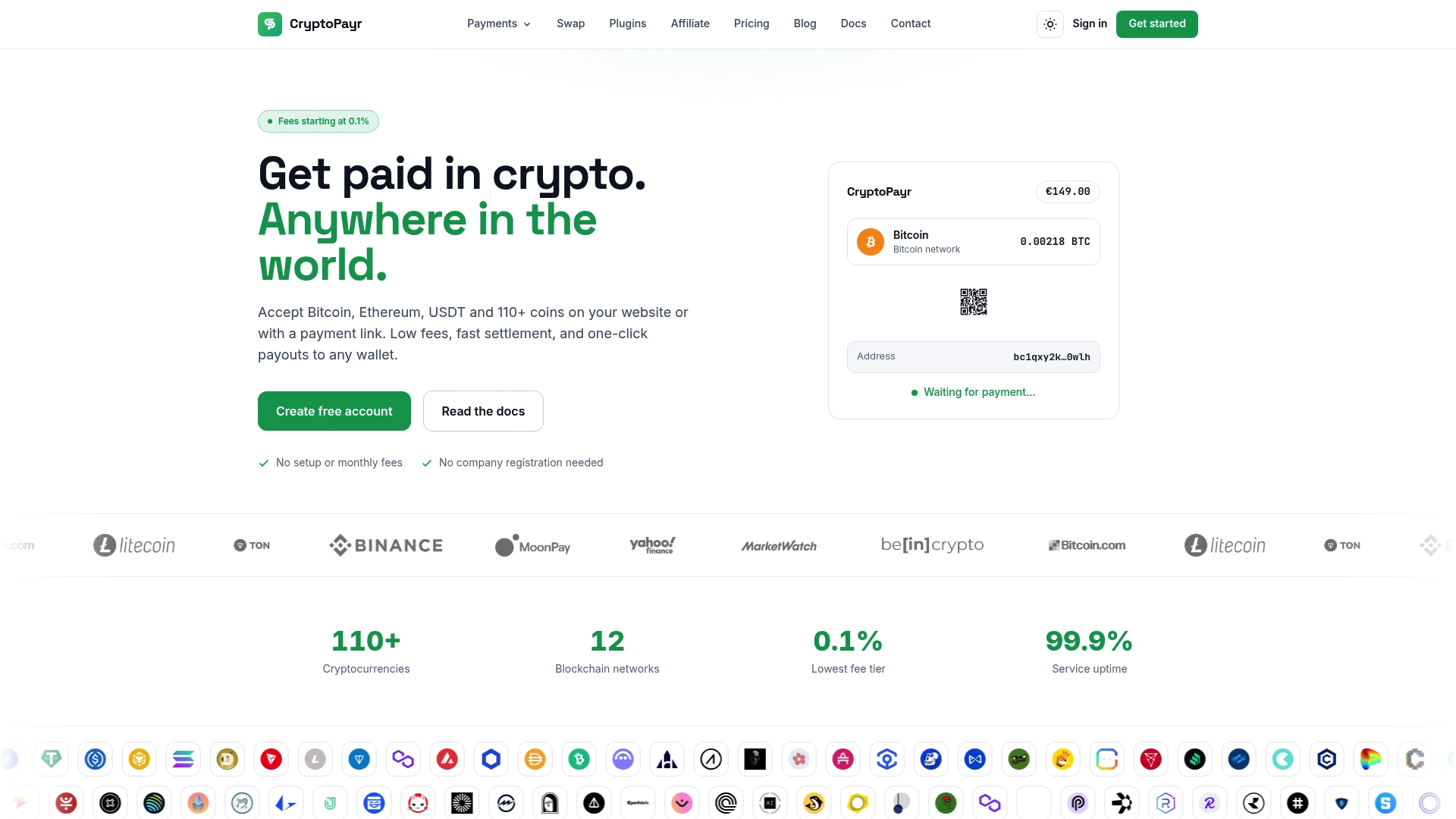
A game server can accept crypto by putting a payment gateway between the store and the blockchain: the player picks a coin, pays an invoice, and the gateway tells your store when the payment is confirmed so the rank, key or currency is delivered automatically. You do not need to run a node or hold a merchant account. CryptoPayr is built for exactly this: a no-KYC gateway that accepts 110+ cryptocurrencies, including Bitcoin and Ethereum, with hosted checkout, plugins, payment links and an API.
This guide is for server owners, indie studios, mobile game teams and gaming platforms that want crypto at checkout. It covers how a payment flows, which integration to pick, what it costs, and the refund and tax questions to settle before launch.
Cryptopayr
Accept Crypto Payments for Your Game Server
CryptoPayr helps gaming businesses accept over 110 cryptocurrencies, with hosted checkout, payment links, plugins and an API for integration.
Game communities already live online, many of them across borders. A Minecraft network with players in a dozen countries often loses sales to card declines, regional blocks and chargebacks. Digital goods are the classic chargeback target: the item is delivered instantly, and a dispute can come weeks later.
Crypto changes three things for a server owner:
Reach. A player with a wallet can pay from anywhere, without a card or a bank that approves foreign gaming charges.
Finality. A confirmed blockchain payment is not reversed by the payer’s bank, so the chargeback cycle does not apply the same way.
Speed. Payment status is visible on the network within minutes, so delivery can be automatic instead of waiting on a manual review.
Those points suit the things servers actually sell: ranks and perks, whitelist or priority access, monthly subscriptions, cosmetic items, in-game currency packs, and server hosting for community-run instances. Our gaming and game servers page goes through these use cases for operators.
How a crypto payment works on your server store
The flow is the same whether you run a web shop, a Discord bot checkout or an in-game menu.
The player chooses a product. Your store creates an order with a price in dollars or another fiat currency.
The gateway creates an invoice. The invoice shows the amount in the coin the player picked and a deposit address or payment QR code.
The player sends the payment from their wallet or an exchange.
The network confirms it. Each blockchain confirms at its own pace. Bitcoin blocks arrive roughly every ten minutes, while many other networks confirm in seconds, so the coin and network matter for the player’s wait.
Your store gets the paid status and delivers the item: a rank command, a license key, a balance top-up.
You settle. Funds arrive in your account, and with auto-conversion to stablecoins you can lock in the dollar value instead of holding a volatile coin.
The common failure points are underpayments (the player sends slightly less because of a wallet fee), late payments after the invoice expires, and delivery firing before a payment is final. Treat only a fully confirmed status as “paid”, and decide in advance what happens in the other two cases: a top-up request, or a manual review.
Choose the integration that matches your setup
You do not have to write code to start. Pick by how your server sells today.
Your setup
Best fit
What you get
A few products, manual delivery, a small community
Payment links
Share a link in Discord or on your site; no store changes
An online store on a common e-commerce platform
E-commerce plugin
Crypto added as a checkout option next to cards
A simple shop page where players pay and are done
Hosted checkout
A ready payment page, with no front end to build
Automated ranks, keys or in-game currency
API
Create invoices and react to payments inside your own code
A network reselling to other server owners
White label
Your brand on the gateway itself
For most servers the sensible path is hosted checkout or payment links in week one, and the API once you know which products sell. Crypto processing covers the core gateway, and the white-label option is there if you want to offer payments under your own brand.
Subscriptions and recurring billing
Monthly VIP ranks and hosted game instances are recurring revenue. Crypto is a push payment, meaning the player sends funds rather than you pulling them, so recurring billing works by issuing a new invoice each cycle. CryptoPayr supports recurring billing, so a renewal can reach the player as a fresh payment request instead of a manual reminder from you.
Coins and networks: what players actually use
Supporting 110+ coins does not mean you need to show players 110 choices. Give them a short, sensible list and let the gateway handle the rest.
Bitcoin is the most recognized and suits larger purchases, though confirmations are slower and network fees can be high for a small payment.
Ethereum and other major coins are widely held by players who already use wallets.
Stablecoins such as USDT and USDC keep a steady dollar value, which makes a $5 rank cost $5 when the payment lands. They are the easiest to price for small in-game purchases.
Low-fee networks matter for micro-transactions: a $2 purchase should not lose a large share to the network fee.
The rule of thumb for small sales is to steer players toward stablecoins on low-fee networks and keep Bitcoin and Ethereum available for those who prefer them. Because the swap widget and API need no KYC, a player who holds the wrong coin can also convert before paying; see our instant exchange.
Mobile games and indie titles
Indie developers and mobile teams ask the same question: where does crypto fit?
Indie games sold on your own site or launcher. This is the simplest case. A payment link or hosted checkout can sell a license key, a supporter pack or an early-access tier, with no storefront approval needed. Because there is no long onboarding, a small team can go from idea to first payment in an afternoon.
Mobile games on app stores. Here the platform rules lead. Apple’s App Review Guidelines set out how apps may sell digital content and how cryptocurrency features are treated, and Google Play publishes its own payments policy. Read the current version of both before you place a crypto button inside an app that sells in-game items. Many mobile studios sell through their own web store instead, with crypto as one option next to cards, and link players there from their community channels.
Gaming platforms with many sellers. If you run a marketplace for skins, mods or servers, you need to split each payment between sellers and the platform. CryptoPayr’s marketplace commission splitting and mass payouts are built for this, and our page on CS2 skin trading sites shows the pattern in a trading context.
What it costs
CryptoPayr has no setup or monthly fees. You pay on volume, and the rate falls as your volume grows:
Plan
Fee
Standard
2%
Growth
1.5%
Scale
1%
Enterprise
0.1%
Flat, per payment
$0.10 per payment
White-label
from 1%
The flat $0.10 per payment is worth a look when your average sale is small. A $4 cosmetic costs 10 cents to process, which works out to 2.5%, while a $40 rank costs the same 10 cents, which is 0.25%. For high-ticket sales, the percentage tiers are lower still as your volume rises. The pricing page has the current terms.
Players also pay the network fee on their own transfer. That is another reason to point small purchases at cheap networks.
Refunds, volatility and fraud
Refunds. A confirmed crypto payment cannot be pulled back by a bank, so a refund is a new payment you send. Write that into your terms: refund window, which coin you refund in, and what happens if the player’s address is wrong. Many server owners refund in the same stablecoin they received, to avoid arguments about price moves in between. This is also where mass payouts help, since you can send many refunds or rewards in one batch.
Volatility. If a player pays 0.002 BTC for a rank on Monday, the dollar value on Friday may differ. Auto-conversion to stablecoins removes that risk from your books: the sale is priced in dollars, and what you hold is dollar-pegged.
Fraud and chargebacks. Because crypto payments are final, the typical card-fraud pattern of buying items, using them, then disputing the charge does not apply. Fraud shifts to other places: stolen accounts, resold items and promo abuse. Delivery rules on your side still matter, such as one-time keys and rate limits. Our guide on cutting chargebacks and running batch payouts for gaming platforms goes deeper.
Tax and compliance basics for US sellers
This is general information, not tax advice; a CPA should confirm how it applies to your business.
The IRS treats digital assets as property. Its digital assets guidance explains that when you receive crypto for goods or services, you report income at its fair market value, measured in dollars on the date you receive it. That is why keeping a record of each payment’s value at confirmation time matters, and why many merchants convert to stablecoins at once. Our accounting guide for crypto payments shows how to reconcile these records, and the sales tax article covers what merchants must do about state sales tax.
On the payment-service side, FinCEN, the US Treasury bureau that handles money-laundering rules, has published guidance on virtual currency business models that explains which activities count as money transmission. CryptoPayr operates as a regulated MSB (money services business), so you are using a registered processor rather than building that layer yourself.
If your players or your company are outside the US, rules differ: tax treatment of crypto income, for example, is set country by country. Check your own country’s tax authority for the local rule.
Is crypto right for your players? A short checklist
Before you add it, answer these:
Do your players already hold crypto? Communities around Minecraft, Rust, FiveM and skin trading often do.
Do you lose sales to declined cards or regional blocks? Those lost sales are the ones crypto recovers.
Are your average sales small? Then choose stablecoins on low-fee networks and the flat per-payment fee.
Do you sell the same item repeatedly? Then automate delivery through the API.
Do you run casino-style games or betting? Those carry extra licensing requirements; see our iGaming page.
Start by offering crypto next to your existing options. Players choose, and you see within a few weeks how much of your revenue it carries.
Start accepting crypto on your server
With CryptoPayr, you sign up with no KYC and get instant approval, with no setup or monthly fees, then add payment links, a hosted checkout, a plugin or the API depending on how you sell. Auto-conversion to stablecoins, recurring billing, commission splitting and mass payouts are available when your server grows into a network or a marketplace. See the full gateway to get started.
Our view on crypto for game servers
Game operators spend a lot of time on things players never see: failed card payments, disputed charges, and manual delivery after a Discord ticket. We built CryptoPayr so a payment can be a simple, finished event.
Our view is that small teams should not need a lengthy onboarding to accept a new payment method. That is why we offer no-KYC sign-up and instant approval, with no setup or monthly fees. A server owner can add a payment link today and move to the API when the store grows.
We also think the plumbing should scale with you. The same gateway that takes a $5 rank can split commissions between sellers on a marketplace, send batch payouts to creators, and convert to stablecoins so your revenue is priced in dollars. Start small, keep your records clean, and let the tools grow with the community.
Dustin
FAQ
Can a Minecraft or other game server accept crypto without coding?
Yes. Payment links and a hosted checkout let you take crypto without writing code, and an e-commerce plugin adds it to an existing store. Move to the API when you want ranks or items delivered automatically the moment a payment is confirmed.
Which coins should a game server accept?
Offer Bitcoin and Ethereum for players who prefer them, and put stablecoins such as USDT first for small purchases, since their value stays steady and low-fee networks keep costs down. CryptoPayr supports 110+ coins, so you can widen the list later based on what your players ask for.
How long does a crypto payment take to confirm?
It depends on the network. Bitcoin blocks arrive about every ten minutes, while many other networks confirm in seconds to minutes. Deliver the item only once the payment shows as fully confirmed.
What happens if a player wants a refund?
A confirmed crypto payment is final, so a refund is a new payment you send back. State your refund window and the coin you refund in on your store, and use mass payouts if you need to send several at once.
Do I need KYC to start?
No. CryptoPayr offers a no-KYC sign-up with instant approval, so you can start taking payments without a lengthy onboarding.