International Crypto Payments: A 2026 Enterprise Guide
For most cross-border payment corridors, the fastest path to lower cost and faster settlement is stablecoin-based settlement through an enterprise gateway that handles auto-conversion, hosted checkout, and API access in one stack. Here is what to do first:
- Pick your settlement currency. Decide whether you want to hold USDT, USDC, or another stablecoin in treasury, or auto-convert to fiat on receipt. That single decision shapes your FX exposure, reconciliation complexity, and off-ramp costs.
- Enable auto-convert rules. Configure your gateway to convert incoming crypto to your chosen settlement asset immediately on confirmation. This eliminates volatility risk during the settlement window.
- Run a pilot on one corridor. Choose a route where correspondent banking is expensive or slow, such as a Latin American supplier payout or a Southeast Asian contractor payment, and measure landed cost against your current wire fees.
The quick wins are real: stablecoin settlement on active corridors often completes in minutes rather than the two to five business days typical of correspondent banking, and total landed cost is frequently lower once you strip out SWIFT fees, intermediary bank charges, and FX spreads. Reconciliation also simplifies because every transaction carries an on-chain hash you can match to a gateway payment ID, replacing the opaque reference strings that make wire reconciliation painful.
Key Takeaways
Stablecoin settlement through an enterprise gateway is the most cost-effective and operationally reliable approach to international crypto payments for mid-market and enterprise businesses in 2026.
| Point |
Details |
| Pick stablecoin settlement first |
Choose USDT or USDC settlement on corridors where on/off-ramp liquidity exists before adding volatile assets. |
| Verify on/off-ramp coverage |
Confirm the gateway has real off-ramp liquidity in your specific target markets, not just global stablecoin support. |
| Confirm compliance coverage |
Get written confirmation of the gateway’s licensing in every jurisdiction where your volume will flow. |
| Test reconciliation before go-live |
Run a full webhook and GL-posting dry run in the sandbox; the four key fields are payment ID, on-chain hash, conversion rate, and payout reference. |
| Cryptopayr as implementation choice |
Cryptopayr supports 110+ coins, auto-conversion, mass payouts, and a no-KYC option with fees starting at 0.1%, covering the full enterprise checklist. |
Table of Contents
The commercial case for crypto and stablecoin settlement is not theoretical. BIS research found that cross-border cryptoasset flows peaked at roughly USD 2.6 trillion in 2021, with stablecoins accounting for close to half of that volume. That scale reflects real treasury and payments decisions by businesses that ran the numbers and switched.
Stablecoins accounted for nearly half of cross-border crypto transaction volume at the 2021 peak of USD 2.6 trillion, according to BIS research — a scale that reflects deliberate enterprise adoption, not speculative trading.
The cost and speed arguments are strongest on corridors where the legacy alternative is a correspondent banking chain. A USD wire from a US company to a supplier in Nigeria or Vietnam typically passes through two or three intermediary banks, each taking a fee and adding a day. Total cost including FX spread can reach 3–7% on smaller amounts. A stablecoin transfer on a liquid corridor, by contrast, settles on-chain in minutes and carries a gateway fee plus on-chain gas, often totaling well under 1% at meaningful volumes.
Where stablecoins win most clearly:
- Corridors with expensive remittance rails or thin local banking coverage
- Payments to contractors or suppliers in countries where USD accounts are hard to open
- Marketplace payouts to sellers across many jurisdictions simultaneously
- B2B invoice settlement where both parties have crypto treasury capability
The pre-funding problem is worth naming specifically. Correspondent banking requires companies to hold pre-funded nostro accounts in destination currencies, tying up working capital. Stablecoin settlement eliminates that dependency: you send on-chain and the recipient receives, with no pre-funded float required on your end. That shortens cash conversion cycles in a way that CFOs notice.
The nuances matter, though. On-chain gas fees on congested networks can spike unpredictably. Liquidity in local off-ramps varies by corridor. And some jurisdictions restrict or prohibit crypto receipts for businesses, which means compliance review is not optional. Bitso’s cross-border payment infrastructure demonstrates what stablecoin-powered transfers look like in practice on Latin American corridors, where they can complete in minutes and reduce reliance on pre-funded correspondent accounts. The BIS also notes that capital flow controls have had limited effect on digital cross-border transactions, meaning stablecoins can provide an alternate settlement path where traditional banking is constrained.
How to choose a stablecoin and crypto payments gateway
Vendor selection for an enterprise crypto gateway is not complicated if you work from a structured checklist. The categories below cover what actually differentiates providers in production.
Core settlement and coin coverage
- Supported stablecoins and coins. Confirm USDT and USDC at minimum, plus the specific coins your customers or counterparties use. A gateway supporting 110+ cryptocurrencies gives you room to expand without switching providers.
- Settlement options. Does the gateway support on-chain stablecoin settlement, auto-convert to fiat, or both? Can you configure rules per corridor or per merchant account?
- On/off-ramp liquidity. Ask specifically about the corridors you need. A gateway may support USDC globally but have thin off-ramp coverage in your target markets.
- FX treatment. Understand exactly when the conversion rate locks in, what spread the gateway applies, and whether you can choose your own off-ramp provider.
Integration and developer experience
- API and SDK availability. A REST API with clear authentication, idempotency support, and versioning is non-negotiable for production integrations. Check whether a sandbox or testnet environment exists before you commit. Developer tooling quality directly predicts how fast your engineering team can reach pilot.
- Hosted checkout and plugins. For teams that want speed to market, a hosted checkout page or a pre-built e-commerce plugin (WooCommerce, CS-Cart, Easy Digital Downloads) can cut integration time from weeks to days.
- Webhooks and reconciliation APIs. Every payment event should fire a signed webhook. Confirm the gateway exposes payment IDs, on-chain transaction hashes, and conversion rates in its event payloads.
Compliance, legal, and operational filters
- Licensing and jurisdiction coverage. Ask which jurisdictions the gateway is licensed or registered in, and whether it can legally serve your business and your customers’ locations.
- KYC/AML workflows. Understand what KYC the gateway requires of your business versus your end customers. Some gateways offer a no-KYC integration path for merchants, which matters for checkout friction.
- Dispute handling and SLAs. What is the process when a payment is flagged, reversed, or disputed? What is the support response time for production incidents?
- Audit reports and insurance. Request third-party security audit reports and ask about custody insurance. Absence of both is a disqualifying signal for enterprise deployments.
Pro Tip: Before signing any gateway contract, run a test transaction end-to-end in the sandbox, including a webhook failure and retry. Gateways that cannot demonstrate reliable webhook delivery in a test environment will cause reconciliation headaches in production.
- Does the gateway provide downloadable transaction reports in CSV or via API?
- Is there a white-label option if you need to present the checkout under your own brand?
- Can you configure velocity limits and sanctions screening at the account level?
- Is there a dedicated account manager or technical integration support for enterprise onboarding?
What integration architecture and settlement flow should you build?
The right architecture depends on how much control your engineering team wants versus how fast you need to go live. These are the four patterns most enterprise teams choose between.

Hosted checkout is the fastest path. The gateway serves the payment page; you redirect the customer and receive a webhook on completion. Engineering effort is minimal, typically a few days. The trade-off is limited UI customization and a redirect experience that some enterprise buyers find jarring.
Payment links require no integration at all. You generate a link from the gateway dashboard and share it by email or invoice. Useful for B2B invoice settlement or one-off supplier payments, but not suitable for high-volume automated flows.
E-commerce plugins sit between hosted checkout and direct API. A CS-Cart crypto plugin, for example, handles the payment flow natively within your storefront. Setup takes hours rather than days, and the customer experience stays on your domain.
Direct API gives full control: you build the checkout UI, call the gateway API to create a payment request, poll or receive webhooks for status, and handle the settlement logic yourself. This is the right choice for platforms with complex routing needs, marketplace commission splits, or custom reconciliation requirements. It also requires the most engineering investment.
Settlement architecture choices
- On-chain stablecoin settlement: Funds arrive in your wallet in USDT or USDC. You control when and how you off-ramp. Best for treasury teams that want to hold stablecoins or route them to multiple destinations.
- Auto-convert to fiat: The gateway converts on receipt and pays out to your bank account. Simplest for accounting; you never touch crypto directly. The conversion spread is your main cost variable.
- Hybrid (hold stablecoins, payout fiat on schedule): You accumulate stablecoin receipts and trigger fiat payouts on a schedule, batching to reduce per-transaction off-ramp costs. Useful for high-volume merchants.
- Immediate off-ramp routing: Some gateways integrate directly with off-ramp providers to route funds to local bank rails in the destination country within minutes of on-chain confirmation. Visa’s stablecoin infrastructure demonstrates how wallet-to-card linkage can make this experience nearly invisible to the recipient.
For reconciliation, design your integration so every payment carries a unique, immutable payment ID that appears in both the gateway record and the on-chain transaction. Pair that with the on-chain hash, the conversion rate at settlement, and the payout reference. Those four fields are what your finance team needs to close the books cleanly. XRPL’s settlement rails show what low-cost, high-throughput on-chain settlement looks like for tokenized assets, and the same design principles apply when choosing which chain to settle on.
What does international crypto payment processing actually cost?
Fee structures vary enough across gateways that comparing headline rates is misleading. Total landed cost is what matters, and it has five components.
The five cost layers:
- Gateway transaction fee: The percentage the gateway charges per payment. This ranges from 0.1% at the low end to 1%+ for consumer-facing gateways with more features. Volume tiers typically reduce this rate.
- On-chain gas: Paid to the network, not the gateway. Varies by chain and congestion. Ethereum mainnet gas can spike to dollars per transaction. L2 networks and chains like Solana or XRPL keep gas under a cent in most conditions.
- Stablecoin swap or conversion spread: If the gateway converts between stablecoins or from crypto to fiat, it applies a spread. This is often 0.1–0.5% but can be higher on illiquid corridors.
- FX conversion: If you receive in stablecoin and off-ramp to local fiat, the off-ramp provider applies an FX rate. This is the largest variable cost on many corridors.
- Payout rail fees: Bank transfer fees on the fiat side. ACH is cheap; SWIFT is not.
How to calculate total landed cost
- Start with the payment amount.
- Add the gateway fee (percentage of amount).
- Add on-chain gas (fixed, network-dependent).
- Add the conversion spread if auto-converting.
- Add the off-ramp FX spread and payout rail fee.
- Divide total fees by payment amount to get effective rate.
Example scenarios:
- Low-value remittance ($200, USDT, Polygon): Gateway fee at 0.5% = $1.00. Gas ≈ $0.01. Off-ramp spread 0.3% = $0.60. Total ≈ $1.61, or 0.8%. A comparable wire would cost $15–25 plus FX spread.
- B2B invoice settlement ($50,000, USDC, Ethereum L2): Gateway fee at 0.2% = $100. Gas ≈ $0.10. Off-ramp spread 0.15% = $75. Total ≈ $175, or 0.35%. A SWIFT wire for the same amount typically costs $25–50 in fees but 1–3% in FX spread.
- Marketplace payout batch (100 × $500, USDT): Batching reduces per-transaction gas to near zero. Gateway fee at 0.1% per transaction = $0.50 each. Total gateway cost = $50 across $50,000 in payouts.
The pitfall most teams miss is the conversion timing. If your gateway holds funds in volatile crypto for even a few minutes before converting, price movement during that window is an unhedged cost. Auto-convert rules that trigger on confirmation eliminate this. Also factor in what accepting crypto costs versus cards when building your business case, since card interchange and chargeback costs are often underestimated in the comparison.
What compliance requirements apply to cross-border crypto payments?
Compliance expectations for crypto payment gateways have converged significantly across major jurisdictions. The baseline controls are now well understood, even if specific rules vary by country.
Pro Tip: Before going live in any new corridor, map the gateway’s licensing coverage against the specific countries where your customers or counterparties are located. A gateway licensed in the EU may not be authorized to serve customers in certain Asian or African markets, and that gap is your liability, not the gateway’s.
Core compliance controls to verify:
- Transaction monitoring: The gateway should screen every transaction against sanctions lists (OFAC, EU, UN) in real time. Ask for documentation of the screening provider and update frequency.
- KYC thresholds: Understand what triggers enhanced due diligence on your customers. Some gateways handle KYC on behalf of merchants; others pass the obligation to you. For high-risk industries, this distinction is critical.
- Beneficial owner transparency: For B2B payments above certain thresholds, most jurisdictions require documentation of the beneficial owner of the sending entity.
- Velocity limits and risk scoring: Configure per-account velocity limits and confirm the gateway applies risk scoring to flag unusual patterns before they become compliance events.
- Manual review workflows: There should be a defined process for payments that hit a compliance flag, including who reviews, what documentation is required, and what the SLA is for resolution.
Licensing coverage is the most commonly overlooked dimension. A gateway’s terms of service may list dozens of supported countries, but legal authorization to process payments is a different question. Ask specifically: Is the gateway registered or licensed as a payment institution, money services business, or virtual asset service provider in the jurisdictions where your volume will flow? Get that answer in writing.
For finance and audit teams, document your compliance posture by capturing the gateway’s AML policy, its sanctions screening provider, and its KYC tier structure. When your auditors ask how you manage crypto payment risk, that documentation is what closes the conversation. Loop your legal team before go-live on any corridor with ambiguous regulatory status, and consider a specialist compliance provider if you are operating in more than five jurisdictions simultaneously.
What security and custody model should you require from a gateway?
Custody is where enterprise risk lives in crypto payments. The model you choose determines who controls the keys, who bears the loss if something goes wrong, and what your operational recovery looks like.
Custody models and their trade-offs:
- Hosted custodial: The gateway holds funds on your behalf. Simplest operationally; the gateway manages key security. Your risk is counterparty: if the gateway is compromised or insolvent, your funds are at risk. Require insurance coverage and audit reports before accepting this model.
- Non-custodial integration: Funds flow directly to your own wallet; the gateway never holds them. Maximum control, but your team owns key management, backup, and access control.
- Managed hot/cold split: The gateway holds a small hot wallet for operational liquidity and sweeps to cold storage on a schedule. Standard for high-volume gateways; ask for the sweep threshold and cold storage provider.
- Multi-sig for treasury: Requires multiple key holders to authorize large outflows. Appropriate for treasury wallets holding significant stablecoin balances.
Security signals to request before signing:
- Third-party security audit reports (Certik, Hacken, Trail of Bits, or equivalent) with remediation notes
- SOC 2 Type II or ISO 27001 certification, or a timeline for achieving it
- Custody insurance coverage amount and provider
- Penetration test results from the past 12 months
- Key rotation policy and frequency
Operational controls to confirm:
- Role-based access control with least-privilege enforcement
- IP whitelisting and hardware 2FA for admin accounts
- Transaction approval workflows for payouts above a defined threshold
- Audit logs for all administrative actions, exportable for your own records
Disaster recovery expectations are often skipped in vendor evaluation and then become urgent after an incident. Ask the gateway for its RTO (recovery time objective) and RPO (recovery point objective) for payment processing, and confirm whether it has a documented incident response plan that includes customer notification timelines.
How do you reconcile crypto payments and handle accounting?
Reconciliation is where crypto payments create the most operational friction for finance teams, and it is almost entirely solvable with the right data fields captured at the point of payment.
The four fields that make reconciliation clean:
- Gateway payment ID: Your canonical reference, unique per transaction, present in every webhook and report.
- On-chain transaction hash: The immutable blockchain record. Pair this with the payment ID in your ledger so you can verify settlement independently of the gateway.
- Conversion rate at settlement: The exact rate applied when crypto was converted to stablecoin or fiat. This is what you use to calculate realized FX gain or loss.
- Payout reference: The bank transfer or stablecoin transfer reference on the outbound side, linking the gateway settlement to your bank statement.
Stablecoin receipts that you hold (rather than immediately convert) require a position on how you recognize revenue. Most accounting teams treat stablecoin receipts as cash equivalents at the USD value on receipt date, then recognize any gain or loss when the stablecoin is sold or converted. This is the conservative approach and the one most auditors are comfortable with. For USDT or USDC held at $1.00, the practical FX gain/loss is minimal, but you still need to document the policy.
For ERP integration, the cleanest approach is webhook-driven GL posting: your integration listens for payment confirmation webhooks, extracts the payment ID, amount, conversion rate, and timestamp, and posts a journal entry automatically. Practical reconciliation requires on-chain transaction hashes paired with gateway-native payment IDs and downloadable reports that map to GL entries. Most enterprise gateways provide CSV exports and API endpoints for transaction history; confirm both are available before committing to a provider.

Tax reporting varies significantly by jurisdiction. In the US, crypto received as payment is generally taxable income at fair market value on receipt. In the EU, VAT treatment of crypto payments is still evolving by member state. Confirm your gateway provides the transaction-level data your tax advisors need, including timestamps, amounts in both crypto and fiat equivalent, and conversion rates.
What does a realistic enterprise rollout timeline look like?
Most teams underestimate the compliance and treasury policy work and overestimate the engineering complexity. Here is a realistic phase breakdown.
-
Discovery and compliance check (2–3 weeks). Map the corridors you want to activate. Confirm the gateway’s licensing coverage for each. Get legal sign-off on the jurisdictions. Update your treasury policy to include crypto and stablecoin holdings. Identify your settlement currency and auto-convert rules.
-
Pilot integration (2–4 weeks). Engineering integrates the API or installs the plugin in a staging environment. Configure webhooks, test idempotency, and run end-to-end payment flows in the sandbox. Finance sets up the reconciliation mapping in your ERP or accounting system.
-
Internal testing and reconciliation dry run (1–2 weeks). Run live test transactions on the target corridor with small amounts. Verify that every webhook fires, every payment ID appears in your ledger, and the conversion rate matches the gateway report. Confirm your customer support team knows how to handle a crypto payment inquiry.
-
Go-live on pilot corridor (1 week). Enable the payment method for a defined customer segment or supplier group. Monitor transaction success rates, webhook delivery, and reconciliation match rates daily for the first two weeks.
-
Scale and optimize (ongoing, months 2–6). Add corridors based on pilot results. Negotiate volume-based fee tiers. Evaluate whether holding stablecoins in treasury makes sense given your cash management policy. Consider mass payout flows for marketplace or contractor payments at scale.
Common blockers: legal review taking longer than expected (plan for it), treasury policy approval requiring board sign-off, and engineering discovering that the existing ERP cannot accept webhook-driven journal entries without custom middleware. Build two weeks of buffer into every phase.
Which industries and use cases benefit most from crypto settlement?
Not every payment flow benefits equally. The strongest fit is where legacy rails are expensive, slow, or simply unavailable.
Core use cases:
- Cross-border supplier payouts: Manufacturing, sourcing, and logistics companies paying suppliers in Asia, Africa, or Latin America where SWIFT costs and delays are a recurring pain point.
- Marketplace payouts to sellers: Platforms with sellers in dozens of countries can replace a patchwork of local payout rails with a single stablecoin payout API. Crypto payouts at scale become operationally simpler when every seller receives the same asset regardless of location.
- SaaS subscriptions from card-limited markets: Cards decline at high rates in many emerging markets. Crypto payments for SaaS convert customers who would otherwise churn due to payment failure, not product dissatisfaction.
- Digital goods and gaming: Instant settlement and no chargebacks make crypto the natural fit for virtual goods, in-game purchases, and gaming server operators. The no-KYC checkout option matters here for reducing friction.
- B2B invoice settlement: Finance teams at both ends increasingly prefer stablecoin settlement for large invoices because it is faster, cheaper, and produces a clean on-chain audit trail.
- Contractor and freelancer payouts: Companies with geographically dispersed contractors can pay in USDT or USDC, letting recipients off-ramp locally at their preferred exchange.
Industry fit by priority:
- Highest fit: Digital goods and services, gaming, cross-border marketplaces, SaaS with global user bases, companies with emerging-market supplier networks.
- Strong fit: Media and content platforms, affiliate networks, crypto-native businesses, remittance services.
- Moderate fit: Physical goods e-commerce (chargeback protection is weaker; evaluate carefully), professional services firms with international clients.
The selection criterion that matters most varies by use case. For supplier payouts, FX cost sensitivity dominates. For SaaS, payment success rate in target markets is the primary metric. For gaming and digital goods, checkout friction and settlement speed are what drive conversion. Selling to a global audience where cards do not reach is the clearest commercial case for adding crypto as a payment method.
How does Cryptopayr implement international crypto payments?
Cryptopayr is built specifically for the enterprise and mid-market use cases described in this guide. Here is how its feature set maps to the evaluation checklist above.
Feature coverage:
- 110+ supported cryptocurrencies including Bitcoin, Ethereum, USDT, USDC, and a broad range of altcoins, giving merchants flexibility without needing multiple gateway relationships.
- Hosted checkout, payment links, and direct API covering the full range of integration architectures from fast-launch to fully custom.
- E-commerce plugins for platforms including CS-Cart and Easy Digital Downloads, with more in the ecosystem.
- Auto-conversion to stablecoins configurable at the account level, eliminating volatility exposure during the settlement window.
- Mass payouts for marketplace and contractor payment flows, with commission splitting for multi-vendor platforms.
- White-label gateway for platforms and agencies that need to present crypto payments under their own brand.
- KYC-free crypto swap widget and API for merchants where checkout friction is the primary conversion risk.
Operational proof points:
- Transaction fees starting at 0.1%, with volume-based tiers that make the economics work at scale.
- Developer documentation and sandbox environment for engineering teams to test before committing.
- No-KYC integration path where applicable, reducing onboarding friction for merchants and their customers.
- Enterprise SLA options for production support.
Pro Tip: Start with Cryptopayr’s hosted checkout on your highest-volume corridor to get a live cost comparison within days. Once you have real transaction data, you can make an informed decision about whether to invest in a direct API integration for more control.
For teams evaluating Cryptopayr against a build-in-house option, the math usually favors the gateway: the engineering cost of building reliable webhook delivery, reconciliation APIs, multi-chain support, and compliance tooling from scratch exceeds the gateway fee many times over at any meaningful volume. The Cryptopayr gateway covers checkout, API, and payment links in one product.
The stablecoin-first case is stronger than most teams realize
The conventional wisdom in enterprise payments is to treat crypto as a niche add-on, a checkbox for crypto-native customers, and nothing more. That framing misses the actual opportunity.
Stablecoin settlement on active corridors is not a crypto product. It is a treasury and payments optimization tool that happens to use blockchain rails. The businesses getting the most value from it are not crypto companies; they are logistics firms, SaaS platforms, and marketplaces that ran a cost comparison on a specific corridor and found that stablecoin settlement was cheaper, faster, and more auditable than the wire they had been using for years.
The trade-offs are real and worth naming plainly. Local off-ramp liquidity is thin in some markets, which means the last mile can be slow or expensive even when the on-chain leg is fast. Compliance overhead is non-trivial, especially if you are activating multiple jurisdictions simultaneously. And your operations team needs to be comfortable with crypto-native concepts like on-chain confirmation, gas fees, and wallet management before you go live at scale.
My honest recommendation: pick one corridor where the pain is clearest, run a pilot with a gateway that has production-ready reconciliation tooling, and measure landed cost against your current rail. Do not try to convert all corridors at once. The pilot data will tell you where the economics work and where they do not, and that is a far better basis for a treasury policy decision than any vendor’s projected savings figure.
Cryptopayr gives you a faster, lower-cost path to cross-border settlement
The gateway fee comparison and corridor analysis in this guide point to the same conclusion: for most international payment flows, a stablecoin-first approach through a purpose-built gateway beats correspondent banking on cost, speed, and auditability. Cryptopayr delivers that in a single platform, with fees starting at 0.1%, 110+ supported coins, and integration options that range from a hosted checkout you can launch in a day to a full API for custom enterprise flows.
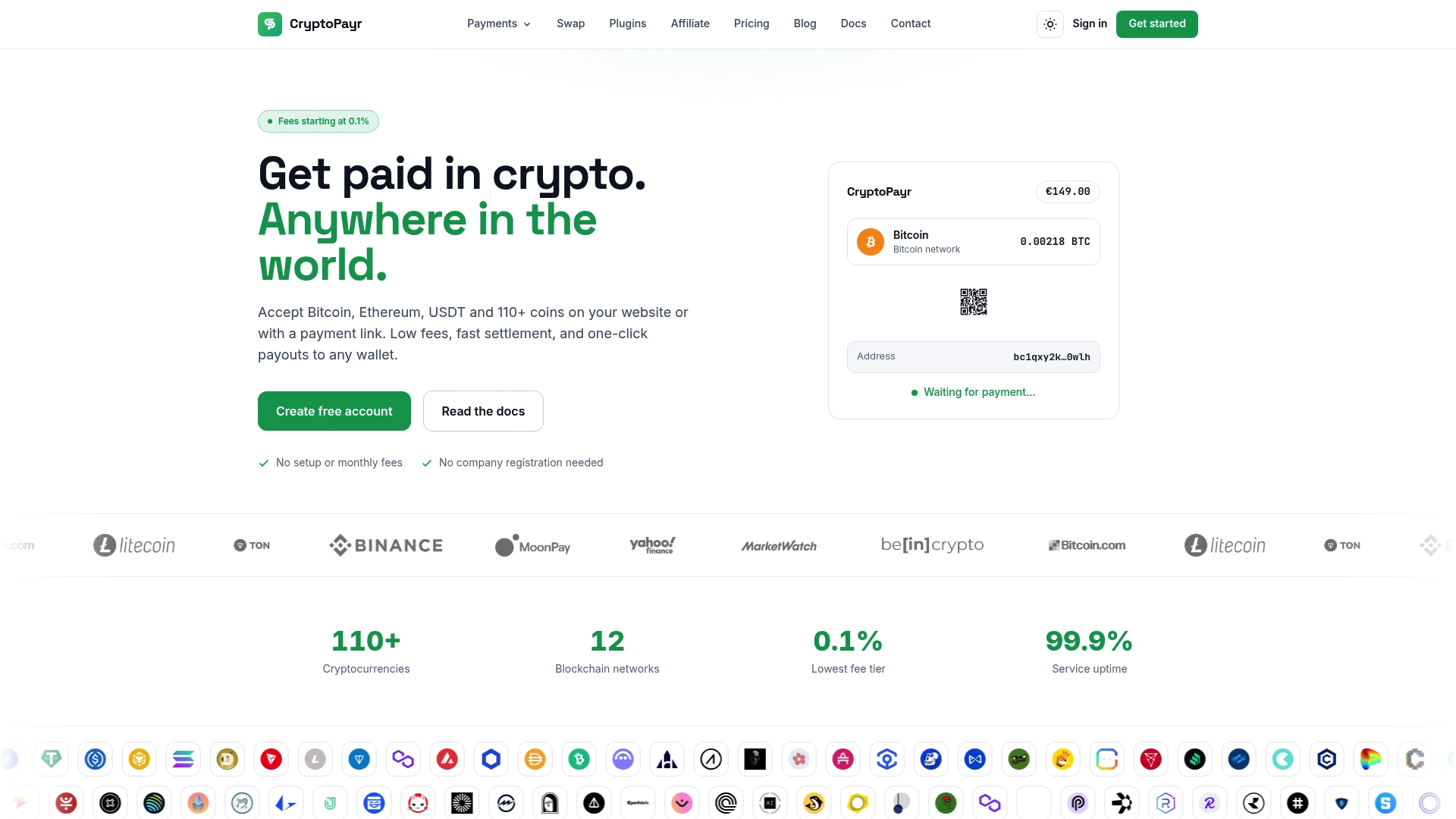
For platforms that need their own branded experience, the white-label gateway puts the full feature set under your brand. For teams ready to run a corridor cost comparison or start a sandbox pilot, the Cryptopayr gateway is the right starting point. Request access, run a test transaction end-to-end, and compare the landed cost against your current wire or card processing fees on the same corridor.
Frequently asked questions
What is the fastest way to start accepting international crypto payments?
Use a hosted checkout or payment link from a gateway like Cryptopayr. You can generate a payment link from the dashboard with no engineering work and start accepting payments on the same day. For a production integration, a hosted checkout with webhook notifications typically takes a few days to implement.
Are stablecoins better than Bitcoin for cross-border B2B payments?
For most B2B use cases, yes. Stablecoins eliminate the volatility risk that makes Bitcoin settlement complicated for invoicing and reconciliation. You receive a predictable USD-equivalent amount regardless of market movement during the settlement window.
How do I handle KYC requirements when accepting crypto payments internationally?
It depends on the gateway and your jurisdiction. Cryptopayr offers a no-KYC integration path for merchants in applicable markets, which reduces checkout friction. Your own KYC obligations as a business depend on your local regulatory requirements and the nature of your customers. Consult your legal team for jurisdiction-specific guidance.
What on-chain fees should I expect for stablecoin transfers?
Gas fees vary by network. Ethereum mainnet gas can reach several dollars per transaction during congestion. Ethereum L2 networks, Solana, XRPL, and Polygon typically keep gas under $0.10 in normal conditions. Chain selection is a meaningful cost decision for high-volume or low-value payment flows.
How long does it take to reconcile crypto payments in my accounting system?
With the right data fields captured at payment time (payment ID, on-chain hash, conversion rate, payout reference), reconciliation can be automated via webhook-driven GL posting. Manual reconciliation using gateway CSV exports typically takes minutes per batch rather than the hours that wire reconciliation can require.
Is crypto payment processing legal for businesses in all countries?
No. Regulatory status varies significantly by jurisdiction. Some countries restrict or prohibit businesses from accepting crypto payments; others have clear licensing frameworks. Always confirm the legal status in each country where you plan to accept or send payments before going live. This guide provides general information, not legal advice — confirm current rules with a qualified legal professional in your jurisdiction.
Sources
The sources below back the claims in this guide and are worth reading directly if you are building an internal business case or evaluating gateway options.
Recommended