Launch a Hosted Crypto Checkout in a Day with 110+ Coins
Launch a hosted crypto checkout fast with a merchant‑first plan: CryptoPayr supports 110+ coins, no‑KYC onboarding and fees down to 0.1%.
CryptoPayrSep 29, 202614.00 min read
Launch a Hosted Crypto Checkout in a Day with 110+ Coins
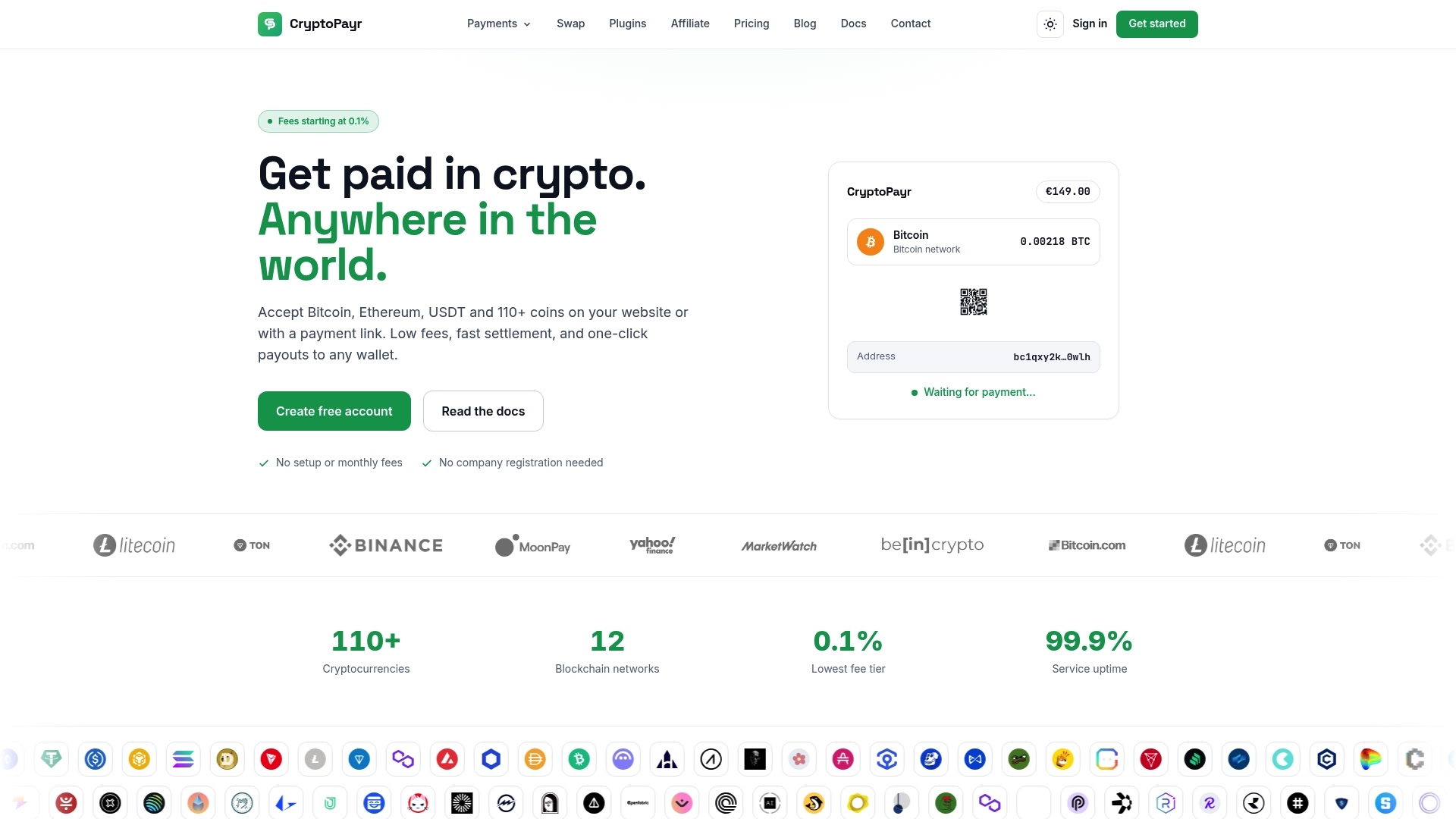
For merchants who want a working crypto payment page without weeks of setup, CryptoPayr is the practical choice: it supports over 110 cryptocurrencies, offers no-KYC onboarding, and charges fees starting at 0.1% according to its pricing page, all through a hosted checkout page. If you need a fuller comparison first, plugins, payment links, and API options are all available once you are ready to integrate.
TL;DR:
CryptoPayr’s hosted checkout supports over 110 cryptocurrencies with no-KYC onboarding and fees starting at 0.1%, enabling fast setup for merchants.
Key factors when choosing a provider include coin support matching customer holdings, webhook support, and settlement options like crypto, stablecoins, or fiat.
Testing in the sandbox environment, especially webhook reliability and reconciliation accuracy, is essential before processing live transactions.
Merchants should prioritize settlement preferences and compliance requirements, such as IRS reporting rules, before selecting a payment provider.
CryptoPayr offers the fastest onboarding for merchants who want quick deployment and scalable fees, with seamless plugin integrations for common e-commerce platforms.
Cryptopayr
Start Accepting 110+ Cryptocurrencies
CryptoPayr helps e-commerce, SaaS, gaming, and digital businesses add crypto payments through a user-friendly, no-KYC gateway.
What is a hosted crypto checkout and when should you use one
A hosted crypto checkout is a payment page the provider builds, hosts and maintains. Instead of coding a payment form yourself, you redirect the customer (or open a popup) to a page controlled by the gateway, where they pick a coin, get a wallet address or QR code, and confirm the transfer. The provider handles the wallet interaction, price conversion display and confirmation logic, so you never touch private keys or build a crypto-aware frontend.
For merchants, this matters because it removes most of the engineering burden. You are not maintaining node connections, tracking blockchain confirmations or building a UI that works across dozens of wallets. A hosted page also tends to launch faster: many merchants can go from signup to a live payment link in a single afternoon rather than a multi-week API integration.
Hosted checkout fits best when you want a self-service, low-maintenance setup: a single product page, an invoice link sent to a client, or a storefront where you would rather not touch code. An embedded or API-driven approach makes more sense when you need the payment experience to look and feel identical to the rest of your checkout flow, or when you are processing high volumes and want programmatic control over order creation and status.
Both one-time payments and recurring billing can run through a hosted page. For subscriptions, the provider typically generates a new invoice or payment request each billing cycle and notifies your system by webhook when it is paid, which keeps the subscription logic on your side simple.
How to choose a hosted crypto checkout provider
Picking a provider is mostly a matter of matching features to how your business actually operates. Work through this checklist before committing to one.
Feature checklist:
Confirm coin and network support matches what your customers actually hold, not just Bitcoin and Ethereum.
Check that the checkout UX shows clear pricing, a countdown timer and support for both desktop and mobile wallets.
Verify subscription or recurring billing support if you sell anything beyond one-time purchases.
Look for webhooks that fire on payment creation, confirmation and final settlement, not just a single “paid” event.
Business checklist:
Ask what settlement currencies are available: crypto, stablecoins or fiat.
Confirm payout timing (same day, next day or on a schedule) and whether it is consistent or varies by coin.
Check whether reconciliation and reporting exports are provided in a format your accounting software can ingest.
Understand the fee model: flat per-transaction, percentage-based or tiered by monthly volume.
Compliance checklist:
Ask whether the provider takes custody of funds during processing or simply routes wallet-to-wallet.
Clarify the KYC policy for merchants and, separately, for their end customers.
Ask how the provider handles law-enforcement requests and what data it retains.
Operational checklist:
Confirm plugin availability for your platform (WooCommerce, PrestaShop, OpenCart) if you are not building custom.
Test the sandbox environment before committing, and check the documentation quality while you’re there.
Ask about support response times and whether there is a formal service level agreement for critical issues.
Red flags worth walking away from: fee schedules that aren’t published anywhere, no webhook support at all, documentation that hasn’t been updated in years, or a provider that won’t let you test in a sandbox before going live.
Pro Tip:Run a $1 test transaction through the sandbox and production environment before launch, even if the provider swears everything works identically.
Setting up a hosted crypto checkout step by step
Most hosted checkout providers give you four ways to accept payment: a full hosted page redirect, a shareable payment link, a popup widget that overlays your existing checkout, or a minimal API call that creates an order and returns a payment URL. Which one you use depends on how much control you want over the customer experience versus how fast you want to launch.
A typical launch flow looks like this:
Create a merchant account and complete whatever onboarding the provider requires.
Configure your settlement preference: hold crypto, auto-convert to stablecoins, or settle in fiat.
Select which coins and networks you want to accept.
Run test transactions in the sandbox environment, checking that webhooks fire correctly.
Switch to production and process a small live transaction to confirm the full flow, from checkout to confirmation to settlement.
If you run an online store, plugin integrations shortcut most of this. WooCommerce, PrestaShop and OpenCart all support crypto checkout plugins that handle order creation and status updates automatically once installed. If you don’t have a developer on hand, CryptoPayr’s Webflow integration guide walks through adding a hosted checkout without writing code, and the general guide to accepting bitcoin payments covers the underlying mechanics if you want more context.
Before calling the integration done, test three things: that webhooks arrive for every payment state (created, confirmed, settled), that confirmation thresholds match your risk tolerance for high-value orders, and that your reconciliation export lines up with what actually hit your settlement account. The most common troubleshooting issue merchants hit is a webhook endpoint that times out or returns the wrong status code, which silently breaks order fulfillment even though the payment itself succeeded.
Pro Tip:Log every webhook payload for the first two weeks after launch. It’s the fastest way to catch a fulfillment mismatch before a customer complains.
Security, compliance and tax rules that affect your setup
Crypto payment processors increasingly sit inside the same reporting framework as traditional brokers. Beginning with transactions on or after January 1, 2025, certain digital-asset processors classified as brokers must report customer dispositions of digital assets on Form 1099-DA. Whether this applies to your specific setup depends on how the processor is structured and who is deemed to control the transaction, so it’s worth confirming directly with any provider you use rather than assuming either way.
Separately, the IRS FAQs on digital asset transactions cover basis identification for units held in hosted wallets when broker reporting rules don’t apply, along with the default identification rules added in December 2025. If your business holds crypto even briefly before converting or paying out, talk to an accountant about how these rules apply to your books.
On the technical side, Bitcoin developer documentation recommends moving away from the deprecated BIP70 payment protocol in favor of modern approaches like BIP21, since older protocols carry known security weaknesses.
Due diligence on partners matters too. The FBI’s reporting on the Tornado Cash case shows how transaction-obfuscation tools can complicate investigations and recovery, which is a good reason to vet any payment partner’s practices before routing volume through them.
Automated broker reporting under IRS rules now applies to transactions from January 1, 2025 onward, which means merchants should assume some processors will start issuing 1099-DA forms for qualifying activity.
Practical steps worth taking regardless of provider:
Retain transaction and webhook logs for at least as long as your tax records require.
Enable webhook signature verification so you can trust the events hitting your system.
Get an accountant familiar with digital assets involved before your first tax filing that includes crypto revenue.
How fees and settlement choices affect your cashflow
Hosted checkout providers usually price one of three ways: a flat fee per transaction, a percentage of transaction value, or a tiered percentage that drops as your monthly volume grows. CryptoPayr’s own fee structure runs from a Standard tier at 2% per month down to Enterprise at 0.1% per month based on volume, alongside a flat $0.10 per-payment option for merchants who prefer a fixed cost per transaction.
Settlement choice is the other lever that affects your bottom line. You can hold the crypto you receive, auto-convert it to stablecoins to avoid price swings, or settle straight to fiat. Holding crypto means you’re exposed to price movement between receipt and whenever you eventually convert or spend it. Auto-converting to stablecoins removes that exposure while keeping you inside the crypto rail. Fiat settlement removes it entirely but usually adds a conversion spread and a settlement delay.
That spread is worth interrogating before you commit to a provider. A small percentage difference on every transaction adds up quickly at volume, and it often isn’t itemized the same way a processing fee is.
Before signing up, ask any provider:
What is the actual spread on instant conversion, separate from the processing fee.
How often payouts run and whether timing is consistent across coins.
What format the reconciliation export uses and whether it maps to standard accounting software.
Why CryptoPayr fits merchants who want to move fast
A provider supports a broad range of cryptocurrencies including major ones, with no-KYC onboarding for merchants and scalable fees. The hosted checkout, payment links and API sit alongside plugin support, so a merchant running WooCommerce or a no-code Webflow site can get a working payment page without a developer on staff.
The Webflow launch guide and platform-specific plugin pages exist specifically to shortcut integration time for merchants who don’t want to build from raw API calls. CryptoPayr’s stated results, based on its own client outcomes, point to faster transaction processing, lower fees than traditional processors, and improved customer satisfaction from merchants who adopted the gateway.
Before committing, it’s worth confirming directly with CryptoPayr’s team a few specifics that vary by business: exact payout timing for your settlement currency, which fiat conversion partners are available in your region, and any region-specific compliance considerations that apply to your business type.
How CryptoPayr stacks up against other hosted checkout providers
Coinbase Commerce, BitPay and CoinGate are the names most merchants encounter first when researching hosted crypto checkout. Coinbase Commerce integrates tightly with the Coinbase ecosystem and is straightforward to set up, though merchants sometimes find its coin selection narrower and its fee structure less flexible for high-volume sellers. BitPay has a long track record and strong fiat settlement options, but has historically required more identity verification during onboarding, which slows launch for merchants who want to start quickly. CoinGate supports a wide range of coins and plugins similar to CryptoPayr, with settlement flexibility that appeals to European merchants in particular, though its fee tiers can be less favorable at lower volumes.
Where CryptoPayr differentiates is the combination of no-KYC merchant onboarding, a broad 110-plus coin list, and fees that scale down to 0.1% at higher volume, without requiring a lengthy verification process before your first transaction. For a merchant who wants to test hosted checkout without a multi-day approval wait, that combination matters more than marginal differences in supported coin count. None of these providers is wrong for every merchant. The right pick depends on how fast you need to launch, how much identity verification you’re willing to complete up front, and which settlement currencies your accounting setup already expects.
What actually matters when you pick a checkout provider
Most merchants overthink coin selection and underthink settlement friction. It rarely matters whether a provider supports 40 coins or 110: what matters is whether your actual customers use any of them, and whether the money lands somewhere useful without a spread eating the margin. The providers that get recommended most often aren’t necessarily the fastest to set up. They’re the ones with the longest track record, which isn’t the same thing as the best fit for a merchant trying to launch this week.
My honest read: the no-KYC onboarding path that CryptoPayr and a handful of others offer is underrated by merchants who assume more verification always means more legitimacy. It does not. It means a longer wait. Verification exists to satisfy compliance obligations, not to guarantee a better payment experience.
If you take one thing from this guide, decide your settlement preference before you pick a provider, not after. Everything else, coin list, plugin availability, fee tier, is easier to compare once you know whether you want crypto, stablecoins or fiat hitting your account.
Three moves worth making this week: settle on a settlement preference, run a sandbox test with webhooks enabled, and pilot a small batch of real transactions before routing full volume through any single provider. If you run a marketplace or operate in a higher-risk sector, talk to a provider’s sales team directly about payout structure before committing.
— Dustin
Get your hosted checkout live this week
CryptoPayr’s hosted checkout, payment links and API let you accept over 110 cryptocurrencies without a KYC wait, with fees that drop to 0.1% at scale. Marketplaces and platforms can add mass payouts for splitting commissions automatically.
Test the sandbox, review the pricing tiers, or contact the CryptoPayr team about a custom integration for your platform.
This article is general information, not a substitute for advice from a qualified financial advisor. Consult a qualified financial professional about your own circumstances before acting on anything here.
The IRS can access wallet and transaction information through broker reporting requirements and blockchain analysis, particularly as processors classified as brokers begin filing Form 1099-DA for qualifying transactions. Taxpayers are also required to answer the digital asset question on their returns, per IRS guidance.
Can the FBI track a Bitcoin wallet?
Law enforcement can trace Bitcoin transactions on the public blockchain, though tools like mixers can complicate that process, as seen in the FBI’s investigation into Tornado Cash. Recovery becomes harder, not impossible, when obfuscation tools are involved.
Can I pay for web hosting with crypto?
Many hosting providers now accept cryptocurrency directly or through a payment gateway integration, though availability depends on the specific host. Checking your hosting provider’s payment page or asking their support team directly is the fastest way to confirm.
What is the best crypto payment gateway for merchants?
The best gateway depends on how fast you need to launch and how much verification you’re willing to complete first. CryptoPayr suits merchants who want no-KYC onboarding, support for over 110 coins, and fees starting at 0.1% at volume, while providers like Coinbase Commerce, BitPay and CoinGate suit merchants with different settlement or verification priorities.
How long does it take to launch a hosted crypto checkout?
Most merchants can go from signup to a live hosted checkout page within a single day when using plugins or payment links, since no custom development is required. A full API integration with custom order logic typically takes longer depending on your development resources.