$500 Rule for Merchants: On Chain vs Off Chain Payments
On-chain payments write value directly into a blockchain’s ledger, giving you public, immutable finality at the cost of fees and confirmation delays. Off-chain payments settle outside that main ledger, through channels, rollups, or custodial books, trading some of that trust guarantee for speed and near-zero cost. The rule of thumb: route high-frequency, low-value transactions off-chain, and reserve on-chain settlement for high-value transfers where irreversibility actually matters.
TL;DR:
- Off-chain solutions like payment channels and rollups offer near-instant, low-cost transactions but introduce risks related to operator dependence and withdrawal delays.
- High-value transfers should still use on-chain settlement due to the irreversibility and public verification it provides, especially with longer finality times on networks like Ethereum.
- Micro and high-frequency payments are best routed off-chain through custodial ledgers or channels to avoid high gas fees and confirmation delays.
- The choice between off-chain and on-chain depends heavily on transaction value, speed needs, finality requirements, and operator trustworthiness.
- Hybrid architectures combining internal ledgers with periodic on-chain settlement are the most common, with transaction routing rules based on dollar thresholds to simplify operations.
Table of Contents
Understanding On-Chain Transactions: Mechanics, Security, and Fees
An on-chain payment starts when a wallet signs a transaction and broadcasts it to the network. Validators or miners pick it up, check it against consensus rules, and bundle it into a block. Once that block gets buried under enough subsequent blocks, the transaction becomes practically irreversible. That’s the entire appeal: no bank, no processor, no single party can quietly reverse or alter it after the fact.
This is what on-chain transactions trade in exchange for slower processing: trust-minimization and a public audit trail anyone can verify independently, without asking permission from the network operator.
Finality timing depends heavily on which chain you’re using. Ethereum mainnet typically finalizes transactions within minutes under its proof-of-stake consensus, while other networks range from seconds to well over ten minutes depending on block time and confirmation depth required.
Fees move with congestion, not with the payment amount. A quiet Tuesday afternoon might cost you a few cents in gas; a hyped NFT mint or a market crash can spike that same transaction into double digits. A few things drive that swing:
- Network demand at the moment of broadcast (more competing transactions means higher bids to get included)
- The complexity of the transaction itself (a simple transfer costs less than a smart contract call)
- Priority fees you attach to jump the queue during busy periods
Gas costs aren’t linear with payment size. A $10 transfer and a $10,000 transfer on the same congested network can cost the exact same gas fee, which is why micro-payments rarely make sense settled directly on a base layer chain.
Understanding Off-Chain Transactions: Who Enforces the State?
Off-chain payments move value without writing every step to the main ledger, and the mechanism enforcing that value differs wildly depending on the setup. That difference in enforcement is the single most important thing to understand before choosing an off-chain route.
Four common forms dominate the space:
- Custodial ledgers: an operator keeps an internal database of balances, similar to a bank’s back office, and settles net positions on-chain only periodically
- Payment channels: two parties lock funds on-chain, then exchange signed updates privately, settling the final balance on-chain only when the channel closes
- Layer-2 execution (rollups): transactions process on a separate execution layer that periodically posts proofs or batches back to the base chain
- Sidechains: independently operated chains with their own validator set and consensus rules, bridged to the main chain
Trust models vary sharply across those four. A custodial ledger asks you to trust the operator outright, the way you trust a bank. A rollup inherits security from the underlying chain to different degrees depending on its design, with cryptographic proofs offering stronger guarantees than optimistic fraud-proof models. A sidechain runs its own validator set, meaning its security is only as strong as that separate network’s own incentives and decentralization.
The upside across all four: latency drops to near-instant, cost drops to fractions of a cent, and privacy improves since intermediate steps stay off the public ledger. The catch is reversal risk and operator dependency. A payment channel needs both parties online and honest; a custodial ledger needs the operator solvent and not compromised; and every off-chain balance eventually needs an on-chain settlement to become truly final.
Types of Off-Chain Solutions and How They Differ
Not all off-chain systems carry the same risk profile, and confusing them is where a lot of merchants get burned. Here’s how the four main architectures actually stack up.
-
Payment channels give you instant transaction confirmation because nothing touches the base chain until the channel opens or closes. The trade-off is that funds are locked in that channel until settlement, and both parties need to stay reachable to update balances honestly.
-
Optimistic rollups batch thousands of transactions and post them to the base layer with an assumption of validity, challengeable within a window. That challenge period is the catch: optimistic rollups typically carry multi-day withdrawal windows before funds are fully spendable on the base layer.
-
ZK rollups batch transactions the same way but attach a cryptographic proof of correctness upfront, which lets them finalize to the base chain far faster than optimistic designs, without waiting out a challenge period.
-
Sidechains run entirely separate consensus, meaning throughput and cost look great, but security depends on that chain’s own validator set rather than inheriting anything from a more established network.
-
Custodial or internal ledgers are the fastest and cheapest of the bunch because nothing hits a public chain at all during normal operation, but that speed rests entirely on trusting the operator’s solvency and honesty.
Pro Tip: Before choosing a rollup for a payment product, check its withdrawal window explicitly. A ZK rollup and an optimistic rollup can look identical in a demo, but one lets a customer withdraw in minutes and the other might make them wait days during a dispute period.
Key Trade-offs: Speed, Cost, Finality, and Risk
Five dimensions determine whether a payment method actually works for your business, and they rarely all favor the same option.
Speed ranges from sub-second on custodial ledgers and payment channels, to a few minutes for most L1 finality, up to multiple days for an optimistic rollup’s challenge period before funds move freely to the base layer.
Cost swings just as widely. Layer-2 transfers commonly run from a fraction of a cent to a few cents after recent data-posting improvements, while equivalent base-layer transfers can run anywhere from a few cents to several dollars depending on congestion.
Finality and settlement certainty aren’t the same thing. A checkout confirmation on an L2 might feel instant to the customer, but if that L2 uses an optimistic model, the merchant’s actual claim on the underlying asset isn’t fully settled until the challenge window closes.
- Checkout UX suffers when customers wait several minutes for L1 confirmation on a $15 purchase
- Refund logistics get complicated when a payment is “confirmed” on L2 but not yet withdrawable to L1
- Accounting and tax reporting need a defined finality point, not just a wallet balance that updates in real time
- Privacy is generally better off-chain, since intermediate transaction details stay outside the public ledger, though the final settlement transaction usually is visible
Operational risk rounds out the list: an off-chain system depends on an operator’s uptime and honesty, while an on-chain system depends only on the underlying network staying live and uncensored.
A Decision Framework for Choosing Payment Rails
Most merchants overthink this. The right choice usually comes down to two numbers: how much the payment is worth and how often it happens.
-
Micro and high-frequency payments (tips, in-app purchases, gaming credits, pay-per-use API calls) belong off-chain almost automatically. Routing these through a custodial ledger or payment channel avoids fee erosion and latency entirely, since gas costs on a base chain would often exceed the payment itself.
-
Mid-value transactions (typical e-commerce checkouts, subscription renewals) do well on a Layer-2 rollup, where confirmation feels near-instant and fees stay negligible, with periodic settlement to the base chain handling final reconciliation.
-
High-value, one-off settlements (large B2B invoices, real estate deposits, escrow releases) belong on-chain directly. The extra minutes and higher fee are worth it for the irreversibility and public verification a buyer or auditor might demand.
-
Payroll and mass payouts often work best as a hybrid: batch payouts internally, then settle the net total on-chain once per cycle rather than sending hundreds of individual on-chain transactions.
Pro Tip: Set a dollar threshold in your own system, something like $500, below which everything routes off-chain by default and above which it routes to on-chain settlement. It removes the guesswork from every transaction and gives your accounting team a consistent rule to audit against.
Hybrid Architectures: How Production Payment Systems Actually Work
Almost no serious payment operation picks purely on-chain or purely off-chain. Production systems typically run an internal ledger for day-to-day transactions and settle net positions on-chain periodically, which is the pattern behind most crypto checkout experiences that feel instant to the customer.
Three patterns show up repeatedly across real deployments:
- Internal ledger plus batch settlement: every transaction updates an internal database instantly, and the operator nets out balances to the base chain once daily or on another fixed schedule
- Threshold routing: transactions above a set dollar amount go straight on-chain for immediate settlement, while everything below the threshold batches together
- Layer-2 execution with periodic L1 checkpoints: rollups process the bulk of activity while relying on the base chain’s security through regular checkpoint transactions, giving merchants L1-grade guarantees without paying L1 fees on every transaction
Whichever pattern you run, reconciliation can’t be an afterthought. Withdrawal windows on optimistic rollups, sequencer delays on some L2s, and settlement lags on custodial ledgers all mean the balance a dashboard shows isn’t always the balance you can spend right now. Serious operators track proof-of-reserve where it’s available and monitor withdrawal timing as closely as they monitor uptime.
How to Evaluate a Payment Solution: Checklist and Red Flags
Before committing to any gateway or architecture, ask who actually controls the keys during settlement, and how funds and customer data are kept separate from operating capital. Then check the settlement model: does it post to the base chain immediately, batch on a schedule, or run through an L2 with a withdrawal window you need to plan around?
Pro Tip: Treat an opaque reconciliation process as a hard red flag. If a provider can’t explain exactly when your funds move from “confirmed” to “spendable,” you’re the one absorbing that timing risk, not them.
Dispute Resolution and Fraud Prevention Off-Chain
Off-chain systems can’t rely on blockchain immutability to settle disagreements, since the whole point is that most activity never touches the public ledger until settlement. That gap gets filled by contractual and technical safeguards instead.
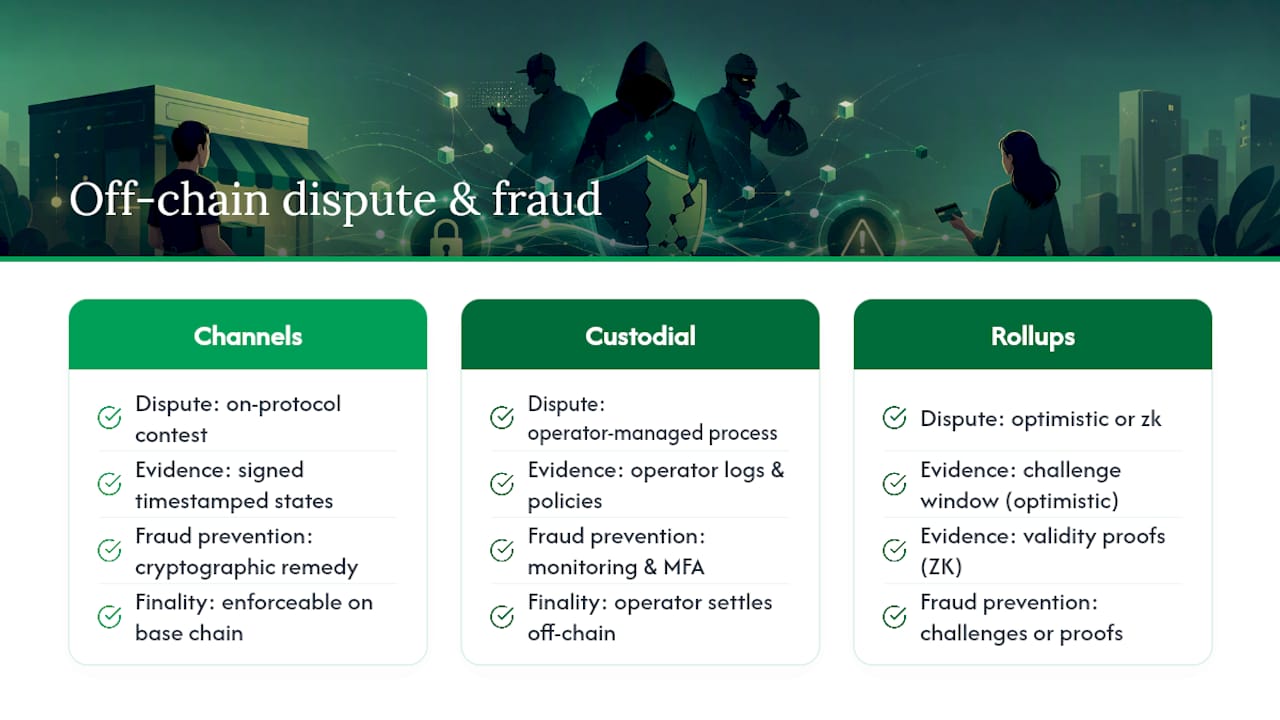
Payment channels build dispute resolution into their protocol: each party holds a signed, timestamped copy of the latest balance, and if a counterparty tries to broadcast an outdated state, the honest party can submit their newer signed state to the base chain and claim the correct balance. That’s a cryptographic remedy, not a customer service ticket.
Custodial ledgers work differently. Disputes go through the operator directly, similar to a chargeback process with a card network, which means the operator’s own policies, transaction logs, and reputation carry the weight a blockchain would otherwise carry. Fraud prevention here leans on the same tools used across digital payments broadly: transaction monitoring for unusual patterns, rate limits on withdrawals, and multi-factor authentication on account access.
Rollups sit in between. Optimistic designs build fraud prevention directly into their challenge period, letting any observer submit proof that a batch was invalid before it finalizes. That window is the dispute mechanism itself, not a separate process layered on top. ZK rollups skip this entirely by requiring mathematical proof of validity before a batch posts at all, which removes the need for a challenge period but adds computational overhead.
Wallet Compatibility and the Onboarding Experience
The single biggest drop-off point in crypto payments isn’t price or trust, it’s friction at the wallet step. A customer who has to install a browser extension, fund a new wallet, and understand gas fees before completing a $30 purchase will often abandon the cart entirely.
On-chain checkout usually means the customer needs a compatible wallet already funded on the right network, and picking the wrong network is a common, costly mistake that can strand funds. Off-chain and custodial flows soften this considerably: a hosted checkout page can accept a payment and handle network selection, conversion, and confirmation behind the scenes, letting the customer interact with something closer to a familiar checkout form.
That difference in onboarding friction is a major reason off-chain and hybrid rails dominate consumer-facing checkout, while on-chain settlement stays more common in B2B contexts where the counterparty already runs a wallet as a matter of course. Merchants choosing between a hosted checkout, a plugin, or a direct API integration are really choosing how much of that wallet complexity they want to absorb on behalf of their customer versus expose directly.
Regulatory and Compliance Considerations
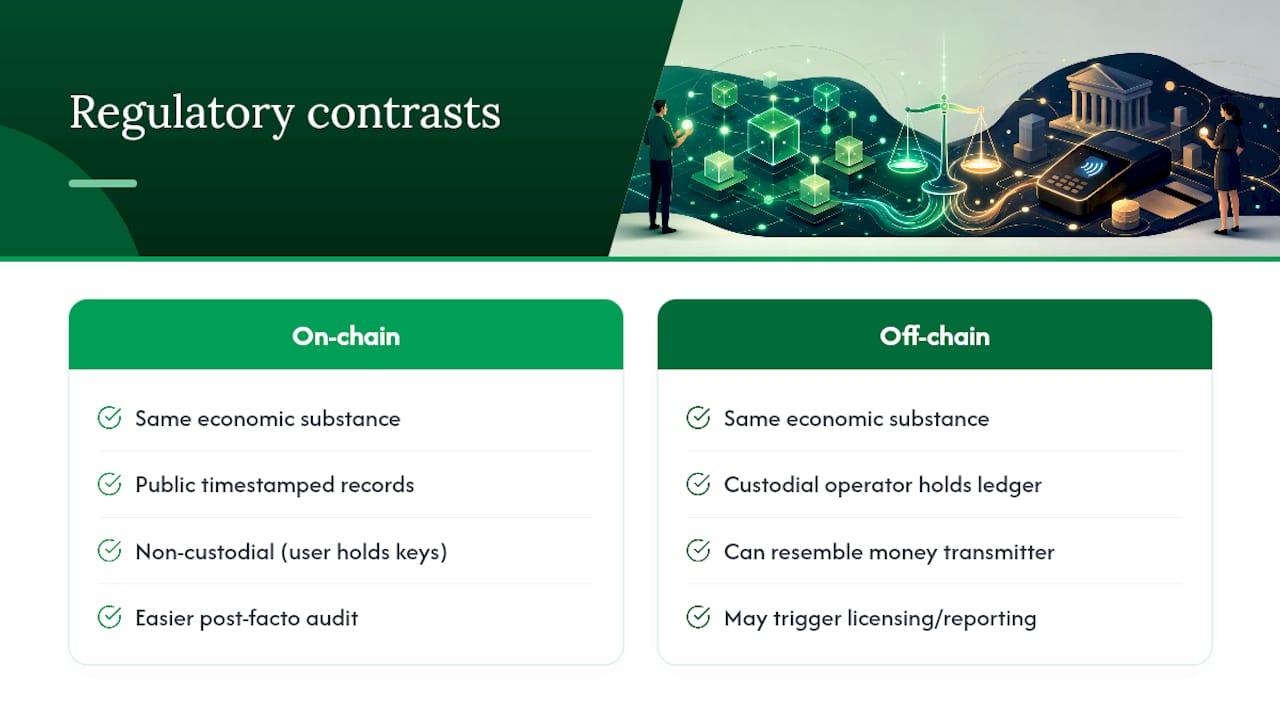
Regulatory treatment of a payment doesn’t change because it happened off-chain instead of on-chain. Tax authorities and financial regulators in most jurisdictions care about the economic substance of a transaction, not which ledger recorded it. A sale is a sale whether it settles instantly on a base chain or nets out through a custodial ledger at the end of the day.
Where the distinction matters is recordkeeping and custody. Custodial off-chain ledgers put the operator in a position that can resemble a money transmitter or payment processor in the eyes of regulators in various jurisdictions, which can trigger licensing or reporting obligations that a purely non-custodial on-chain flow might not. On-chain transactions, by contrast, leave a public, timestamped record that’s straightforward to audit after the fact, even if attributing that record to a specific legal entity requires additional off-chain documentation.
Merchants operating across borders should treat this as jurisdiction-specific rather than assume one rule applies everywhere. A no-KYC gateway, a fully custodial exchange, and a self-hosted wallet each sit in different regulatory categories depending on where the merchant and customer are located, and the safest approach is confirming obligations with a qualified professional in each relevant market rather than assuming crypto payments sit outside conventional payment regulation entirely.
What Merchants Actually Choose in Practice
Hybrid flows aren’t a compromise, they’re the default every serious merchant lands on eventually. Pure on-chain checkout sounds appealing until the first customer abandons a cart waiting on confirmation, and pure off-chain custody sounds appealing until an accountant asks for a clean, final settlement record.
What we see work best is UX-first thinking: let the customer experience feel instant, then handle finality and accounting on the back end where the customer never has to see it. That’s the entire logic behind supporting hosted checkout, API integration, and mass payouts side by side, rather than forcing one architecture on every merchant.
— Dustin
Get Paid in Crypto Without Picking Sides
You don’t have to choose one rail and live with it. Cryptopayr lets merchants accept 110+ cryptocurrencies, including Bitcoin and Ethereum, with fees starting at 0.1% and no KYC slowing down setup.
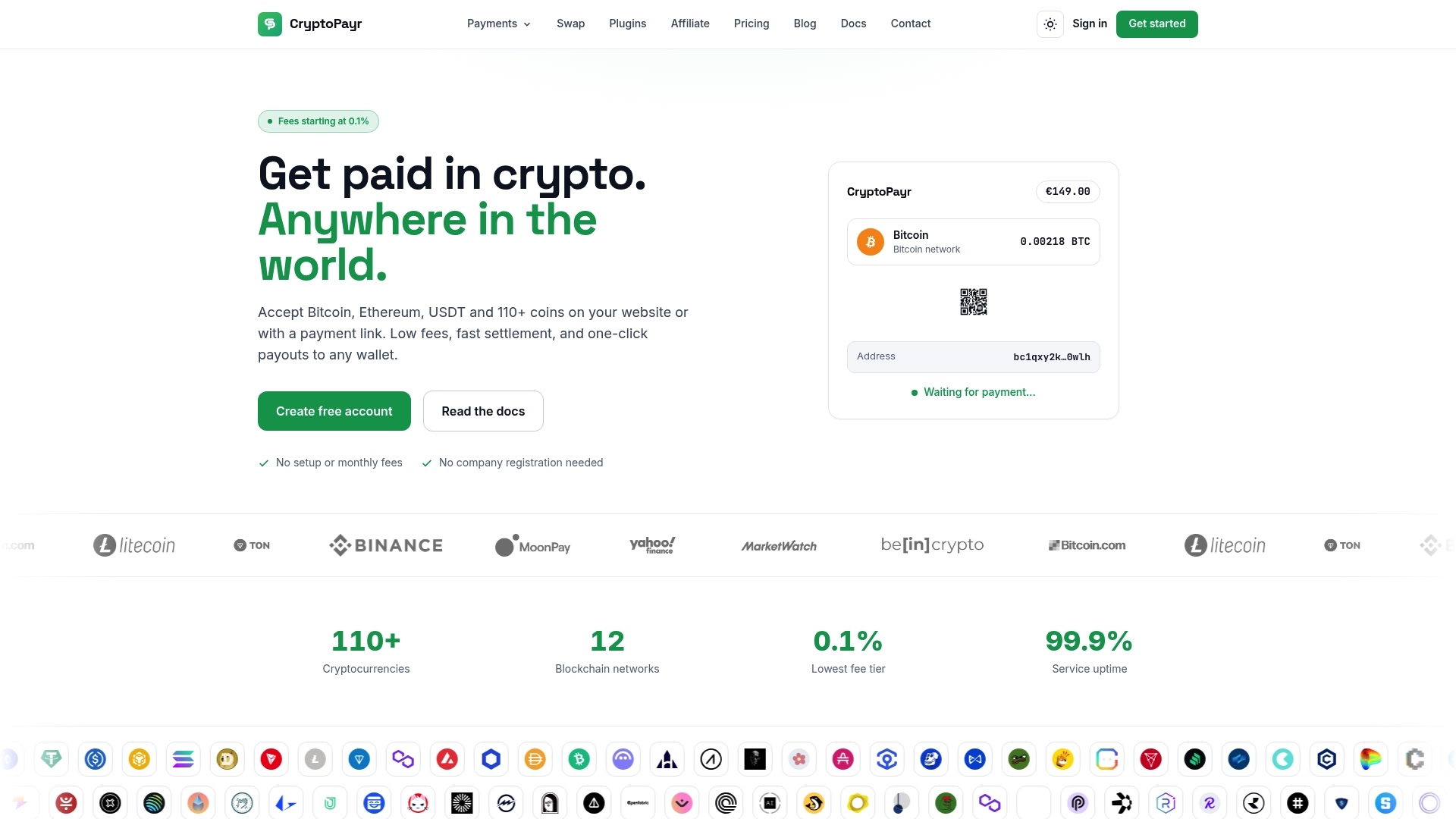
Different integration options like hosted checkout pages, payment links, or direct API access allow teams to choose how much control they want over payment settlement timing. Some platforms offer features like auto-conversion to stablecoins to help manage volatility during marketplace payouts or recurring billing.
If you’re weighing a plugin against a direct API for your own payment stack, start with the gateway overview to see which integration matches your volume and control needs, or check the supported coins page to confirm your customers’ preferred currencies are covered before you commit to an architecture.
Sources
Recommended


