White Label Crypto Payments: Fast Setup for Business
For most merchants and fintech teams, a white label crypto payment gateway is the right first move. Building a custom gateway from scratch means months of engineering work across wallet management, reconciliation, security, and monitoring — overhead that most teams avoid by choosing a platform. A white-label solution cuts that to days or weeks, gives you full brand control, and supports settlement in crypto, stablecoins, or fiat from day one.
Three reasons this approach wins for most buyers:
- Time-to-market: Hosted checkout and pay links can go live very quickly. A full API integration typically takes a couple of weeks.
- Coin coverage: Leading providers support 100+ cryptocurrencies, including Bitcoin and major stablecoins like USDT and USDC, without you managing individual blockchain nodes.
- Settlement flexibility: Auto-conversion to stablecoins or fiat protects you from volatility without requiring a separate treasury operation.
Your next step: map your integration needs (hosted checkout, plugin, or API), then evaluate providers against the checklist in this guide. Cryptopayr’s white-label gateway is a strong starting point for most teams.
Key Takeaways
| Point |
Details |
| White-label beats building |
Custom gateway development requires months of engineering; white-label cuts launch to days or weeks. |
| Start with hosted checkout |
Hosted checkout and pay links go live fastest; migrate to API once volume and UX needs justify it. |
| Verify security controls |
Require 2FA enforcement, independent audits, and a documented custody model before signing. |
| Watch the full fee picture |
Headline transaction rates matter less than settlement schedule, conversion spreads, and hidden routing fees. |
| Cryptopayr as a starting point |
Fees from 0.1%, 110+ coins, no-KYC option, and full API with plugins cover most merchant and platform needs. |
Table of Contents
What is a white-label crypto payment gateway?
A white-label crypto payment gateway is a ready-built payment infrastructure that you brand as your own. It typically includes a hosted checkout page, an API for embedded flows, e-commerce plugins, and custody or settlement options — all presented under your logo and color scheme rather than the provider’s.
The contrast with direct wallet-to-wallet acceptance is significant. Accepting crypto directly means you manage key storage, track incoming transactions manually, handle reconciliation, and build your own confirmation logic. A white-label gateway handles all of that, plus KYC and AML compliance frameworks where required, and gives you a dashboard to manage it.
Compared to building a custom gateway, the difference is cost and speed. Custom development covers wallet management, reconciliation, monitoring, and security from scratch. A white-label provider has already solved those problems. You get the infrastructure; you own the brand experience.
Practical benefits that matter immediately: your customers see your brand at checkout, you can settle in fiat or stablecoins without a separate conversion step, and you launch in days rather than quarters. For a deeper look at how this product category works, the CryptoPayr blog covers the definition and integration options in detail.
Core features to expect from white-label crypto payments
Not every provider offers the same depth. Before shortlisting, confirm these capabilities are present:
- API-first integration with webhooks, SDKs, and sandbox/testnet access for pre-launch validation.
- Hosted checkout and pay links for merchants who need a fast path to accepting payments without embedding code.
- E-commerce plugins for platforms like WooCommerce, WHMCS, and others — critical for teams without dedicated engineering resources.
- Settlement options: settle in the received cryptocurrency, auto-convert to a stablecoin like USDT, or convert to fiat. Stablecoin settlement is increasingly common as a volatility hedge.
- Custody choices: non-custodial merchant wallets, provider-managed hot/cold custody, or MPC-managed keys. Each carries different speed and control trade-offs.
- Recurring billing and subscription support for SaaS and membership platforms.
- Mass payouts for marketplaces and platforms disbursing to multiple recipients.
- Marketplace split payments to route commissions automatically at settlement.
- Reporting and reconciliation tools with exportable transaction logs and webhook-based event streams.
- Branding controls: hosted checkout styling, iframe embedding, or fully white-labeled flows with your domain and design system.
Bitcoin settlement behaves differently from stablecoins: confirmation times and on-chain fees vary with network congestion, so your provider’s handling of confirmation thresholds matters. Ask specifically how they manage unconfirmed transactions and what finality rules they apply.
How you integrate a white-label gateway and typical time-to-market options
Three integration paths cover most use cases, and the right one depends on your engineering capacity and how much brand control you need.
- Hosted checkout (fastest): the provider generates a payment page at a unique URL. You redirect the customer there, the provider handles blockchain confirmation and settlement, and you receive a webhook when payment is complete. Live in hours, not days.
- Plugins and pay links (fast for e-commerce): install a plugin for your platform or generate shareable payment links. No custom code required. Reusable pay links work well for freelancers and small merchants who invoice manually.
- API/SDK integration (fully embedded): your UI, your flow, your brand at every step. More engineering work, but the customer never leaves your product. Most teams start with hosted checkout and migrate to API once volume and UX requirements justify the investment.
| Integration path |
Typical time-to-live |
Engineering effort |
| Hosted checkout |
Hours to 2 days |
Minimal |
| Plugin or pay link |
1–3 days |
Low |
| API/SDK (embedded) |
1–2 weeks |
Medium to high |
| Full white-label licensing |
2–4 weeks |
High |
Before going live, work through this checklist:
- Confirm webhook reliability: test delivery, retry logic, and failure alerts in the sandbox.
- Validate quote locking: check how long a price quote is held before it expires and the customer must re-initiate.
- Run testnet transactions for every coin you plan to support.
- Map reconciliation: confirm transaction IDs match between the provider dashboard and your internal records.
- Set up notifications for failed, pending, and confirmed payments.
Pro Tip: Start with hosted checkout and pay links to validate demand and reconciliation before committing engineering time to a full API integration. Once monthly volume justifies it, migrate to the embedded flow for a better customer experience.
How funds are secured, custody models, and security controls you must verify
Custody is where most buyers underestimate the complexity. Three models exist, and each changes your risk profile:
- Non-custodial merchant wallets: funds go directly to a wallet you control. The provider never holds your crypto. Maximum control, but you own key management and recovery.
- Provider custody (hot/cold mix): the provider holds funds in a combination of hot wallets (for fast settlement) and cold storage (for security). Faster settlement, but you carry counterparty risk.
- MPC-managed keys: multi-party computation splits key control between you and the provider. No single party can move funds unilaterally. A strong middle ground for teams that want speed without full counterparty exposure.
Security controls to verify before signing:
- Encryption at rest and in transit (TLS 1.2 or higher, AES-256 at rest).
- Hardware security modules (HSMs) for key storage.
- Independent security audits with published reports.
- Two-factor authentication (2FA) enforced for all admin accounts — a basic control that significantly reduces account takeover risk.
- Documented incident response procedures and uptime SLAs.
Ask for the provider’s most recent audit report. If they cannot produce one, that is a disqualifying signal. For more on how Cryptopayr handles fund security and data protection, the security overview covers custody and controls in detail.
Typical pricing shapes for white-label crypto payment services
Fee structures vary more than most buyers expect. The common models:
Per-transaction percentage: the most common structure. Fees typically tier down as monthly volume increases.
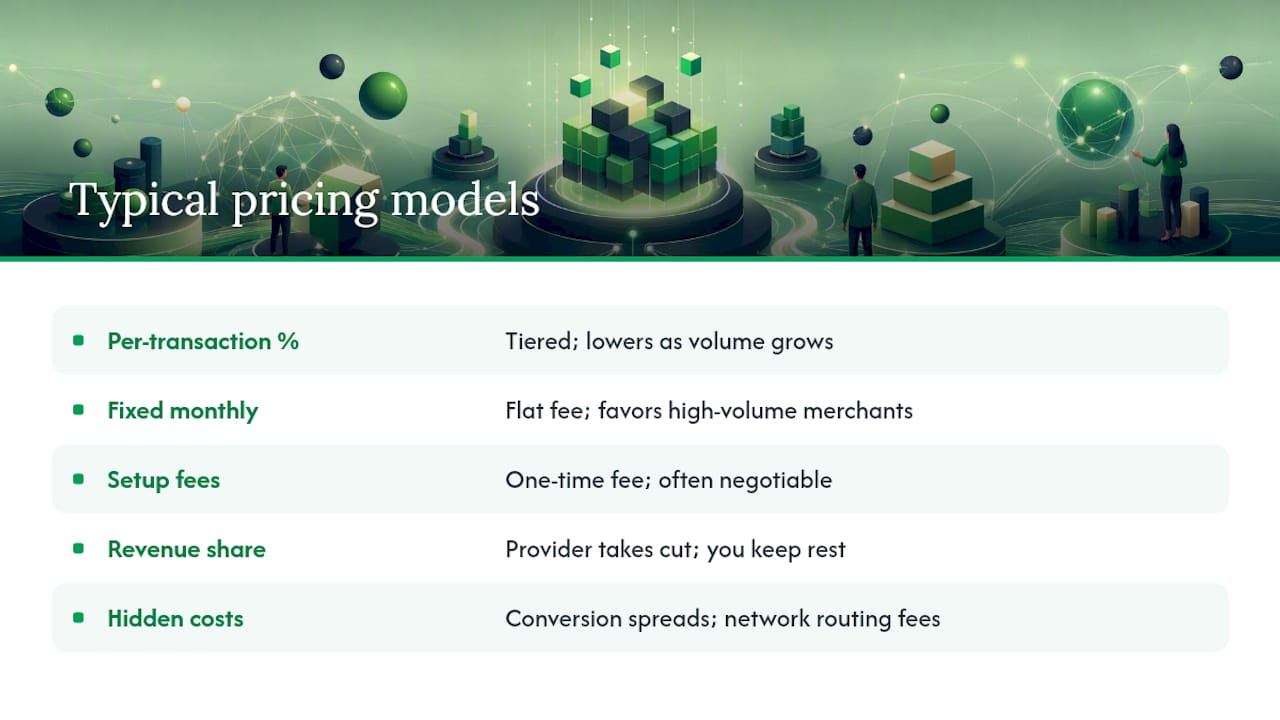
Fixed monthly licensing: some providers charge a flat platform fee, sometimes alongside a lower per-transaction rate. This model favors high-volume merchants where the per-transaction savings offset the fixed cost.
Setup and integration fees: one-time costs for white-label licensing, custom branding work, or dedicated onboarding. These vary widely and are often negotiable.
Revenue share: relevant for agencies or platforms reselling payment services. The provider takes a cut of transaction fees; you keep the rest.
Watch for costs that don’t appear in the headline rate. Auto-conversion from crypto to fiat or stablecoins often carries a spread on top of the transaction fee. Routing fees for specific networks (EVM chains, Solana, Tron) can add up at volume. Ask your sales contact for a full fee schedule, not just the headline percentage.
Questions to ask before signing: What is the minimum monthly volume commitment? What is the settlement schedule (daily, weekly, on-demand)? How are chargebacks or disputed transactions handled? Are there fees for refunds or failed transactions?
White-label licensing changes the cost structure meaningfully. Setup and licensing costs are higher upfront, but per-transaction fees are often lower at scale. Run the math at your projected monthly volume before comparing offers.
Which business types benefit most from white-label crypto payments
The fit is clearest for four categories:
- E-commerce merchants who want a crypto checkout option alongside card payments. Customers holding Bitcoin or stablecoins can pay without the merchant managing wallets or conversion.
- SaaS platforms and marketplaces needing subscription billing, instant cross-border settlement, or mass payouts to multiple recipients. Crypto rails avoid the card network fees and geographic restrictions that block international growth. For SaaS specifically, crypto payments solve card failure problems that cost real revenue.
- Gaming and digital marketplaces where fast in-product settlement and token support matter. Players and creators expect near-instant payouts; blockchain settlement can deliver that without a bank intermediary.
- Agencies and brands building a payment experience for clients. A white-label gateway lets an agency offer branded crypto payments as a service without building or maintaining the underlying infrastructure.
High-risk industries also benefit significantly, since crypto payment rails often remain available where card processors decline to operate.
Selection checklist and red flags: what to evaluate and what to avoid
A short, structured evaluation prevents expensive mistakes after launch.
Decision checklist:
- Integration modes available (hosted, plugin, API, embedded)
- Supported coins and networks (count matters less than coverage of the coins your customers actually hold)
- Custody model and key management approach
- Settlement options and schedule (daily, on-demand, threshold-based)
- Uptime SLA with documented historical performance
- Reconciliation tools and export formats
Vendor questions for sales and engineering: Does the sandbox mirror production behavior? What is the webhook retry policy and failure notification process? How does the provider support KYC and AML obligations for regulated use cases? What is the incident response time and escalation path?
Red flags that should stop a shortlisting process:
- Opaque fee language with no written fee schedule
- No independent security audit or refusal to share one
- Payout schedules longer than 72 hours with no on-demand option
- No reconciliation export or API for transaction data
- Support only via email with no SLA commitment
Running a short pilot: measure settlement time from payment confirmation to funds available, error rate on webhook delivery, and reconciliation mismatch rate between the provider dashboard and your records. A clean pilot over two to four weeks tells you more than any sales call. Review platforms like G2 and Trustpilot can surface operational pain points from other merchants — treat them as signals to probe, not verdicts.
Why Cryptopayr fits the criteria
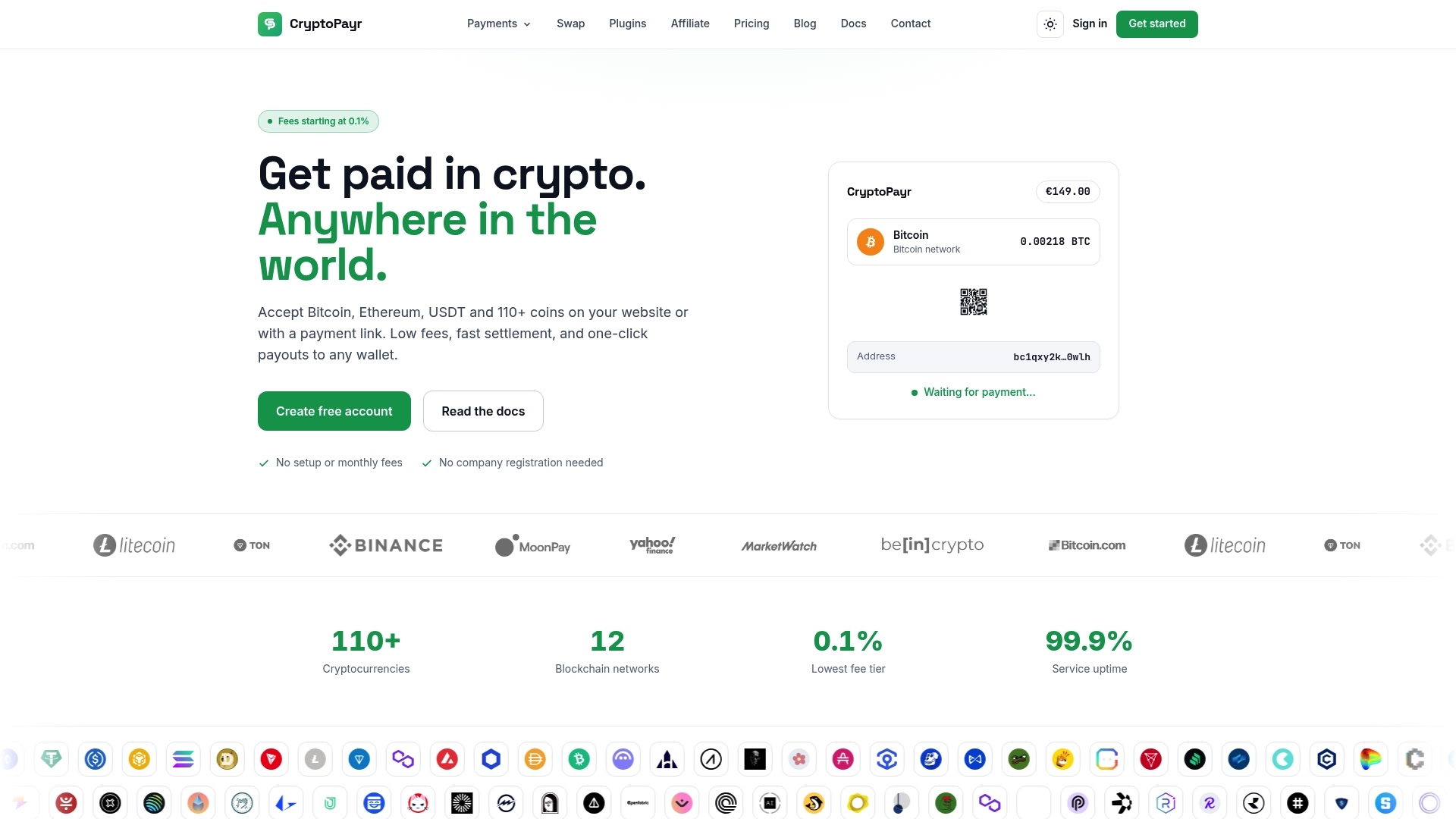
Cryptopayr maps directly to the checklist above. The platform supports many cryptocurrencies including Bitcoin, Ethereum, and major stablecoins, with fees starting at a low percentage per transaction. Integration options cover hosted checkout, pay links, e-commerce plugins (including WordPress and WHMCS), and a full API with webhooks and sandbox access.

The no-KYC option is a genuine differentiator. Most platforms require merchants to complete lengthy onboarding before going live. Cryptopayr’s no-KYC path means a merchant can start accepting payments without that friction, while still supporting KYC-compliant flows for regulated use cases where AML obligations apply.
Additional capabilities that matter at scale: auto-conversion to stablecoins, mass payouts, recurring billing, and marketplace commission splitting. For product and engineering teams evaluating ownership: product owns the integration decision, engineering owns the API and webhook setup, and compliance owns the KYC/AML configuration. Cryptopayr’s gateway documentation covers each phase.
When to choose white-label versus building in-house
The buy-versus-build question has a clear answer for most teams: buy. The engineering cost of building a payment gateway covers wallet management, reconciliation, security audits, monitoring, and ongoing maintenance across multiple blockchain networks. That is a full product team’s worth of work, not a sprint.
Three scenarios where white-label is the obvious choice: you need to launch in weeks, not quarters; your core product is not payments infrastructure; or you want coin coverage across 100+ assets without maintaining individual node connections.
Build makes sense in three narrow cases: you have a unique compliance requirement that no vendor can meet, you need a proprietary custody model for regulatory reasons, or your transaction volume and margins are high enough that the per-transaction fee savings from owning the stack outweigh the engineering and ops cost. That last threshold is higher than most teams expect.
Total cost of ownership is the honest frame. The alternative — engineering salaries, security audits, infrastructure, and ongoing maintenance — is also a cost, just one that shows up differently on the P&L. For most businesses below very high transaction volumes, the white-label path is cheaper in total, not just faster.
Cryptopayr’s white-label offering: what you get and how to start
Cryptopayr gives merchants and platforms a branded crypto payment experience without the infrastructure overhead. The offering covers 110+ coins, no-KYC onboarding, hosted checkout, pay links, e-commerce plugins, a full API, mass payouts, auto-conversion to stablecoins, and recurring billing — everything on the selection checklist in one platform.
White-label licensing adds custom branding, dedicated support, and lower per-transaction rates at volume. The fastest path to live: start with hosted checkout or a plugin, validate reconciliation over a short pilot, then migrate to the embedded API when volume justifies it.
Visit the white-label product page to review licensing options, or go directly to the gateway documentation to start a sandbox integration today.
Sources
Authoritative sources to consult as you evaluate and implement:
Recommended