110+ Coins, From 0.1% Fees: Multi Chain Crypto Payments for Merchants
How merchants and developers accept multi chain crypto payments using intent based routing and standards like ERC-7683/x402, plus CryptoPayr's 110+ coin...
CryptoPayrSep 21, 202612.00 min read
110+ Coins, From 0.1% Fees: Multi Chain Crypto Payments for Merchants
Multi-chain crypto payments let a business accept and settle digital assets across several blockchain networks through one integration instead of building separate rails for each chain. The direct payoff is reach: customers pay with whatever wallet and network they already hold, without your team maintaining a dozen bespoke connections. Modern payment stacks pull this off with intent-based routing and native protocols that route funds automatically, so nobody on your side is manually bridging tokens between chains.
TL;DR:
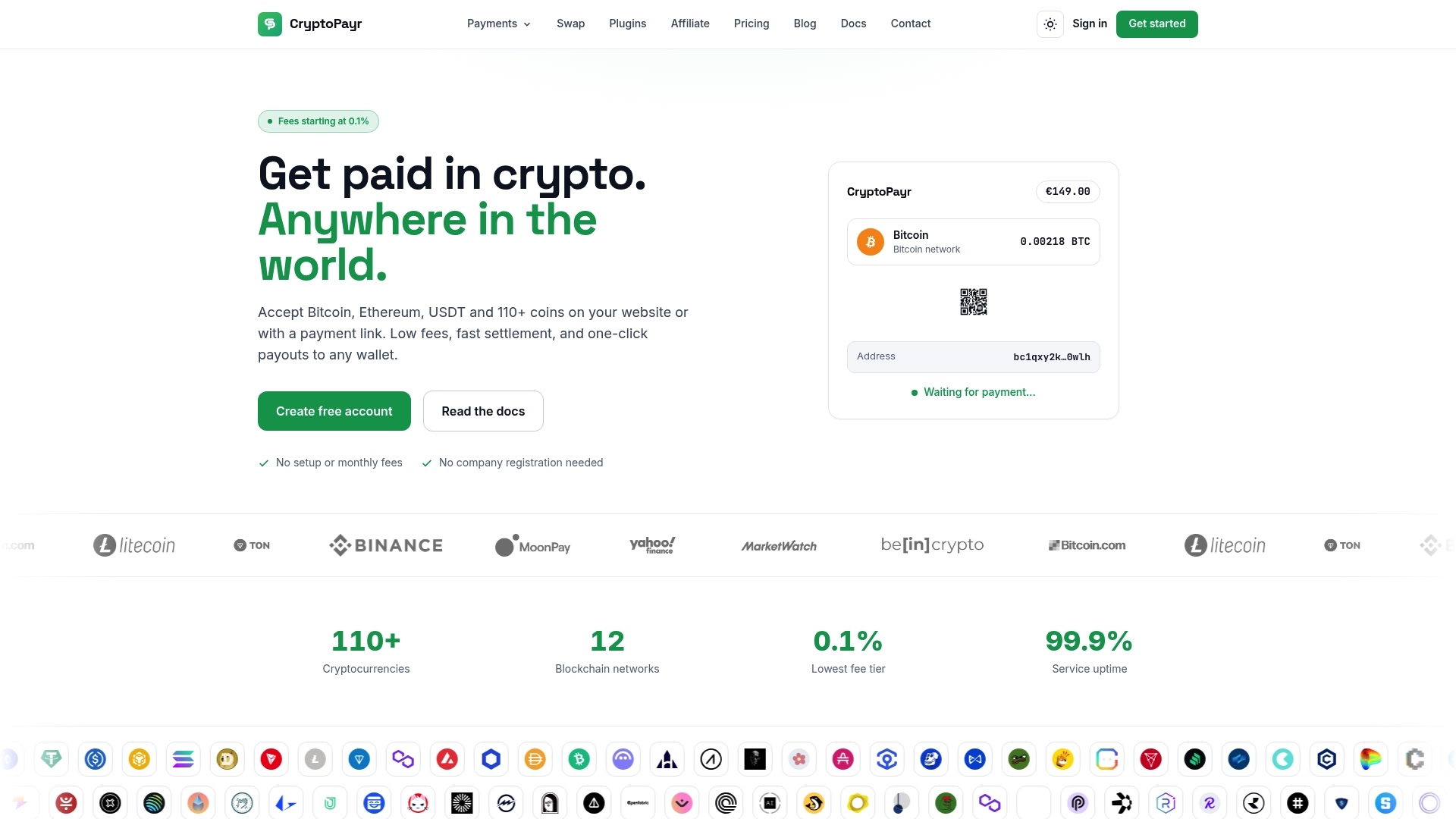
Supporting more than 110 cryptocurrencies, CryptoPayr offers broad network coverage to minimize checkout failures from incompatible customer wallets.
Its architecture using intent-based routing promises near-instant transfers with low fees by letting the system determine the best route for each payment.
The platform’s native burn-and-mint protocol avoids bridging risks by burning tokens on one chain and minting on another, enhancing security for cross-chain transfers.
CryptoPayr’s compliance-free, no-KYC model enables quick onboarding and simplifies reconciliation, especially during initial deployment on one to three commonly used chains.
Fees start at 0.1% and vary by volume, with options for hosted checkout, full API control, or mass payouts, supporting flexible integration for different business scales.
Cryptopayr
Accept Crypto Payments Across 110+ Coins
CryptoPayr helps merchants add crypto payments with minimal fees, no KYC, and integration options for e-commerce, SaaS, gaming, and marketplaces.
“Multi-chain” and “cross-chain” get used interchangeably, but they describe different things. Multi-chain means a payment system can accept assets on several independent blockchain networks, say Ethereum, Polygon, and Base, each handled on its own rails. Cross-chain means value or data moves between those networks, which is what happens when a customer pays on one chain and you need the funds settled or converted somewhere else.
For a business, both matter at once. A customer might hold USDC on Arbitrum while your settlement account lives on a different network entirely, and the payment stack has to bridge that gap invisibly.
This shows up across several concrete scenarios:
Checkout flows where customers choose their preferred chain instead of being forced onto one network.
Payouts to freelancers, affiliates, or gig workers who hold wallets on different chains than the platform’s treasury.
Marketplace commission splits that divide a single payment among sellers, platforms, and referral partners across chains.
Subscription billing where recurring charges need to hit the same settlement account regardless of which chain the customer pays from.
Cross-border remittances, where network choice often comes down to whichever chain has the lowest fees in the sender’s country.
Token and network coverage directly affects conversion. A checkout that only accepts one network turns away anyone whose funds sit elsewhere, and forcing a manual bridge step before checkout is a reliable way to lose the sale.
How Modern Multi-Chain Payment Stacks Actually Work
Three architectural patterns dominate how value moves between chains today, and the differences matter for anyone deciding how to build or buy.
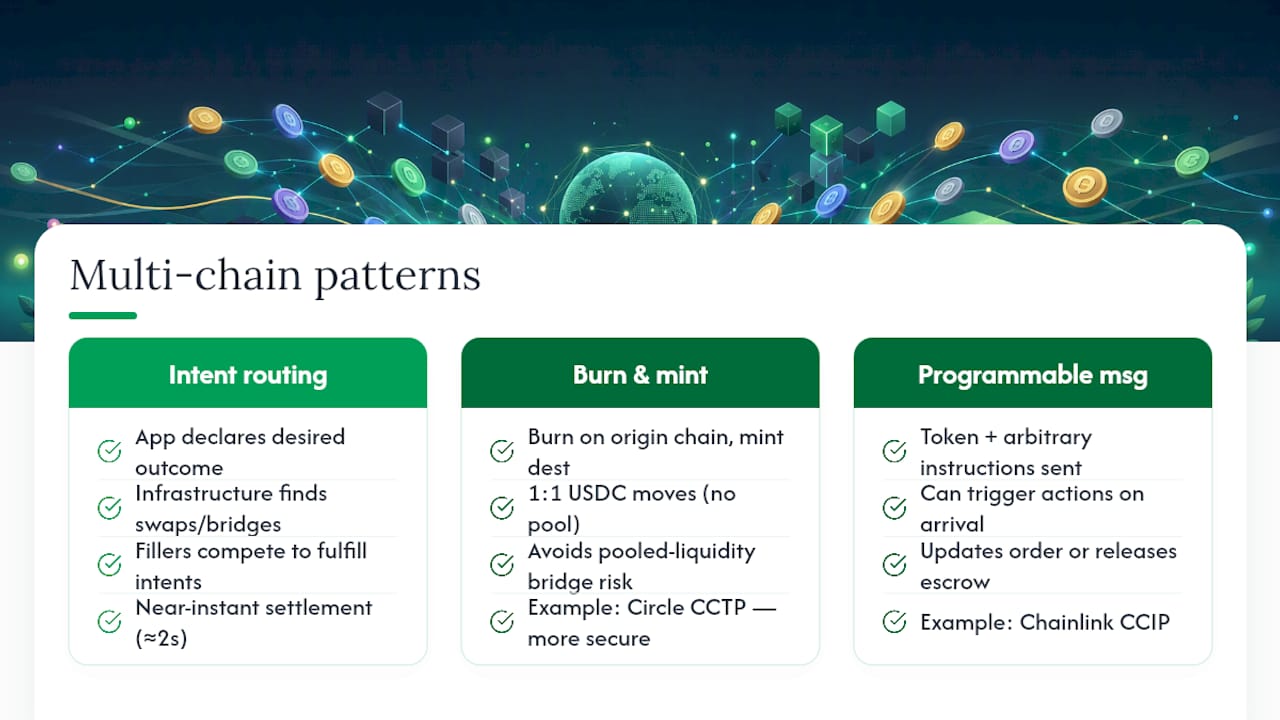
Intent-based routing flips the traditional model. Instead of specifying the exact path a payment takes, the application defines the desired outcome, “get 100 USDC to this address on Base”, and the infrastructure figures out the swaps and bridges needed to get there. Across Protocol built its entire architecture around this idea, and it reports near-instant transfers with low fees because fillers compete to fulfill intents rather than routing through a fixed bridge path.
Native burn-and-mint takes a different approach to the same problem. Circle’s Cross-Chain Transfer Protocol burns USDC on the origin chain and mints an equivalent amount on the destination chain, a 1:1 move that skips the pooled liquidity bridges typically rely on. That matters for security: bridge hacks almost always target the liquidity pool sitting in a smart contract, and CCTP’s design avoids holding that pool at all.
Programmable messaging extends transfers beyond simple value movement. Chainlink CCIP can carry a token plus arbitrary instructions in the same transfer, which lets a payment trigger a follow-up action, updating an order status or releasing an escrow, on the destination chain automatically.
Industry reporting on Across’s transfer performance points to settlement under two seconds for many transfers running on intent-based infrastructure, a speed gap that matters when a customer is staring at a checkout spinner.
Orchestration layers like Trails from Polygon’s Open Money Stack sit on top of these primitives, exposing a single SDK that finds the optimal route across whichever protocol fits best. That is the practical unlock for most teams: you stop choosing between CCTP, bridges, and messaging protocols case by case and let the orchestration layer decide.
Building the Integration: APIs, SDKs, and Standards
The standards question decides how much rework you face when a new chain launches, similar to how Braintree: A Payments Solution You Can’t Live Without illustrates the impact of payment APIs and integration complexity in traditional payment systems. Two are worth prioritizing right now.
ERC-7683 standardizes how cross-chain intents get expressed, defining order structures and settlement interfaces that any compliant filler network can execute. Build against it and you are not locked into one router’s proprietary format. x402 takes a web-native approach, embedding payment requirements directly into API endpoints and supporting multiple networks, tokens, and currencies through schemes like exact-amount and batch settlement. For simpler EVM-only flows, EIP-681 URIs still cover basic payment requests without extra tooling.
A working integration typically follows this sequence:
Generate a payment payload that specifies the amount, accepted tokens, and destination, ideally in an ERC-7683 or x402 compliant format.
Surface a wallet confirmation so the customer approves the exact route and fee before funds move.
Handle the callback from your payment processor or orchestration SDK once the transfer settles on the destination chain.
Build in idempotency keys on every payment request so retried network calls never double-charge a customer.
Reconcile against your ledger automatically, matching on-chain settlement events to internal order records rather than relying on manual checks.
Test on public testnets first, roll out to one or two low-volume chains before expanding, and keep monitoring on failed or stuck transactions from day one.
Pro Tip:Build your reconciliation logic before you add your fifth supported chain, not after. Retrofitting idempotency checks onto a system that already has real transaction volume is far more painful than designing for it up front.
How Payments Actually Settle, Step by Step
A single crypto payment across chains moves through a predictable sequence: the payer initiates from their wallet on the origin chain, the router or bridge picks up the transfer, it lands on the destination chain, and your system marks it settled once confirmations clear.
Timing varies enormously depending on which architecture handles the transfer:
Intent-based systems often settle in seconds because fillers pre-fund liquidity and get reimbursed later, so the customer isn’t waiting on a multi-step bridge confirmation.
Custodial bridges can take longer, sometimes minutes, because funds move through a lock-and-mint or lock-and-release sequence with its own confirmation requirements on both chains.
Native burn-and-mint transfers land somewhere in between, fast, but still bound by the destination chain’s own block time.
Once funds arrive, many businesses auto-convert to stablecoins or fiat to avoid holding volatile assets on the balance sheet. That conversion step introduces its own timing considerations: exchange rate locks, bank cutoff times for fiat payouts, and conversion fees that eat into margin if you are not watching them closely. Mass payout systems that batch these conversions and settlements, similar to the workflows covered in CryptoPayr’s guide to sending crypto at scale, reduce a lot of this friction for platforms paying out hundreds of recipients at once.
Where the Real Risks Live, and How to Cover Them
Bridge exploits remain the single biggest category of loss in cross-chain infrastructure, because pooled liquidity sitting in a smart contract is a concentrated target. Native burn-and-mint protocols like CCTP sidestep that specific risk by never holding a bridged pool, though they still depend on the security of the underlying chains involved.
Gas fragmentation is the quieter problem. A customer holding USDC on a chain with no native gas token in their wallet simply cannot complete a transaction, and that failure mode kills more payments than most teams realize until they check their logs.
Cover the operational side with a short list of non-negotiables:
Monitor every transaction state in real time rather than relying on customers to report stuck payments.
Build automatic retries with backoff for transient network failures.
Add fallback routing so a failed path on one bridge or router doesn’t strand the payment entirely.
Set internal SLAs for settlement time and alert when a transfer exceeds them.
Pro Tip:Gas abstraction, letting the payment system cover network fees so customers never need a second token just to pay, quietly fixes more failed transactions than any bridge upgrade you could make.
Choosing a Provider: The Checklist That Actually Matters
Vendor selection usually comes down to a handful of concrete questions that separate a solid fit from a costly mismatch.
Which chains and tokens does it actually support, not just advertise, and does that list match where your customers already hold funds?
What settlement options exist, stablecoin, fiat, or both, and what are the conversion fees and bank cutoff windows?
How is pricing structured, flat per-transaction fees versus percentage-based tiers, and how does that scale as volume grows?
What is the KYC/AML posture, and does it match your risk tolerance and the regions you operate in?
How mature are the API and SDK, and can your engineering team integrate without months of custom work?
What reporting and reconciliation tools ship out of the box, versus what you would need to build yourself?
What uptime and SLA guarantees back the settlement promises, especially during network congestion?
Weigh custodial liquidity models against native protocol approaches carefully. Custodial models sometimes offer faster support for niche chains; native approaches tend to offer stronger security guarantees but narrower token support. On a sales call, ask directly which chains hit production versus testnet, and ask for real settlement-time data rather than marketing claims.
Where CryptoPayr Fits Into This Checklist
That maps directly onto the checklist above in a few specific ways:
Broad token and network coverage means fewer gaps between what customers hold and what checkout accepts.
Hosted checkout and e-commerce plugins cover teams that want a working integration without custom development.
A full API covers teams that want direct control over payment flows and reconciliation logic.
Mass payouts handle marketplace and platform disbursements across many recipients at once.
White-label deployment lets platforms offer branded crypto payment infrastructure without building it from scratch.
Settlement and reconciliation stay straightforward because the no-KYC model removes the onboarding delay that often stalls a first integration for weeks.
Rolling This Out Without Overbuilding
Start with the two or three chains your customers already use, not the full list a provider supports. Chasing coverage before you have volume just multiplies your reconciliation work for no real benefit.
Gas abstraction and clean reconciliation deserve more attention than chain count in the first quarter of any rollout. A payment that fails because a customer lacked gas costs you more than a chain you haven’t added yet.
When you’re ready to move past testnet, CryptoPayr’s documentation and support team are a reasonable next stop for the specifics.
— Dustin
Getting Started With CryptoPayr
CryptoPayr offers a solution for multi-chain payment infrastructure that aims to avoid lengthy compliance delays, with no mandatory minimums and a pricing model that adjusts with transaction volume.
Whether you’re adding crypto checkout to an online store, automating payouts to a distributed workforce, or building a white-label payment layer for your own platform, the integration path stays the same: hosted checkout for speed, a full API for processing when you need control, or mass payouts if you’re disbursing to many recipients at once. Start at Cryptopayr to see current fee tiers and get a sandbox key, no lengthy application required.
What Is the Best Multi-Chain Wallet for Accepting Payments?
There’s no single best wallet since the right choice depends on which chains your customers already use. Most businesses don’t rely on one wallet at all; they use a payment gateway like CryptoPayr that abstracts wallet compatibility away entirely, accepting funds from whatever wallet the customer already has.
Can Law Enforcement Track a Bitcoin Wallet?
Bitcoin transactions are recorded on a public ledger, so investigators with the right tools can trace wallet activity and, in many cases, link addresses to real identities through exchange records or on-chain analysis. It is not automatically anonymous, and treating it that way is a common mistake for both individuals and businesses handling crypto payments.
Which Crypto Works Best for Cross-Border Payments?
Stablecoins like USDC tend to work best for cross-border payments because they avoid the price swings of assets like Bitcoin while still settling faster and cheaper than most traditional wire transfers. Native transfer protocols such as Circle’s CCTP move USDC directly between chains without relying on bridged liquidity, which keeps cross-border settlement both fast and lower-risk.
Why Is My Crypto Payment Stuck on the Blockchain?
A payment usually gets stuck due to network congestion, an underpriced gas fee, or a bridge step waiting on confirmations from both the origin and destination chain. Payment systems built on intent-based routing, like those behind Across Protocol, reduce this risk because fillers compete to complete transfers quickly instead of funds sitting in a single bridge queue.
How Much Does CryptoPayr Charge for Multi-Chain Payments?
CryptoPayr’s fees start at 0.1% depending on your monthly transaction volume tier, with no setup or monthly fees required to get started. Current pricing details and volume tiers are listed on CryptoPayr’s site.