Arbitrum Payments: EIP-3009, OFAC Checks, and a Fast Merchant Path
Developer-ready merchant playbook for Arbitrum payments. Learn EIP-3009 vs Permit2, OFAC checks, and how a gateway can get you live in a day.
CryptoPayrSep 20, 20269.00 min read
Arbitrum Payments: EIP-3009, OFAC Checks, and a Fast Merchant Path
Yes, you can accept Arbitrum payments today, and for most merchants a payment gateway is the fastest, safest way to do it. A gateway that supports stablecoins like USDC and USDT on Arbitrum handles chain monitoring, sanctions screening, and settlement for you, cutting integration time from weeks to hours. The immediate next step is choosing a gateway that supports Arbitrum stablecoins and post-confirmation webhooks. Some payment gateways fit that description directly.
TL;DR:
Most merchants should choose a payment gateway that supports stablecoins like USDC and USDT on Arbitrum for quick, secure, and compliant transactions.
Settlement typically happens in stablecoins to avoid volatility, requiring two to three confirmations, with auto-conversion options to limit platform risk.
Integration methods vary from hosted checkout for speed to API and webhooks for full control, depending on engineering capacity and payment flow needs.
Developers should carefully implement gasless transfer protocols like EIP-3009 and consider token decimal handling to prevent common bugs.
Security and compliance require pre-settlement OFAC screening, role-based access, encrypted storage, and detailed transaction logging to ensure operational robustness.
Cryptopayr
Add Crypto Payments With Less Complexity
CryptoPayr helps businesses accept over 110 cryptocurrencies through a user-friendly gateway with minimal fees and no KYC.
Before writing a line of code or signing up for anything, get four decisions settled. Skipping this step is why most Arbitrum payment integration projects run over schedule.
Settlement currency: Most merchants settle in USDC or USDT rather than the native ARB token, since stablecoins avoid price swings between checkout and payout. Confirm the current token contract addresses directly from official documentation before going live, since addresses differ across Arbitrum One versus test networks.
Receiver model: Decide between a gateway-hosted wallet (less operational overhead) or your own custodial wallet (more control, more responsibility).
Infrastructure: You’ll need an RPC provider such as Alchemy or Infura, plus a webhook endpoint that fires when a payment clears.
Reconciliation and compliance: Map out how crypto receipts get logged for accounting, and set your policy on OFAC screening, KYC, and refunds before the first transaction lands.
Integration Options: Hosted Checkout, Plugins, Payment Links, and API
The right integration path depends entirely on how much engineering time you have and how much control you need over the payment flow.
Hosted checkout and payment links get you live fastest. The gateway manages private keys, monitors the chain, and confirms settlement, so a merchant with zero blockchain experience can start accepting digital assets on Arbitrum within a day.
E-commerce plugins suit stores already running on established platforms like WooCommerce or Shopify. A white-label gateway can even keep the checkout branded as your own rather than a third-party page.
API plus webhooks is the route for SaaS platforms, marketplaces, and anyone needing full control over how a confirmed payment triggers an action, like activating a subscription tier the moment a stablecoin transfer clears. This matters for SaaS billing flows where a webhook needs to unlock access instantly.
Mass payouts and split payments matter specifically for marketplaces and platforms that need to divide one incoming payment among multiple sellers, affiliates, or commission tiers automatically.
For most merchants, the trade-off is simple: hosted checkout gets you live today, while an API integration takes longer but gives you the flexibility marketplaces and subscription businesses eventually need anyway.
Settlement, Tokens, Fees, and Confirmation Timing on Arbitrum
Arbitrum’s entire pitch as a payment rail comes down to cost and speed. Transaction fees on Arbitrum run a fraction of what the same transfer costs on Ethereum mainnet, and confirmations land in roughly a minute rather than several minutes, which is precisely why BitPay added support for Layer-2 networks like Arbitrum in the first place.
Most merchants accept USDC or USDT specifically because stablecoin settlement removes the guesswork of price movement between the moment a customer pays and the moment you convert or bank the funds. A typical setup requires two to three block confirmations before a payment counts as final, a small buffer against chain reorganizations that costs you almost nothing in speed given Arbitrum’s fast block times.
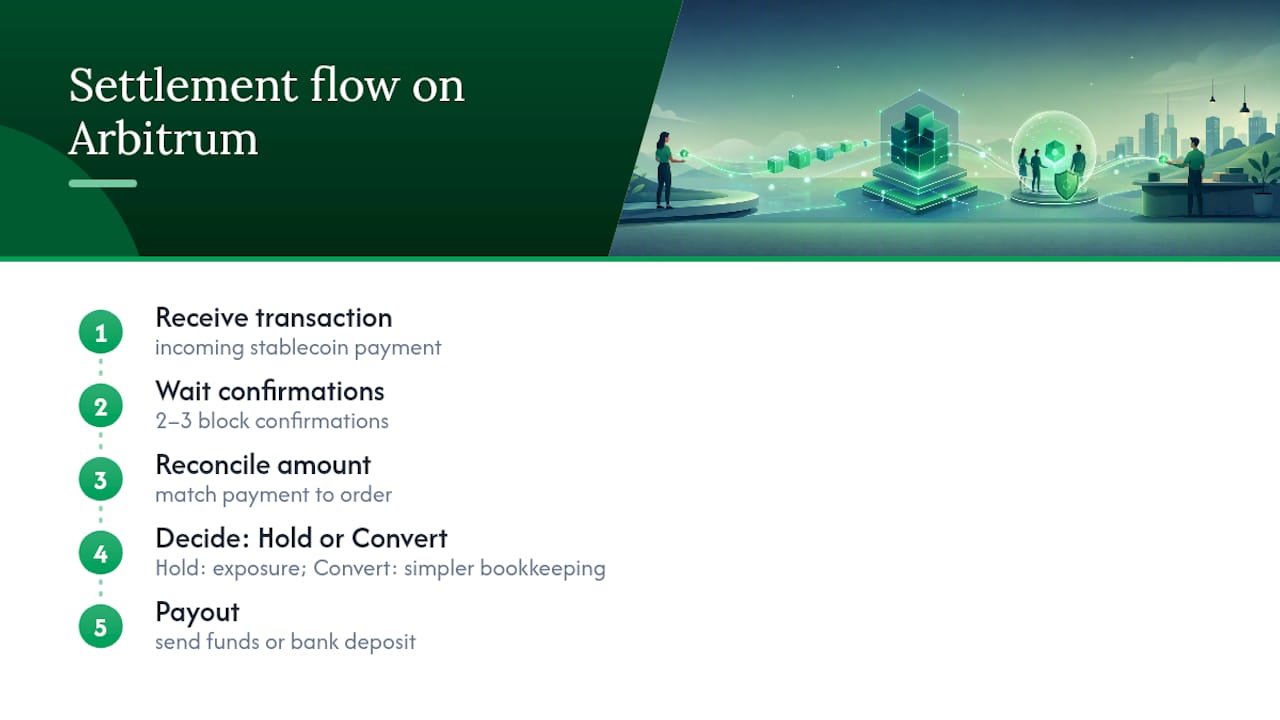
You’ll also need to decide whether to hold the stablecoin or auto-convert to fiat immediately. Holding keeps you exposed to counterparty and platform risk; auto-converting simplifies bookkeeping but adds a conversion step to your payout timeline. The settlement flow itself is straightforward: receive the transaction, wait for the required confirmations, reconcile the amount against the order, then payout or convert.
Developer Notes: EIP-3009, Permit2, and the mppx Pattern
This is where most Arbitrum payment gateway integrations either go smoothly or fall apart in production. Arbitrum’s documentation describes a machine payments pattern, often shortened to mppx, built around a 402 challenge: the server responds with a payment request, the client signs an authorization off-chain, and the merchant’s server settles the transaction onchain. That last part matters because the merchant’s server pays the gas, not the payer, so keep it funded.
EIP-3009 (transferWithAuthorization) lets a payer sign a transfer authorization without ever broadcasting a transaction themselves or holding ETH for gas, which is what makes gasless checkout flows possible.
Permit2 supports permit-based transfers and can split a single authorization across multiple recipients, but it requires the payer to have granted approval in advance, an extra step some checkout flows skip and later regret.
A working example of this flow shows a facilitator receiving a signed authorization from the client, calling transferWithAuthorization, then forwarding the merchant’s share, all documented in the Arb402 facilitator project.
Watch token decimals closely. USDC and USDT on Arbitrum typically use 6 decimals, and a raw-unit mismatch is one of the most common bugs in early Arbitrum cryptocurrency payments builds.
Run OFAC address checks before settlement, not after, and handle an OFAC_SANCTIONED error explicitly rather than letting it fail silently.
Pro Tip:Build idempotent receipt handling from day one. Webhooks retry on failure, and without an idempotency key, a single confirmed payment can trigger a duplicate order or double payout.
Security, Compliance, and Operational Best Practices
Treat compliance as infrastructure, not an afterthought bolted on before launch.
Screen every sender address against OFAC sanctions lists before you settle, not after the funds have moved.
Keep production keys separate from development keys and enforce role-based access control on who can trigger payouts.
Encrypt sensitive data at rest; AES-256-GCM is the standard most crypto payment libraries default to.
Build alerting for stuck or failed settlements, and write down your recovery and refund process before you need it, not during an incident.
Log every transaction hash and confirmation receipt. When a customer disputes a payment, that log is your entire case.
A payments library documenting this exact flow shows OFAC screening running as a standard pre-settlement check, alongside Alchemy-based monitoring for confirmation status.
Why Arbitrum Payments Make Sense for Merchants Right Now
Layer-2 networks solved the problem that kept crypto payments impractical for years: fees eating into small transactions and confirmations taking too long for checkout. Arbitrum’s speed makes micropayments and international receipts genuinely usable for the first time, and stablecoin settlement removes the volatility that made accounting a headache. If you sell anything internationally, the case for adding an Arbitrum payment gateway alongside your existing options is getting harder to ignore.
— Dustin
Get Set Up With CryptoPayr’s Arbitrum Payment Gateway
There are gateways built for merchants who want Arbitrum cryptocurrency payments live without a compliance headache. Some gateways offer no-KYC onboarding with instant approval, so you can go from signup to accepting your first payment the same day.
The setup itself covers the ground this guide just walked through: hosted checkout for merchants who want speed, a full API and gateway for developers who want control, plugins for existing storefronts, and auto-conversion so you’re not left holding volatile assets you didn’t ask for. Support extends across USDC and dozens of other tokens, with mass payout tools built in for marketplaces splitting revenue across sellers. Fees start at 2% per month on the Standard tier and scale down to 0.1% at the Enterprise tier, with no setup or monthly fees to get started.
To get moving, create a CryptoPayr account, enable a hosted checkout test transaction, turn on USDC settlement, and set your payout cadence. That’s the whole quick start.
Any wallet supporting the Arbitrum One network works, including MetaMask, Coinbase Wallet, and hardware wallets like Ledger once configured for chain ID 42161. Merchants typically don’t manage a wallet directly; a gateway like CryptoPayr handles receiving and monitoring funds instead.
What Is Arbitrum Used For?
Arbitrum is a Layer-2 network built on Ethereum that processes transactions faster and at a fraction of mainnet gas costs. Merchants use it specifically for payments and stablecoin transfers where low fees and fast confirmation matter, like e-commerce checkout or SaaS billing.
How Much Is 1 Arbitrum Worth in US Dollars?
The ARB token’s price floats with the broader crypto market and changes constantly, so there’s no fixed dollar figure to quote here. Merchants accepting Arbitrum cryptocurrency payments typically settle in USDC or USDT specifically to avoid this volatility altogether.
Which Network Is Arbitrum On?
Arbitrum One runs as chain ID 42161, a Layer-2 network built on top of Ethereum. It’s the network most merchants mean when discussing Arbitrum payment solutions, distinct from Arbitrum Nova, which supports different token contracts and shouldn’t be assumed interchangeable.
Does CryptoPayr Charge Setup Fees for Arbitrum Payments?
No, CryptoPayr charges no setup or monthly fees for its standard gateway. Transaction fees run on a tiered structure starting at 2% per month on the Standard plan down to 0.1% on Enterprise, with pricing detailed on the CryptoPayr site.