The fastest, lowest-risk way for a gaming platform to accept crypto is to integrate with a regulated payment gateway that supports stablecoins, invisible-rail UX, and mass payouts. That combination eliminates chargebacks entirely and opens deposits from players in markets your bank never touches. Before you sign anything, check the partner’s SDK, API documentation, and payout options against your actual transaction volume.
TL;DR:
- Verify your crypto payment partner’s regulatory registration through official regulator portals or warning lists to prevent compliance risks and delays.
- Ensure the provider offers SDKs, APIs, and sandbox environments aligned with your transaction volume to streamline integration.
- Use stablecoins for off-chain settlement to avoid volatility and simplify reconciliation when accepting crypto deposits.
- Batch large payouts with smart contracts to reduce transaction costs and facilitate quick, traceable payouts for tournament winnings.
- Choose custodial or noncustodial models based on your license to balance regulatory compliance with user experience.
Cryptopayr
Simplify Crypto Payments for Gaming
Cryptopayr helps digital businesses accept over 110 cryptocurrencies with minimal fees and straightforward platform integration.
Table of Contents
How Gaming Crypto Payments Move From Player to Payout
A player never sees the blockchain plumbing behind a well-built checkout. They pick a payment method, the platform handles everything else, and the operator gets paid in whatever asset makes sense for the business.
On the player side, most platforms now offer a handful of entry points:
- Wallet pay: the player connects MetaMask, Phantom, or a mobile wallet and signs a transaction directly.
- Card-to-crypto on-ramp: a player pays with a debit card and the gateway converts it to crypto behind the scenes.
- Hosted checkout: a branded page collects the payment without the operator touching raw wallet addresses.
- Payment links: a single URL for one-off deposits, tournament buy-ins, or affiliate payouts.
Once funds hit the gateway, settlement splits into two paths. On-chain settlement keeps the transaction native to whatever chain the player used. Off-chain settlement converts instantly into a stablecoin like USDC or USDT, which shields the operator from volatility between the moment a player deposits and the moment the platform reconciles books. Most gaming operators choose the second path.
Merchants then decide whether to hold crypto, hold stablecoins, or auto-convert to fiat on a schedule. A gateway worth using handles the gas and network complexity itself, including refunds, which normally require re-sending funds on the correct network rather than clicking a button in a merchant dashboard.
What Compliance Checks Should Gaming Operators Run Before Enabling Crypto?
A gaming licence is worth protecting, and a sloppy payments integration is one of the fastest ways to put it at risk. Before enabling crypto, verify your partner’s regulatory footprint the same way you’d vet a bank.
Start by requesting proof of registration. Providers like Triple-A appear directly in regulator portals, such as Singapore’s MAS, and that kind of filing is exactly what you should ask any partner to produce. In Canada, operators can cross-check a provider against the FINTRAC MSB registry before signing a contract. France’s fintech ecosystem lists activators like Lyzi in the FranceNum directory, which gives you a second, independent trust signal beyond the provider’s own marketing.
Statistic Callout: Regulators publish warning lists specifically to flag unregistered payment providers, and checking a partner against a list like the AMF France warnings registry before integration takes minutes but can save months of remediation.
A few operational habits reduce your exposure further:
- Split AML/KYC responsibilities explicitly in your contract, so it’s clear who screens which side of a transaction.
- Keep transaction logs with timestamps, wallet metadata, and conversion rates for tax and audit purposes.
- Set velocity limits on deposits and payouts to catch abnormal patterns before they become losses.
- Run pre-transaction checks on new wallets and unusual device signals.
Making Crypto Feel Invisible to Players
Players don’t want to manage a seed phrase to buy tournament credits. The operators winning mainstream adoption treat crypto as infrastructure, not a feature the player has to understand.
Sui’s gaming documentation lays out the pattern well: zkLogin and sponsored transactions let a player sign in with a Google or Apple account and transact without ever paying gas or holding a wallet address in their head. The platform absorbs the network fee and the complexity; the player just clicks “deposit.”
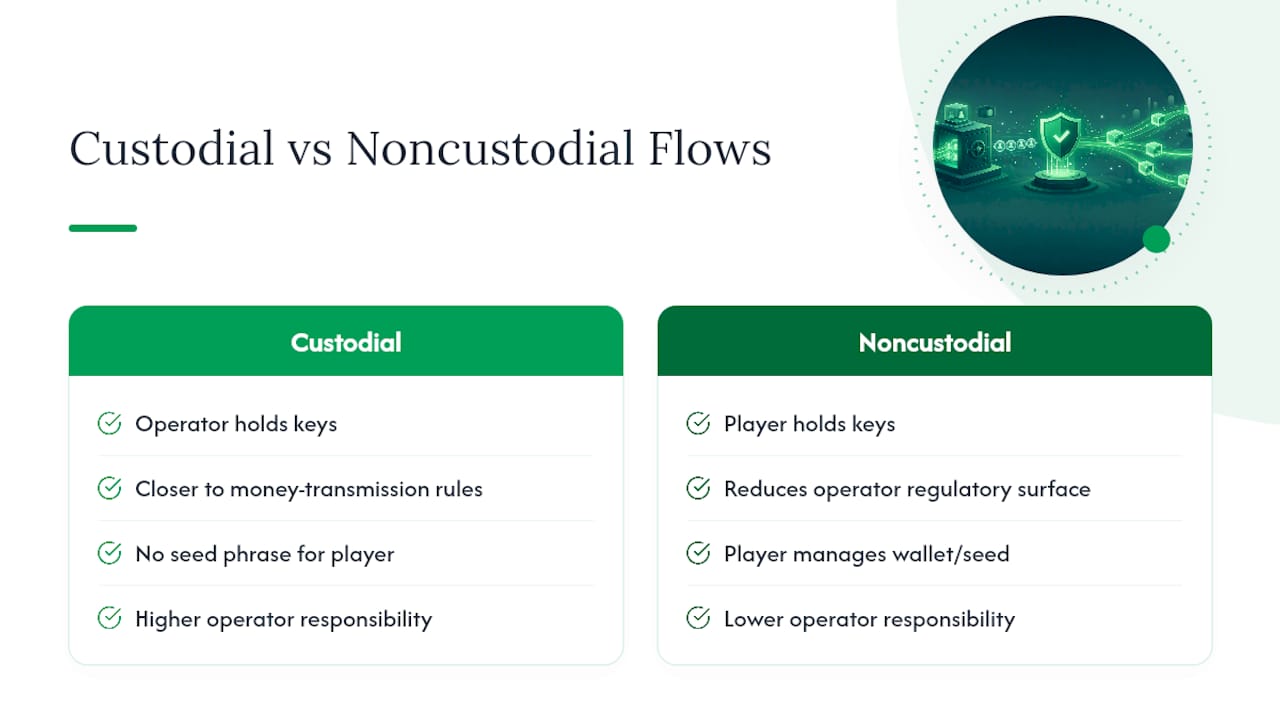
That said, custodial and noncustodial models carry different regulatory weight. Custodial wallets put the operator closer to money-transmission rules in some jurisdictions, since the platform holds keys on the player’s behalf. Noncustodial flows push more responsibility onto the player but reduce the operator’s regulatory surface area. Choose based on your licence, not just your UX preference.
When evaluating a partner, ask specifically about zkLogin support, social login, sponsored gas, and instant crediting on deposit confirmation. Those four features determine whether your onboarding funnel looks like a modern app or a crypto exchange from 2018.
Pro Tip: Track drop-off between “deposit initiated” and “deposit confirmed” as its own funnel step. If that gap is wide, the friction usually isn’t the payment method. It’s the wallet setup happening in between.
Handling Tournament Payouts, Creator Earnings, and Affiliate Splits
Paying out ten thousand tournament winners one transaction at a time is slow and expensive on most chains. Batching solves that: one on-chain transaction fans out to many recipients through a smart contract, cutting gas costs and clearing the whole payout run in a single confirmation window.
From there, operators typically choose among a few delivery methods:
- On-chain stablecoin transfer, fast and traceable, ideal for global player bases.
- Fiat rails, useful when a payee prefers a bank deposit over holding crypto.
- Virtual cards, a middle ground that lets recipients spend immediately without converting manually.
Reconciliation gets easier when every payout carries a unique payment ID tied to a webhook that fires on confirmation, which lets your accounting system export clean records without manual matching. When negotiating fees with a payments partner, ask specifically about volume tiers. Batch payouts at scale should cost meaningfully less per transaction than one-off transfers, and a partner unwilling to discuss that tiering is one worth reconsidering.
Integration Checklist: Evaluating a Crypto Payments Partner
Procurement conversations move faster when you’re checking specific boxes instead of listening to a generic pitch. Run any candidate partner through these four categories:
- Technical fit: Does the partner offer SDKs, e-commerce plugins, a sandbox environment, and support for the chains and stablecoins your player base actually uses?
- Compliance posture: What licences does the partner hold, what’s their custody model, and what AML tooling comes built in versus bolted on?
- Operational reliability: How fast is settlement, what reporting exports are available, and how are disputes handled when a player claims a payment never arrived?
- Commercial terms: What’s the fee schedule at your volume, is white-label available, and what SLA governs payout timing?
| Evaluation Area |
What to Ask For |
Why It Matters |
| Technical |
SDK docs, plugin list, sandbox access |
Determines integration timeline |
| Compliance |
Licence filings, custody model |
Protects your gaming licence |
| Operations |
Settlement SLA, webhook support |
Drives reconciliation accuracy |
| Commercial |
Fee tiers, white-label pricing |
Controls margin at scale |
Most platform documentation across the industry converges on SDKs, REST APIs, webhooks, and testnet sandboxes as baseline developer expectations. If a partner can’t offer all four, expect a longer integration cycle than their sales deck implies.
Publisher Perspective: Why Cryptopayr Positions Itself for Gaming Operators
What strikes me about the gaming payments space is how many platforms treat crypto as a bolt-on rather than a core rail. Cryptopayr’s approach, supporting over 110 cryptocurrencies with fees starting at 0.1% and a no-KYC checkout, fits the operator reality better than a traditional processor retrofitted for digital assets. Hosted checkout, mass payouts, and white-label options address the actual friction points operators hit daily. Compliance-first infrastructure models, like the one Genesis Engine describes, point toward where the whole category is heading.
— Dustin
Get Started With Cryptopayr’s Gaming Payment Gateway
Cryptopayr cuts the two biggest costs of running crypto payments in gaming: chargeback exposure and onboarding friction.
If you’re running a tournament platform, a marketplace, or an iGaming site with players scattered across markets your current processor won’t touch, start by testing the crypto payment gateway in sandbox mode against your own checkout flow. Platforms that need a fully branded experience can look at the white-label gateway instead, which keeps your brand front and center while Cryptopayr handles the settlement and conversion underneath. Either way, the next step is the same: request sandbox access and run a real transaction before you commit.
Sources
Verification matters more than marketing copy when picking a payments partner. Check provider status directly through regulator tools like the MAS institution registry and the FINTRAC MSB registry, review local activator listings such as FranceNum’s Lyzi entry, and read Sui’s technical documentation on sponsored transactions and zkLogin for a deeper look at invisible-rail architecture. For a comparison of alternative in-game trade security models, see Dropskin’s guide to item escrow.
Recommended


