Marketplace Split Payments: A Complete Builder’s Guide

Marketplace split payments divide a single customer payment among multiple recipients automatically, typically deducting a platform commission and routing the remainder to one or more sellers. According to Sharetribe, this is the core mechanic behind how most marketplace platforms monetize transactions while paying out vendors. For most U.S. marketplaces, the right starting point is a point-of-sale split when your processor supports it at capture; otherwise, use a platform-collected model where you hold funds in a controlled balance and disburse on a defined schedule. Both approaches work. The difference is who bears liability during the window between collection and payout.
Quick orientation before diving into mechanics:
- Percentage splits are the most common: the platform typically takes a portion of the payment as commission, and the seller receives the remainder.
- Fixed splits work for flat-fee services or when commission is a set dollar amount.
- Mixed splits combine both, often used for tiered commission structures.
- Processing fees are typically absorbed by the platform or deducted before the seller’s share is calculated.
- For crypto-native marketplaces, Cryptopayr supports multi-recipient splits, mass payouts, and API-driven commission routing across a wide range of cryptocurrencies with low fees.
Key Takeaways
Choosing the right routing model at the start determines your compliance exposure, reconciliation complexity, and how refunds behave across the entire lifecycle of your marketplace.
| Point |
Details |
| Routing model choice |
Immediate splits at capture reduce liability and reconciliation work; delayed routing fits multi-rail or gradual seller onboarding. |
| Compliance before launch |
Collect W-9 data from sellers before first payout and get legal review on money-transmitter exposure before go-live. |
| Ledger design matters |
Immutable, transaction-centric records with idempotent payout jobs prevent double-disbursements and make audits straightforward. |
| Test refunds and failures |
Sandbox testing must cover partial refunds, simulated payout failures, and settlement delays before production launch. |
| Cryptopayr for crypto splits |
Cryptopayr supports multi-recipient splits, mass payouts, and API-driven commission routing across 110+ cryptocurrencies at fees from 0.1%. |
Table of Contents
How do marketplace split payments actually work?
Two routing models dominate production implementations, and choosing between them shapes everything downstream: your liability exposure, your reconciliation workload, and how refunds behave.
On-transaction (immediate) splits divide funds at the moment of capture. The processor routes each share directly to the appropriate balance account. No funds sit on the platform’s books overnight. This model is cleaner for liability and simpler for reconciliation, but it requires your processor to support split instructions at the API level, and not all do.

Platform-collected then disbursed (delayed routing) means the platform receives the gross amount, holds it in a custodial or escrow-like balance, and sends payouts on a schedule. Card rails typically settle gross to the platform on a multi-day window anyway, so this model matches how card networks actually operate. The trade-off: you’re now responsible for the funds in transit, which triggers state money-transmitter considerations depending on your volume and structure.
At the API level, split instructions are expressed in one of three ways: as a percentage of the transaction total, as a fixed amount in the transaction currency, or as a hybrid combining both. Adyen’s balance-account model, for example, requires you to map each split instruction to a named balance account so funds and fees are booked correctly at capture and again at refund.
Refunds behave differently by model. With immediate splits, a refund reversal must unwind each leg separately, which means the processor needs to know how much came from each recipient’s account. With delayed routing, the platform absorbs the refund from its pooled balance and adjusts the pending payout, which is operationally simpler but requires accurate ledger state.
Pro Tip: Prefer immediate splits when your processor supports them and your sellers are fully KYC-verified. Use delayed routing when you need flexibility on payout timing, when sellers are onboarded gradually, or when you’re operating across multiple rails with mismatched settlement windows.
What features does a split-payments system need?
Not every feature matters equally at every stage. The table below maps requirements to marketplace maturity.
A few of these deserve more than a table cell.
Webhook reliability is the one teams consistently underestimate. Payment events arrive out of order, duplicate, and occasionally fail delivery. Your system needs idempotent event handlers and a retry queue with exponential backoff. Without it, a single missed payout.failed event can leave a seller unpaid with no alert.
KYC/KYB for recipients is non-negotiable at growth stage. The moment you’re disbursing funds to third parties at scale, your processor and potentially your state regulator expect you to know who those parties are. Blocking payouts because a seller failed verification after you’ve already promised them funds is an operational nightmare.
CS-Cart’s analysis of split payments makes the point clearly: careful handling of refunds, chargebacks, and commission calculation is what separates a clean implementation from one that creates accounting drift over time. Build the commission and fee logic once, test it thoroughly, and never let it live in application code that bypasses the ledger.
Which integration pattern fits your marketplace?
Three patterns cover most production implementations.
Hosted checkout is the fastest path to production. You configure split rules in your platform dashboard, pass a session payload at checkout creation, and the processor handles the UI and fund routing. Build effort is low. Control over UX is limited. This works well for marketplaces that are still validating their commission model and don’t want to invest engineering time in a custom flow.
API-first integration gives you full control over the checkout experience and split logic. You create split instructions server-side at authorization or capture, pass them in the API request body, and handle the response to confirm each leg settled correctly. Dintero’s integration pattern is a clean reference: onboard sellers as payout destinations, include split configuration in the session payload, and verify splits in the callback after capture. That three-step pattern maps directly to most processor APIs.
SDKs sit between the two. They abstract the API calls while still letting you control the UX. Useful when your team is moving fast but wants type-safe request construction and built-in retry handling.
For webhooks, subscribe to at minimum:
payment.succeeded — confirm the transaction cleared before triggering any seller notificationsplit.settled — confirm each recipient leg booked correctlypayout.failed — trigger an alert and retry workflow immediatelyrefund.processed — update your ledger and adjust pending payouts
Testing split scenarios in a sandbox should cover multiple payout destinations, simulated payout failures, and partial refunds before you touch production. Settlement delays are worth simulating too, since they expose timing bugs in your ledger logic that only appear when events arrive late.
U.S. compliance, KYC/KYB, and tax reporting for marketplaces
The compliance picture for U.S. marketplaces splits into two distinct areas: recipient verification and tax reporting.
KYC/KYB for recipients depends on your payout rail and volume. ACH payouts to U.S. bank accounts typically require at minimum a name, address, and tax ID for each recipient. Card-funded payouts have similar requirements. Crypto payouts have historically required less, though this is shifting as FinCEN guidance evolves. The practical rule: if you’re disbursing funds to third parties and holding those funds even briefly, consult a legal partner before assuming you’re exempt from money-transmitter registration. Cryptoverse Legal Consultancy’s regulatory guidance is a useful starting point for platforms navigating custody and routing model changes.
Escrow vs. platform custodial balance is a distinction that matters for state licensing. Holding seller funds in a pooled platform account while waiting to disburse can trigger money-transmitter obligations in states like California, New York, and Texas. Immediate splits that never touch the platform’s balance avoid this entirely, which is one underappreciated reason to prefer that model when your processor supports it.
1099-K reporting applies when a marketplace facilitates payments to sellers. The IRS threshold for 1099-K reporting has been subject to phased implementation, so verify the current threshold directly with the IRS or a tax advisor before your next tax year. What’s clear: you need to collect W-9 information (name, address, EIN or SSN) from U.S.-based sellers before their first payout, not after they’ve crossed a reporting threshold. Collecting it late creates both a compliance gap and an operational headache when you need to file.
Key compliance principle: The moment your platform touches funds on behalf of a third party, you have regulatory exposure. The routing model you choose, the rails you use, and how long funds sit in your balance all affect whether you need a money-transmitter license, a payment facilitator agreement, or neither. Get legal review before launch, not after your first audit.
Payout scheduling, reconciliation, and dispute handling
Payout cadence is a product decision as much as a technical one. Your options:
- Instant payouts (where supported): highest seller satisfaction, highest per-transaction cost, and the most exposure to fraud before a chargeback window closes.
- Rolling payouts (e.g., T+2 or T+7): balance fraud risk against seller cash flow; the most common default for card-based marketplaces.
- Scheduled batch payouts (daily or weekly): lowest operational cost, easiest to reconcile, but sellers notice the delay.
- Mass payouts via API or CSV: useful for marketplaces with large seller bases where individual payout triggers would create thousands of API calls.
Reconciliation works best when you maintain a transaction-centric ledger: every payment record links to every split leg, every payout, and every adjustment. A single source of truth. When a refund arrives six weeks after the original transaction, you need to trace it back to the original split amounts without relying on memory or spreadsheets. Sending crypto payouts at scale follows the same principle: one balance, deterministic payout logic, and an immutable record of every disbursement.
Chargebacks in a split-payment context are messy. The processor typically reverses the gross amount from the platform’s account, not from individual seller balances. That means the platform absorbs the chargeback initially and must then claw back the seller’s share, either from a future payout or from a reserve. Build this into your seller agreement and your payout logic from day one.
Pro Tip: Design your ledger with immutable transaction records. Every split, payout, and adjustment gets a new record rather than updating an existing one. Idempotent payout jobs keyed on a unique transaction ID prevent double-disbursements during retries and make audit trails trivial to produce.
Common pitfalls that break split-payment implementations
Many standard checkout systems don’t natively support split payments, which is why teams often discover the limitation after they’ve already committed to a platform. Evaluate split-payment support before choosing your processor, not after.
Beyond platform selection, these are the failure modes that show up most in production:
- Mismatched settlement windows across rails. A card payment settles in two days; an ACH payout takes three. If your ledger doesn’t account for this, you’ll show a seller as “paid” before the funds have actually cleared, creating a temporary imbalance that looks like a bug.
- Rounding and fractional cent errors. Percentage splits on odd transaction amounts produce fractional cents. Decide upfront who absorbs rounding differences (usually the platform) and apply that rule consistently. Inconsistent rounding creates accounting drift that compounds over thousands of transactions.
- Insufficient KYC leading to blocked payouts. If a seller hasn’t completed verification and a payout triggers, the processor blocks it. The seller is angry, the funds are in limbo, and your support team is fielding tickets. Gate payouts behind verification status in your application logic.
- Webhook handling without idempotency. A
payout.succeeded event delivered twice triggers two ledger entries if your handler isn’t idempotent. This is a silent bug that surfaces during reconciliation, not in real time.
- No retry logic for failed payouts. A payout fails because a seller’s bank account details changed. Without automated retry and alerting, that failure sits unnoticed until the seller complains.
Practical setup checklist from design to production
Decision stage
- Choose your routing model: immediate split at capture or platform-collected with scheduled disbursements.
- Decide who holds funds and for how long. Assess money-transmitter exposure with legal counsel.
- Define split-rule types: percentage, fixed, or hybrid. Document the fee model (who absorbs processing fees).
- Select your processor based on split-payment API support, KYC/KYB tooling, and supported payout rails.
Development stage
- Integrate in sandbox. Create split API calls with test recipients and verify each leg settles correctly.
- Build webhook handlers for all four core events: payment succeeded, split settled, payout failed, refund processed.
- Implement idempotency keys on all payout jobs and webhook handlers.
- Build refund and chargeback flows. Test partial refunds against split transactions.
- Implement KYC/KYB verification gates that block payouts until a seller is verified.
Pre-launch QA
- Run reconciliation tests: verify ledger state matches processor settlement reports after each test transaction.
- Simulate payout failures and verify retry logic and alerting fire correctly.
- Test edge cases: odd-amount splits (rounding), simultaneous refunds, and multi-currency transactions.
- Verify fraud detection hooks are active and tested against known fraud patterns.
Go-live and monitoring
- Set up alerting for
payout.failed events with an SLA for retry (recommended: retry within one hour, escalate after three failures).
- Run daily settlement reconciliations against processor reports from day one.
- Monitor for ledger imbalances on a scheduled job, not just on-demand.
Pro Tip: Before go-live, run a full end-to-end test with real (small) amounts in production, not just sandbox. Sandbox environments don’t always replicate processor-specific settlement timing or bank-side rejection codes accurately.
Why Cryptopayr works well for marketplace split payments
Cryptopayr is purpose-built for the marketplace use case, particularly for platforms where crypto is the primary or preferred payment rail. Here’s how its capabilities map to the requirements covered above:
- Multi-recipient splits and commission routing: Cryptopayr’s marketplace platform features support configurable commission splits, letting you define platform fees and vendor payouts per transaction.
- Mass crypto payouts: The mass payout API supports bulk disbursements by API or CSV, covering the high-volume payout scenarios that batch-scheduled marketplaces need.
- Hosted checkout and API-driven splits: Both integration patterns are available, so teams can start with hosted checkout and migrate to API-first as their UX requirements grow.
- 110+ cryptocurrencies: Bitcoin, Ethereum, and over 108 others, with auto-conversion to stablecoins available for sellers who want price stability.
- Fees starting at 0.1%: Significantly lower than card-rail processing costs, which matters when commission margins are thin.
- No-KYC onboarding: For marketplaces where sellers are pseudonymous or where traditional KYC creates friction, Cryptopayr’s no-KYC model removes a common onboarding bottleneck.
- Webhook and API reliability: Event-driven architecture with documented retry behavior, relevant for the webhook reliability requirements covered earlier.
Crypto split payments are especially valuable for marketplaces with global buyer bases where card acceptance rates are low, or for platforms paying international vendors where bank wire fees would erode margins. Paying sellers in crypto at scale covers the operational side of this in detail.
How fees and commissions work in split-payment flows
Commission handling is where most marketplace operators make their first accounting mistake. The question of who pays the processing fee sounds simple, but it has three distinct answers depending on your model.
Platform absorbs the fee: The platform deducts the processing fee from its commission share before calculating the seller’s payout. The seller always receives exactly their agreed percentage. This is the cleanest model for seller trust.
Fee deducted before split: The processing fee comes off the gross transaction amount first, then the split is applied to the net. Both platform and seller share the fee burden proportionally. This is mathematically fair but harder to explain to sellers.
Seller absorbs the fee: The platform takes its commission on the gross, and the processing fee is deducted from the seller’s share. Sellers dislike this model, and it creates support volume.
Tax reporting adds another layer. Commissions the platform earns are platform revenue. The gross transaction amount passing through is not. Your accounting system needs to distinguish between funds in transit (seller money) and platform revenue (your commission) from the first transaction. Mixing them creates a tax reporting problem that’s painful to unwind.
U.S. payment processors that support split payments
Several established processors offer split-payment infrastructure for U.S. marketplaces, each with different trade-offs on pricing, KYC requirements, and integration complexity.
Stripe Connect is the most widely adopted option for U.S. marketplaces. It supports both immediate splits (via destination charges) and delayed routing (via separate charges and transfers). KYC/KYB is handled through Stripe’s connected account onboarding. Pricing is transparent but higher than crypto rails at standard card rates.
PayPal for Marketplaces (now part of Braintree’s marketplace offering) supports split payments through its Adaptive Payments and more recent Commerce Platform APIs. It’s familiar to buyers, which reduces checkout friction, but the API is more complex and the fee structure less predictable for high-volume marketplaces.
Adyen for Platforms targets enterprise marketplaces. Its balance-account model, as noted earlier, books splits to distinct accounts per recipient, which simplifies reconciliation significantly. The trade-off is a higher implementation bar and minimum volume requirements that make it impractical for early-stage platforms.
For crypto-native marketplaces, Cryptopayr fills the gap these processors leave: no card network fees, no lengthy KYC onboarding for sellers, and atomic on-chain splits that settle all recipients without the multi-leg reconciliation overhead that card rails create.
Cloud-native payment infrastructure is worth evaluating when your marketplace operates across multiple jurisdictions, since cross-border settlement complexity scales faster than most teams anticipate.
How long does it take to implement split payments?
The timeline varies by integration pattern and team size, but here’s a realistic breakdown for a growth-stage marketplace with a dedicated engineering team.
Weeks 1–2 (Design and decision): Choose routing model, select processor, define split rules, and get legal review on money-transmitter exposure. Don’t skip the legal review; it’s faster to do it now than to restructure your routing model after launch.
Weeks 3–6 (Sandbox development): Build split API integration, webhook handlers, ledger schema, and KYC/KYB verification gates. Test refund and chargeback flows in sandbox. This phase typically takes longer than teams estimate because webhook idempotency and ledger design surface unexpected complexity.
Weeks 7–8 (QA and reconciliation testing): Run reconciliation tests, simulate payout failures, test edge cases, and validate fraud detection hooks. Include a full end-to-end test with real small amounts in a staging environment that mirrors production processor configuration.
Week 9 (Go-live): Deploy with monitoring and alerting active from the first transaction. Plan for a hypercare period of at least two weeks where engineering is on-call for payout issues.
Total: a few months for a clean implementation with a small engineering team. Add two to four weeks if you’re building KYC/KYB flows from scratch rather than using a processor’s hosted onboarding.
Risk management and liability in split-payment scenarios
Liability in split-payment flows concentrates at two points: the window between collection and disbursement, and the chargeback reversal.

Funds-in-transit liability is the platform’s responsibility in a delayed-routing model. If a seller’s payout fails and funds sit in your balance, you’re holding money that belongs to someone else. Your seller agreement needs to define what happens in that scenario, and your legal structure needs to account for it.
Chargeback liability almost always falls on the platform first. The processor reverses the gross amount from the platform’s account. The platform then needs to recover the seller’s share, which requires either a reserve fund or a clawback mechanism built into future payouts. Marketplaces that skip reserve requirements early often face cash flow problems when chargeback rates spike.
Fraud risk in split-payment flows is higher than in single-recipient flows because fraudulent sellers can use the marketplace as a mechanism to extract funds before a chargeback is filed. Velocity checks, seller reserve holds during the chargeback window, and delayed first payouts for new sellers are the standard mitigations.
Regulatory risk is live and evolving. Platforms changing their routing or custody model mid-operation should treat that as a compliance event and get legal review before making the change. The regulatory environment for multi-party payment flows is tightening, not loosening.
Build vs. partner: a perspective for marketplace operators
The build-vs.-partner question in split payments is less about capability and more about where your team’s time is worth spending.
Building your own split-payment infrastructure makes sense in a narrow set of cases: you have genuinely unique money flows that no existing processor models correctly, you’re at a volume where custom settlement rules create measurable cost savings, or you have a compliance structure that requires full control over fund routing. These are real scenarios, but they apply to a small fraction of marketplaces.
For most teams, partnering is faster and safer. The compliance burden alone, covering KYC/KYB, 1099-K reporting, and money-transmitter exposure, is substantial enough that building it in-house is a distraction from your actual product. Multi-rail support (cards, ACH, crypto) is another area where processors have years of production hardening that a custom build can’t replicate quickly.
The decision rule: if your split logic can be expressed as a percentage or fixed-amount rule per transaction, use a processor. If you need custom settlement logic that no processor supports, build the orchestration layer on top of a processor, not instead of one. The middle path, a thin custom layer over a production-grade payment API, gives you control where it matters without taking on the full compliance and infrastructure burden.
Cryptopayr makes crypto split payments straightforward
For marketplaces that want fast, low-fee payouts without the KYC friction that slows seller onboarding, Cryptopayr is a direct alternative to card-rail processors.
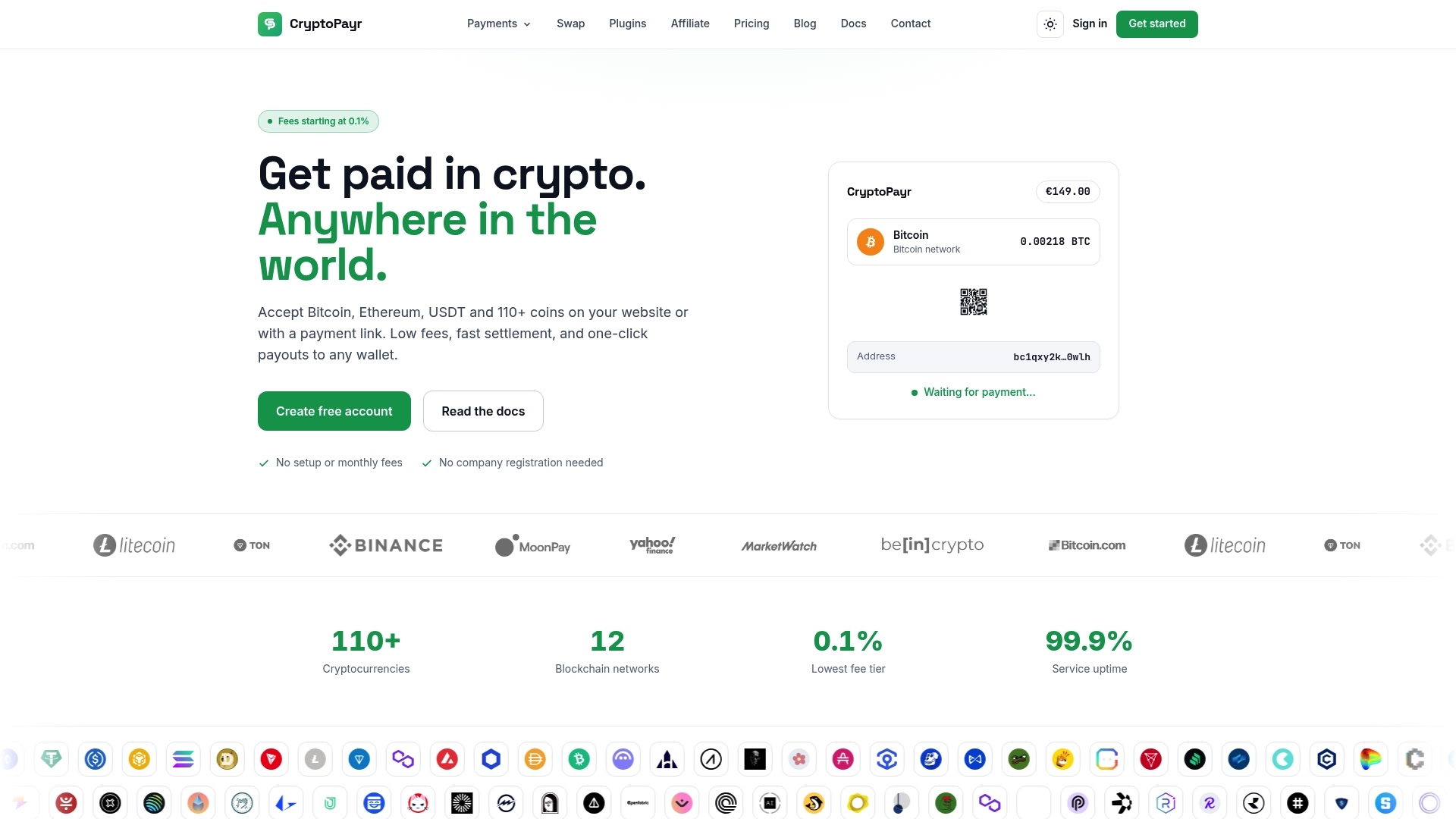
The CryptoPayr gateway supports hosted checkout, API-driven splits, and mass payouts by API or CSV, covering the full range of integration patterns covered in this guide. A sandbox environment is available for testing split calculations, payout failures, and refund flows before you go live. Developer docs and API references are available directly on the platform. If you’re ready to evaluate a crypto-first split-payments solution for your marketplace, start with the gateway and review the platform API documentation to see how split instructions map to your existing checkout flow.
Sources
Recommended