Start Accepting Bitcoin Cash in a Day With Cryptopayr for Merchants
Three ways to accept Bitcoin Cash: gateway, plugins and hosted checkout, or direct wallet. Cryptopayr skips KYC, auto-converts, and can go live in a day;...
CryptoPayrSep 22, 202611.00 min read
Start Accepting Bitcoin Cash in a Day With Cryptopayr for Merchants
Yes, your business can accept Bitcoin Cash right now, through three practical routes: a payment gateway, e-commerce plugins or hosted checkout, or a direct wallet address. Most merchants should start with a gateway, since it handles conversion, security, and reconciliation without added headcount. Pick that path, sign up, and you can be taking BCH within a day.
TL;DR:
Most merchants should start with a payment gateway to accept BCH, as it handles conversion, security, and reconciliation quickly and with minimal setup.
Setting up BCH payments involves verifying business details, embedding checkout options, and testing the full flow, with priority on sandbox testing to avoid errors during live sales.
Auto-converting BCH to fiat or stablecoins reduces exposure to volatility, while holding BCH involves market risk but offers potential for profit if prices rise.
Since BCH payments are irreversible, merchants must establish clear refund policies and understand that refunds require manual transactions, with no chargeback protections.
Accepting BCH makes business sense primarily with cross-border or customer requests, and merchants should sample adoption on select SKUs before full rollout.
Cryptopayr
Accept Bitcoin Cash With Less Friction
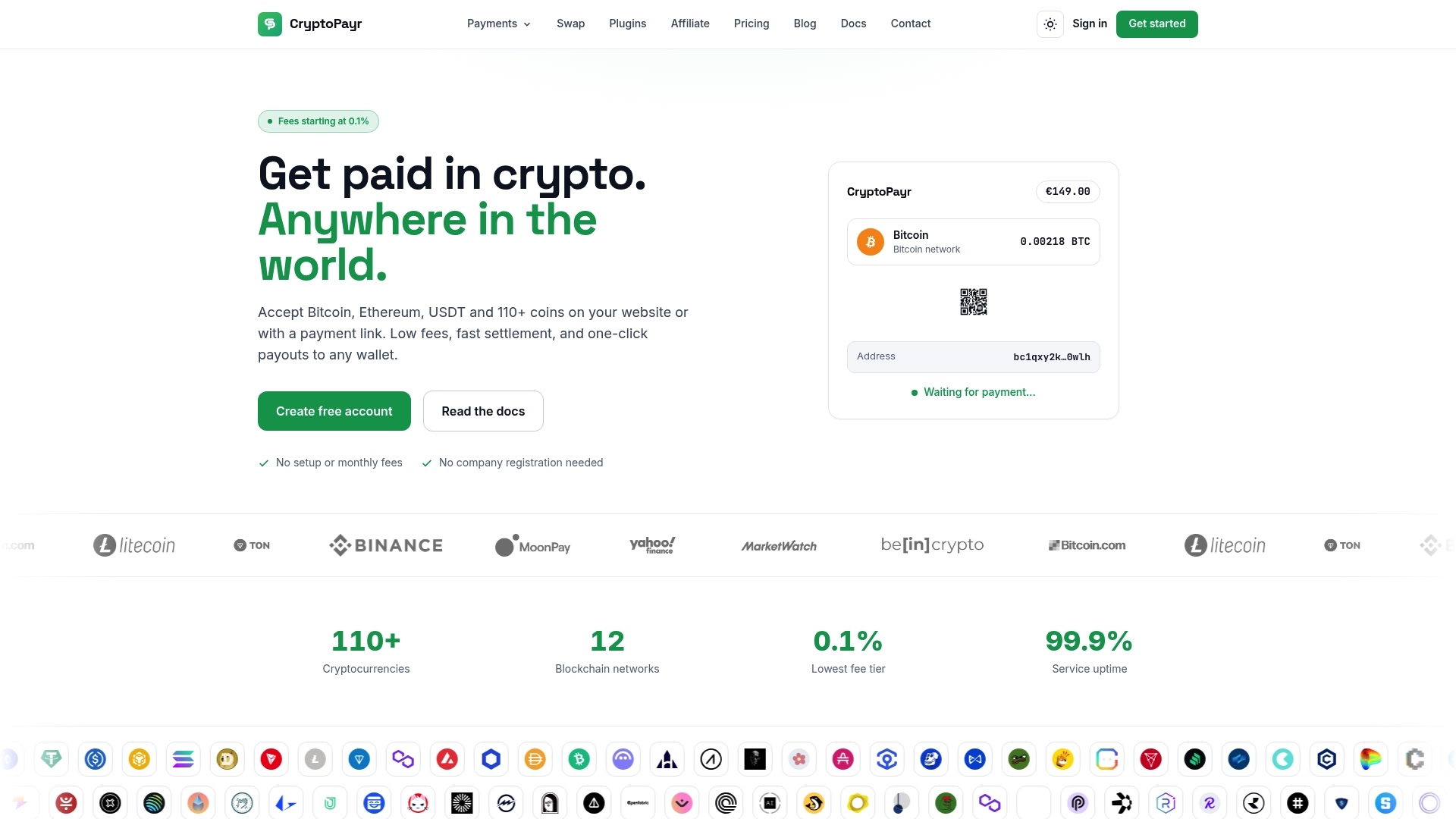
Cryptopayr helps merchants accept over 110 cryptocurrencies through a user-friendly gateway with minimal fees starting at 0.1%.
Merchants have three real options for how to accept Bitcoin Cash, and each fits a different kind of business. A crypto payment gateway is the fastest route for most stores because it handles invoicing, confirmations, and often auto-conversion to fiat without you writing a line of code. Hosted checkout pages and e-commerce plugins sit close behind. They plug into platforms like WooCommerce or Shopify carts and let customers pay in BCH at the same point they’d normally reach for a credit card. Direct wallet receipts give you full control over funds, but they leave reconciliation, security, and price tracking entirely on your plate.
Here’s how the three stack up:
Payment gateway: fastest setup, minimal daily ops, optional auto-convert to stablecoins or fiat.
Hosted checkout / plugins: strong fit for existing online stores, integrates into checkout flows customers already know.
Direct wallet: maximum control and lowest platform dependency, but you own security, bookkeeping, and volatility risk.
For most small and mid-sized merchants, a gateway is the right starting point. It gets you accepting Bitcoin Cash payments quickly, without turning your bookkeeper into a blockchain analyst.
How Do You Set Up Bitcoin Cash Acceptance Step by Step?
The setup process differs depending on which of the three integration paths you pick, but each one follows a predictable sequence.
Hosted checkout:
Sign up with a gateway provider and verify your business details.
Configure your payout currency (BCH, a stablecoin, or fiat).
Embed the checkout widget on your site or redirect customers to a hosted payment page.
Run a test transaction before going live.
E-commerce plugins:
Install the plugin for your platform (WooCommerce, for instance, has BCH-ready merchant tools).
Map your existing product prices so they convert to the correct BCH amount at checkout, since BCH prices move with the market.
Confirm the webhook or notification setup so orders update automatically once payment clears.
Place a small test order to verify the full flow, from cart to confirmation email.
API / direct integration:
Generate a one-time invoice address or QR code for each transaction.
Build webhook listeners that flip order status once the network confirms the payment.
If you’re holding BCH yourself instead of using a custodial gateway, lock down private key storage with hardware wallets or multisig.
Test everything in a sandbox environment before pushing to production.
Whichever path you choose, three things matter across the board: lock the exchange rate for the payment window, wait for adequate confirmations before marking an order complete, and never skip sandbox testing. Skipping that last step is how merchants end up debugging a broken webhook during their first real sale instead of before it.
How Does Settlement and Pricing Work for BCH Payments?
You get to decide whether you hold the Bitcoin Cash you receive or convert it immediately, and that choice shapes your risk and your accounting.
Auto-convert to fiat or stablecoins removes price volatility the moment a payment lands, which is the safer default for most retailers who don’t want crypto exposure on their balance sheet. Holding BCH exposes you to price swings but lets you benefit if the market moves in your favor, and it suits merchants who want to build crypto treasury on purpose.
Fee expectations are simple: you’re generally looking at a gateway fee plus a network fee, and the Bitcoin Cash network is built specifically for low fees and fast confirmations, which keeps that second cost close to negligible even on small transactions.
Lock exchange rates for a short window (commonly a few minutes) to stop price drift from undercutting your margin.
Decide bank payout cadence upfront, daily, weekly, or on-demand, since settlement timing affects cash flow.
Watch for gateway tiers, since fee percentages usually drop as your monthly volume grows.
What Compliance and Tax Rules Apply to BCH Payments?
Rules on money transmission and crypto taxation vary sharply by country, so check your local requirements before you take your first payment. What counts as taxable income, when it’s recognized, and whether you need a specific license all depend on jurisdiction.
A regulated payment gateway often absorbs much of that burden by handling KYC and AML checks on its end, which shifts a chunk of the compliance load off your shoulders. If you’re running a direct wallet setup instead, that custody responsibility, along with the recordkeeping that comes with it, stays entirely with you.
Timestamp every transaction and log the exchange rate at the moment of sale.
Keep records in a format your accountant can reconcile against bank deposits.
Write a clear refund policy before you launch, since Bitcoin Cash payments are irreversible once confirmed.
Pro Tip:Export your transaction log monthly and store the fiat value at time of sale alongside the crypto amount. Tax authorities in most countries want to see the value in local currency at the moment the transaction happened, not today’s price.
What Should the Checkout Experience Look Like for Customers?
Show both the fiat price and its BCH equivalent side by side, and hold that quote for a short rate-lock window so the number on screen doesn’t drift before the customer finishes paying. QR codes work well for in-person point-of-sale terminals, while mobile wallet deep links cut friction for online shoppers checking out from a phone.
Display fiat price alongside the live BCH conversion, with a visible countdown on the rate lock.
Offer a QR code for in-store terminals and a tappable wallet link for mobile checkout.
State your refund policy clearly at checkout, before payment, not buried in a terms page.
Keep the flow to as few steps as possible. Customers new to crypto abandon carts fast when a process feels unfamiliar.
Why Cryptopayr Is a Practical Fit for BCH Acceptance
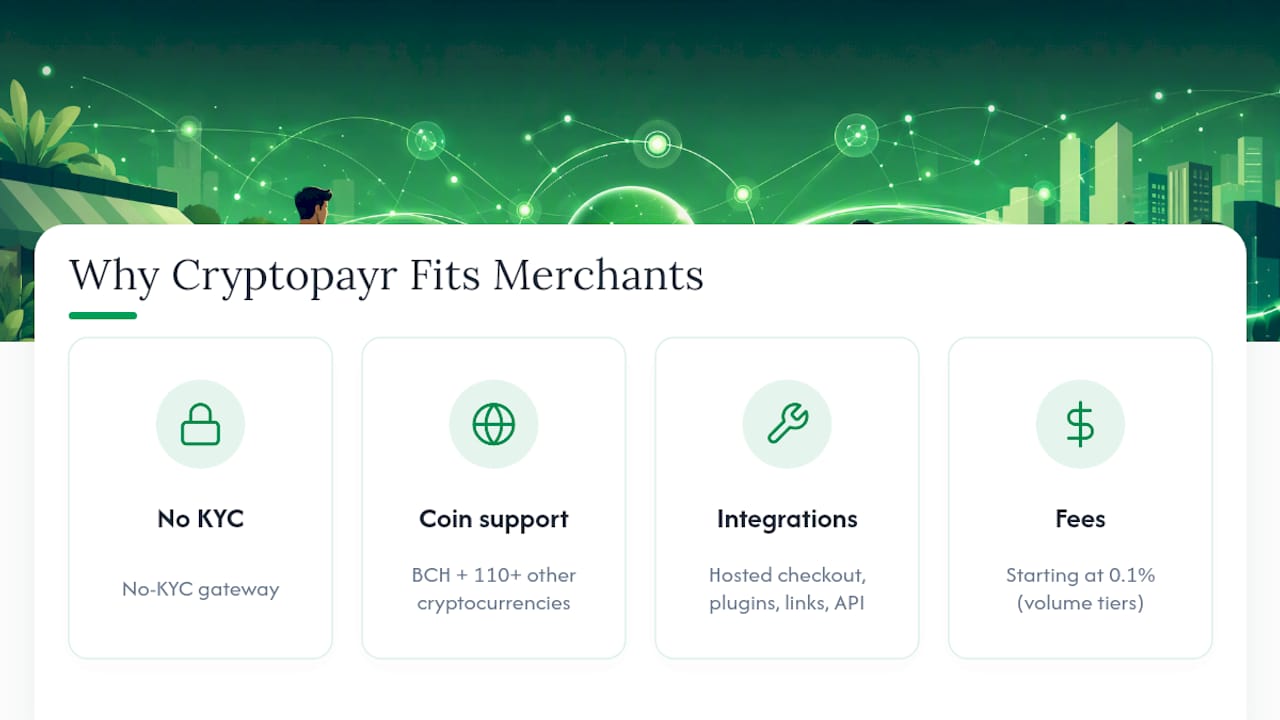
Cryptopayr runs a no-KYC gateway supporting BCH alongside 110+ other cryptocurrencies, through hosted checkout, plugins, payment links, and a direct API. Onboarding skips the lengthy verification cycle typical of traditional processors, and fees start at 0.1% depending on volume tier. Auto-conversion to stablecoins means you’re not stuck watching BCH price charts all day. For a merchant who wants BCH live on their site this week rather than next quarter, that combination of speed and coin breadth is the practical draw.
How Do Refunds and Chargebacks Work With Bitcoin Cash?
Bitcoin Cash transactions don’t support chargebacks the way card networks do. Once a payment confirms on the blockchain, there’s no bank or card network to call and reverse it. That single fact should shape your entire refund policy before you accept your first BCH payment.
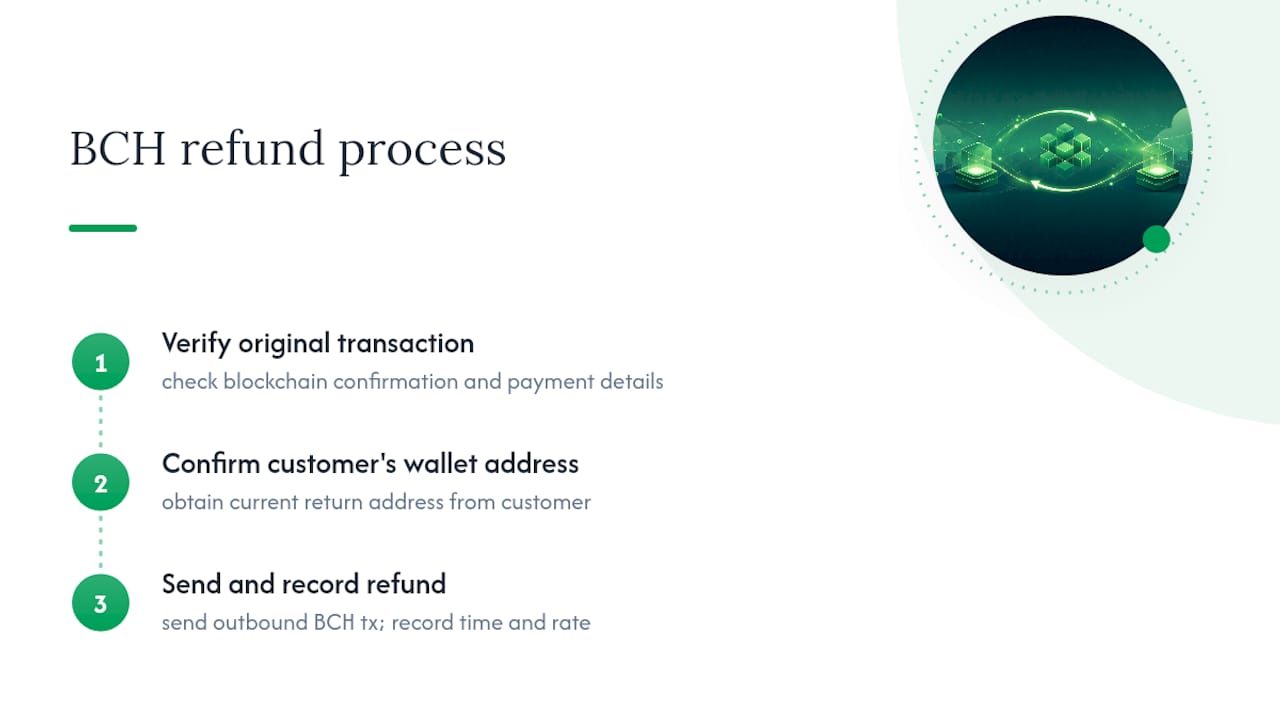
Refunds have to be issued manually, as a new outbound transaction back to the customer’s wallet address. That means you need the customer’s return address at the time of the refund request, since crypto payments typically don’t carry billing details the way card transactions do. Build a simple process: verify the original transaction, confirm the customer’s current wallet address, and send the refund as a standard payment, tracked with its own timestamp and exchange rate for your books.
The absence of chargebacks cuts both ways. It protects you from the fraudulent chargeback disputes that plague card processing, where a customer claims non-delivery weeks after receiving goods. But it also means customers have no built-in recourse if something goes wrong on your end, so a clear, visible refund policy at checkout isn’t optional, it’s what replaces the safety net card networks normally provide. Gateways that offer auto-conversion can complicate refunds slightly, since you may need to reacquire BCH at current market price to send a refund if you already converted the original payment to fiat. Plan for that scenario in your policy rather than discovering it mid-dispute.
When Does Adding BCH Actually Make Business Sense?
Add Bitcoin Cash when you see real signal: customers asking for it, or a chunk of cross-border buyers who’d rather skip high card fees and slow international transfers. That’s a clear win. If your customer base skews risk-averse or price-sensitive to volatility, lean toward stablecoins or majors like Bitcoin instead.
Don’t roll it out storewide on day one. Pick a handful of SKUs, enable BCH there, and measure uptake for a month before deciding whether to expand.
— Dustin
Ready to Start Accepting Bitcoin Cash Payments?
If you’ve been comparing hosted checkout pages against running your own wallet setup, there’s a simpler middle path. Cryptopayr’s gateway skips the KYC paperwork that slows down most processors, so you can go from signup to live checkout without a multi-week verification cycle.
You get hosted checkout, e-commerce plugins, payment links, and a direct API under one setup, plus auto-conversion so BCH volatility never touches your books unless you want it to. Fees include percentage-based tiers and optional flat fees per payment. Merchants running WooCommerce or similar carts can check the e-commerce integration options directly, while anyone wanting to build a custom checkout can start with the gateway documentation. Head to Cryptopayr to set up your account and start accepting your first BCH payment today.
How Can I Accept Bitcoin Payments as a Small Business?
Sign up with a crypto payment gateway, connect it to your website or point-of-sale system, and it generates a payment address or QR code for each transaction. Most gateways, including Cryptopayr’s setup, skip lengthy KYC checks so you can start accepting payments within a day.
Can I Transfer Bitcoin Cash to My Bank Account?
Yes, if you use a gateway with auto-conversion, BCH gets converted to fiat automatically and settled to your bank on a schedule you set, daily, weekly, or on demand. Without auto-conversion, you’d need to sell the BCH on an exchange yourself before withdrawing fiat.
How Do I Pay for Something With Bitcoin Cash?
Scan the merchant’s QR code with a BCH wallet app, or copy the payment address and send the exact amount shown at checkout. Confirmation usually happens within minutes thanks to the Bitcoin Cash network’s design for fast, low-fee transactions.
How Do I Receive Bitcoin Cash as a Merchant?
You need a BCH wallet address or a gateway account that generates one automatically per transaction. A gateway is the simpler option since it handles address generation, confirmation tracking, and optional conversion without you managing wallet security yourself.
What Does It Cost to Accept BCH Through a Gateway?
Fees vary by tier and pricing model; current details are available on Cryptopayr’s site. Details on all tiers are listed on the Cryptopayr site.