Crypto Payment Gateway Fees: What You’ll Actually Pay

Most businesses accepting cryptocurrency pay somewhere between 0% and 1.5% per transaction in headline fees, plus whatever the network charges to move the coins. On a $100 sale, that means $0.40 to $1.50 in gateway costs, sometimes less if you self-host, sometimes more once you factor in conversion spreads and withdrawal fees that never show up in the marketing copy.
For most merchants, the smartest move is crypto-native or stablecoin settlement paired with a provider that publishes its full fee schedule up front. If you’re processing high volume, push for negotiated tiered pricing instead of accepting the advertised rate. CryptoPayr’s role in this picture is straightforward: a no-KYC gateway with fees starting at 0.1%, which undercuts most hosted competitors before you even negotiate.
Three things to act on right now:
- Expect all-in costs ranging broadly depending on the provider and settlement method you choose.
- Watch for conversion spreads and flat withdrawal fees. These often hide in the fine print, not the headline rate.
- Before signing anything, ask the vendor for a written cost example at your actual sales volume.
Verdict: if your average sale is small and you want predictable costs, crypto-native or stablecoin settlement beats fiat auto-conversion nearly every time. Save fiat conversion for when your accounting team genuinely needs it.
Key Takeaways
| Point |
Details |
| Headline rate isn’t the total cost |
Add conversion spread (0.5%–2%) and withdrawal fees before comparing providers. |
| Network choice changes everything |
Lightning or Solana can cost under $0.05 per transfer versus several dollars on Ethereum or Bitcoin mainnet. |
| Calculate your effective rate |
Divide total fees by total volume to get the one number worth comparing across providers. |
| Ask for written quotes |
Request sample all-in costs at your actual volume before signing any contract. |
| CryptoPayr starts at 0.1% |
With no-KYC onboarding and support for 110+ coins, it fits SaaS and e-commerce merchants seeking lower starting fees. |
Table of Contents
What Makes Up Crypto Payment Gateway Fees?
A crypto processing bill is never just “the rate.” It’s a stack of separate charges, some fixed by the blockchain itself, others entirely up to the provider you pick.
The merchant or gateway percentage is the fee everyone quotes, and it’s usually the smallest surprise. Network fees, on the other hand, belong to the blockchain, not the processor, and they swing wildly depending on which chain you’re using. Then there’s the conversion spread, charged when a gateway auto-converts your crypto into stablecoins or fiat. This one rarely gets mentioned until you read the settlement report and wonder why you netted less than expected.
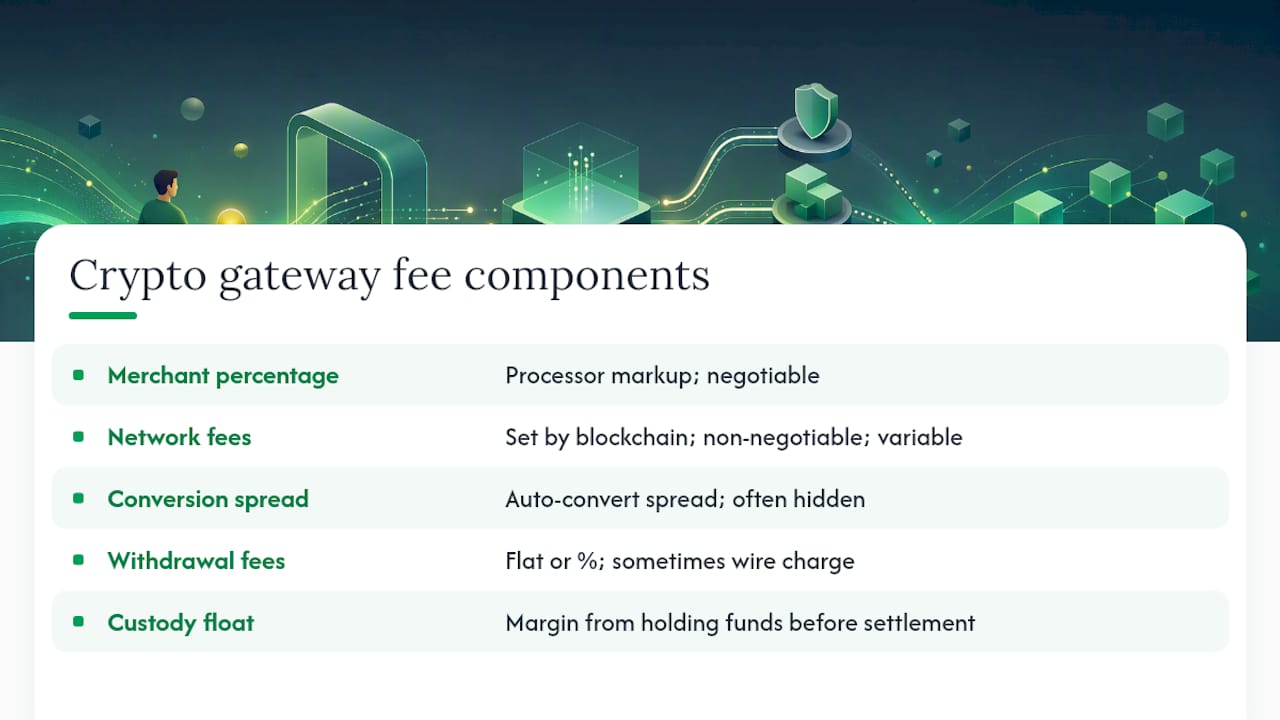
Withdrawal or payout fees hit when you move settled funds out of the platform, sometimes a flat fee, sometimes a percentage, sometimes a wire charge that makes no sense on a $50 payout. Custody float margins are subtler still: some providers earn spread by holding your funds briefly before settlement. Monthly platform fees, sandbox access charges, chargeback or dispute fees, and FX costs for cross-border wires round out the list.
Here’s the part that matters for negotiation: network fees are fixed by the blockchain, but the processor’s markup is where you actually have leverage. Card networks set interchange, and blockchains set gas costs. Nobody negotiates those. But the percentage the gateway tacks on top, and how often it lets you withdraw for free, are both fair game in a vendor conversation.
Pro Tip: Ask specifically about the conversion spread and the per-withdrawal fee in writing. These two line items are where gateways quietly recover the margin they gave up on the headline percentage.
How Much Do You Actually Lose on a $100 Sale?
Headline rates tell you almost nothing until you run them against a real transaction. Hosted custodial gateways typically charge 0.4% to 1.5%, while self-hosted setups can bring the merchant fee down to effectively zero, with the tradeoff being that you absorb network fees directly and handle more of the technical lift yourself.
Take a $100 sale. Add a stablecoin conversion at a 0.5% spread, and you’re down another $0.50, for a total of $1.50 lost before any withdrawal fee applies. Now compare that to a self-hosted Bitcoin setup: no merchant fee, but if you’re settling on the base Bitcoin network during a congested period, the sender’s network fee alone could exceed the entire transaction’s margin on a small sale.

Network choice changes this math dramatically. A Lightning Network or Solana transaction often costs less than $0.05, while Bitcoin’s base layer or Ethereum’s ERC-20 rail can run several dollars per transfer. That difference is invisible on a $1,000 invoice and massive on a $10 coffee sale.
Here’s how the numbers actually shake out:
| Sale amount |
Crypto-native (0.1%–0.5%) |
Stablecoin + convert spread |
Fiat payout with wire fee |
| $100 |
$0.50 |
about $1.50 |
wire fee dominates total cost |
| $1,000 |
$1 – $5 |
$5 – $20 |
about $30 |
- On small tickets, a fixed wire fee can eat your entire margin.
- On larger tickets, that same wire fee becomes a rounding error.
- The crossover point where fiat withdrawal makes sense usually starts somewhere around $1,000-plus per payout batch, depending on your provider’s wire cost.
The takeaway: the fee percentage on the invoice means little without knowing which network and settlement method sits behind it.
Should You Settle in Crypto, Stablecoins, or Fiat?
Settlement currency is the single biggest lever most merchants ignore. Settling directly in crypto (Bitcoin, Ethereum, whatever the customer paid in) keeps your cost closest to zero, but exposes you to price swings between the moment of sale and the moment you convert or spend it.
Stablecoins like USDC or USDT solve the volatility problem while keeping fees relatively low, generally the sweet spot for businesses that want crypto’s cost advantage without holding a volatile asset overnight. Fiat settlement, whether USD or EUR, gives your accounting team the simplest books, but it usually comes with the largest total cost once you stack the conversion spread and a wire fee on top.
- Lowest cost: crypto-native settlement, but you carry FX risk.
- Balanced: stablecoin settlement, low spread, no price volatility.
- Simplest accounting: fiat, highest total cost once spreads and wires are included.
Auto-convert to fiat is worth paying for when you need cash flow predictability or your bookkeeping can’t handle crypto-denominated revenue. It stops being worth it on small-ticket e-commerce, where the spread and wire fee combined can outweigh the entire profit margin on the sale.
Pro Tip: Low-ticket e-commerce businesses generally do best on stablecoin settlement with batched, less frequent withdrawals. B2B operations invoicing in the thousands can absorb fiat conversion costs without much pain.
Where in the Payment Flow Do Fees Actually Get Charged?
Every crypto transaction moves through five distinct stages, and a fee (or a spread) can attach at nearly every one of them.
- Checkout authorization: the customer selects crypto, the gateway generates a payment address or invoice. No fee yet, but the network fee estimate is often locked in here.
- On-chain settlement: the customer’s wallet broadcasts the transaction, and the sender typically pays the network fee, though some gateways absorb or pass this through differently.
- Gateway custody and auto-convert: if you’ve opted into stablecoin or fiat conversion, this is where the spread gets applied.
- Settlement batch: funds accumulate in your merchant account, sometimes with a custody float margin depending on how the provider manages liquidity.
- Withdrawal/payout: you pull funds out, and this is where flat fees or wire costs typically land hardest, especially on smaller batches.
Picture it as a pipeline with five valves. Money enters clean at checkout, and each valve downstream can skim a little before it reaches your bank account or wallet. Knowing which valve costs the most for your specific volume is the entire game.
What Should You Ask Before Signing With a Gateway?
Vendor sales pages rarely show the full picture, so the questions you ask during evaluation matter more than the marketing page you read first.
Run through this checklist before signing anything:
- Fee transparency — Does the provider publish a complete fee schedule, or do you have to request pricing?
- Settlement options — Can you settle in crypto, stablecoins, and fiat, and does each option carry a different fee?
- Supported rails — Which blockchains and networks are supported, and does the provider route to the cheapest one automatically?
- Withdrawal fees — Are payouts flat-fee, percentage-based, or free above a certain threshold?
- Uptime and SLA — What happens to a transaction if the gateway goes down mid-checkout?
- Regulatory coverage — Is the provider licensed in the jurisdictions where your customers are located?
- Escalation path — Who do you call when a settlement is delayed?
Ask vendors directly for a written, sample all-in cost across a few volume tiers. A script that works: “Provide a sample all-in cost on $100, $1,000, and $10,000 in monthly volume, with weekly payout cadence, broken into gateway fee, conversion spread, and withdrawal cost separately.” Most established providers will negotiate on markup once you can show real transaction history, so don’t accept the first number offered.
Red flags worth walking away from: bundled fees that hide the conversion spread inside the headline rate, vague language around “settlement timing,” and any refusal to put fee terms in writing. Delayed settlement is its own risk category worth understanding before you commit to a provider.
How Do You Lower Your Crypto Processing Costs?
Reducing your effective rate isn’t about switching providers every quarter. It’s about a handful of specific, repeatable moves.
- Audit your current statement. Calculate your effective rate: total fees divided by total processing volume, expressed as a percentage. This single number reveals your true cost across every payment method you accept, and it’s the baseline you compare every future quote against.
- Model the impact of routing. Intelligent routing by coin type and network, plus consolidating your payment stack instead of running five separate processors, cuts both fees and reconciliation labor. A merchant running cards, ACH, and crypto separately often duplicates reporting work that a single consolidated platform eliminates.
- Test lower-cost networks. Push customers toward Lightning, Solana, or Polygon rails where the gateway supports them, instead of defaulting to Ethereum mainnet.
- Negotiate volume tiers. Once you can show consistent monthly volume, ask for interchange-plus style pricing instead of a flat blended rate.
- Batch your withdrawals. Fewer, larger payouts amortize any flat withdrawal fee across more revenue.
A quick modeled example: a merchant processing $50,000 a month at a blended 1.2% rate pays $600 in fees.
Pro Tip: Watch for retry storms, repeated failed payment attempts that some gateways bill for individually. A single customer with a flaky wallet connection can generate several billable attempts before one succeeds.
Where Does CryptoPayr Fit Into This Picture?
CryptoPayr was built around the exact cost problems outlined above: unpredictable spreads, opaque withdrawal fees, and onboarding friction that slows down go-live dates. It supports 110+ cryptocurrencies including Bitcoin and Ethereum, with fees starting at 0.1%, a rate that sits below most hosted competitors’ headline range before any volume negotiation happens.
The platform covers the full toolkit finance teams actually need:
- Hosted checkout, payment links, and a direct API for custom integrations
- Auto-conversion to stablecoins for merchants who want price stability without full fiat conversion costs
- Mass payouts for marketplaces and platforms splitting commissions across multiple parties
- White-label checkout for platforms that want their own branding on the payment flow
- No-KYC onboarding, which removes the weeks-long verification delay common with traditional processors
For SaaS businesses losing revenue to failed card payments, or e-commerce platforms selling internationally where card rails don’t reach every customer, the combination of low starting fees and broad settlement flexibility solves the two biggest cost drivers covered in this article: headline rate and hidden conversion spread.
A Note on Priorities: Rate vs. Simplicity
Finance teams often chase the lowest headline percentage and stop there. That’s a mistake.
The hidden cost that catches most teams off guard isn’t the rate on the invoice. It’s the reconciliation time spent chasing down why net settlement never matches the gross sales figure, usually because nobody modeled the spread and withdrawal fee together before signing.
Get a Written Cost Comparison From CryptoPayr
Compare that to traditional processors that require verification cycles before you process a single transaction.
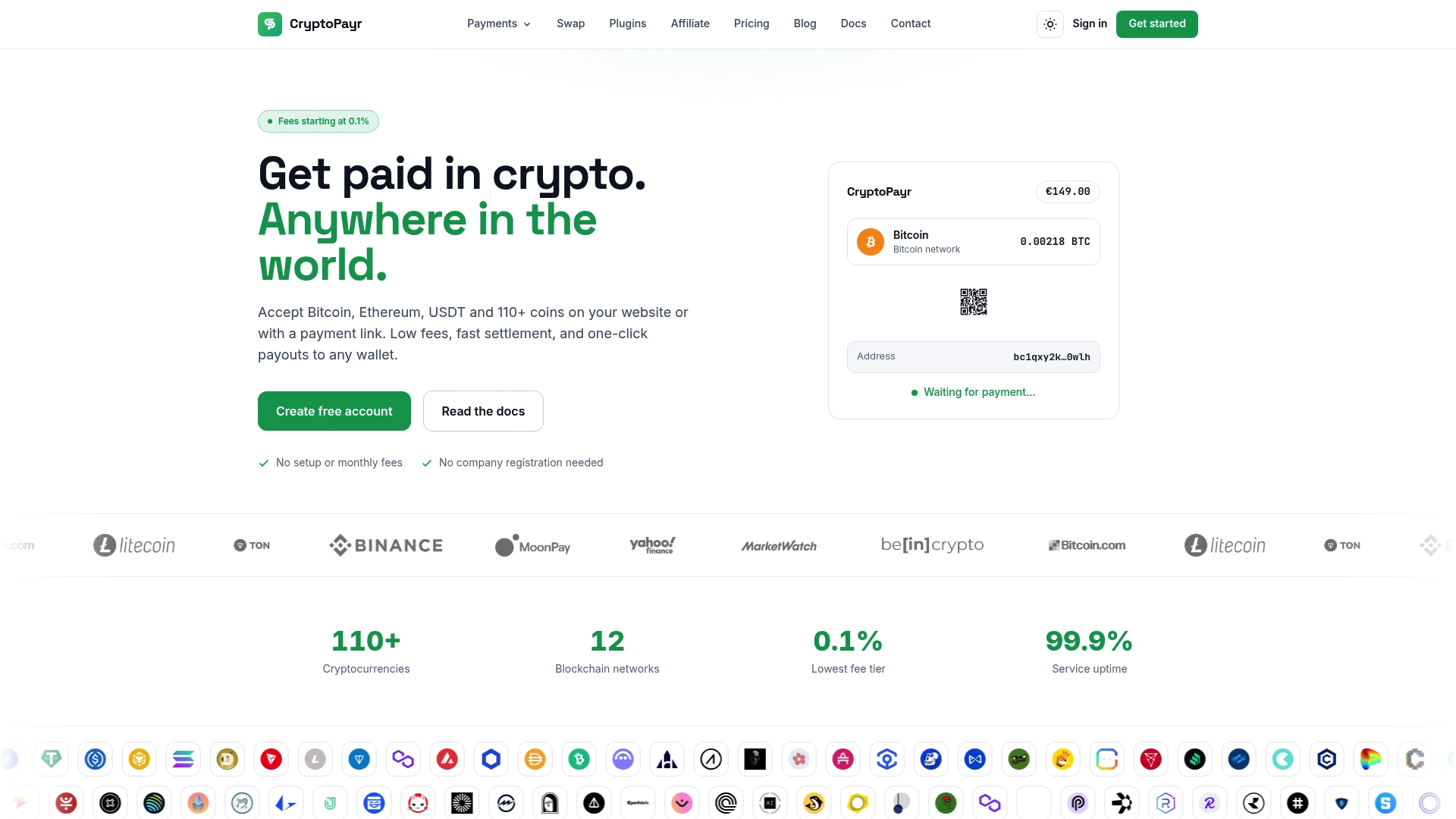
Run your own numbers before deciding anything. Request a written all-in cost breakdown from CryptoPayr for your actual monthly volume, comparing crypto-native, stablecoin, and fiat payout scenarios side by side. The gateway page lists supported integrations, sandbox access for testing before you go live, and the full fee schedule. If you’re a platform or agency looking to offer branded crypto checkout to your own clients, the white-label option is worth a look too. Start with a sandbox integration, model your effective rate, and decide from real numbers instead of a sales page.
Sources
Recommended