No-KYC Payment Gateway for U.S. Merchants: 2026 Guide

U.S. merchants can accept crypto payments with minimal or no merchant-side KYC today, but the phrase “no-KYC payment gateway” covers three very different realities, and only one of them is straightforwardly available to American businesses without regulatory exposure. The shortest path forward: use a non-custodial or KYC-light hosted gateway like Cryptopayr that passes crypto directly to your wallet, keeps onboarding friction low, and lets you handle your own IRS and FinCEN obligations separately.
Before going further, three things every U.S. merchant should know upfront:
- Crypto receipts are taxable income. The IRS treats every crypto payment you receive as a taxable event at fair market value on the date received.
- FinCEN’s Travel Rule and AML rules apply to custodial providers. Any gateway that holds or converts your funds is subject to Bank Secrecy Act requirements, which shapes what “no-KYC” they can actually offer you.
- Merchant-side KYC and buyer-side KYC are different things. Most of what’s marketed as “no-KYC” refers to your customers, not to you as the merchant.
Key Takeaways
Merchants who accept crypto with minimal KYC can do so legally in the U.S., provided they use a non-custodial or KYC-light gateway, handle their own IRS reporting, and understand that buyer-side anonymity and merchant-side no-KYC are two distinct claims.
| Point |
Details |
| Two meanings of “no-KYC” |
Buyer-side anonymity and merchant-side light onboarding are different; know which one a gateway actually offers. |
| Non-custodial settlement is the key |
Gateways that route funds directly to your wallet avoid custody obligations and keep onboarding requirements minimal. |
| IRS and FinCEN obligations remain |
Crypto receipts are taxable income regardless of gateway type; document every transaction for your tax reporting. |
| Fiat conversion adds KYC triggers |
Auto-conversion to stablecoins is the lowest-friction dollar-pegged option; full fiat payouts typically require additional verification. |
| Cryptopayr for KYC-light integration |
Cryptopayr offers direct wallet settlement, 110+ coins, fees from 0.1%, and full plugin and API support with minimal onboarding. |
Table of Contents
What does “no-KYC” actually mean for merchants and buyers?
The term gets used loosely, and that looseness causes real problems when merchants pick the wrong tool for the job. A 2026 roundup of no-KYC gateway options identifies three distinct models: buyer-side anonymity at checkout, tiered or light merchant verification, and fully non-custodial wallet-to-wallet flows. Each means something different operationally.
Buyer-side no-KYC means your customers can pay without creating an account, uploading ID, or going through any identity check on your checkout page. This is the most common claim in gateway marketing, and it’s largely achievable. A customer sends crypto from their own wallet to a payment address you generate, and no personal data changes hands at the point of sale. Payment links, hosted checkout pages, and wallet-to-wallet flows all support this model.
Merchant-side no-KYC is the harder claim. It means you, the business owner, can onboard to a gateway and start receiving funds without submitting business registration documents, proof of identity, or Know Your Business (KYB) verification. This is where the real constraints live for U.S. merchants.
Here’s how each model maps to practical merchant outcomes:
- Buyer-side no-KYC: Customer pays anonymously; you still control settlement wallet, fees are typically lower, and no customer data is stored by the gateway.
- Tiered/light merchant verification: You provide minimal business info (email, wallet address, sometimes a domain), but no full KYB. Settlement goes directly to your wallet. This is the realistic middle ground most U.S. merchants can use.
- Non-custodial wallet-to-wallet: Funds never touch a third-party custodian. You run your own node or use a self-hosted gateway. Maximum control, maximum operational overhead.
Community threads on platforms like Reddit confirm that many merchants searching for a no-KYC payment gateway without verification discover quickly that most options are either informal workarounds, limited-purpose tools, or gateways that quietly require KYC above certain volume thresholds.
Pro Tip: Ask any gateway vendor specifically whether their “no-KYC” claim applies to the merchant onboarding or only to the buyer checkout flow. These are different products with different risk profiles.
U.S. regulatory reality: AML rules, MSB/KYB expectations, and the Travel Rule
The regulatory picture for U.S. merchants accepting crypto is more nuanced than most gateway marketing suggests, and getting it wrong creates real legal exposure.
FinCEN’s position: Businesses that accept, transmit, or convert virtual currency as a core business function may qualify as Money Services Businesses (MSBs) under the Bank Secrecy Act. MSBs must register with FinCEN, implement AML programs, and file Suspicious Activity Reports. A merchant who simply accepts crypto as payment for goods or services generally does not trigger MSB status — but a merchant who also converts, holds, or transmits crypto on behalf of others may. The line depends on your specific business model, and FinCEN guidance has evolved as crypto adoption has grown.
For most e-commerce merchants, the practical regulatory picture breaks down like this:
- Accepting crypto directly to your own wallet for goods or services is generally not an MSB activity. You’re a receiver, not a transmitter.
- Using a custodial gateway that holds and converts your funds means the gateway itself carries the MSB/AML obligations, but it also means the gateway will require KYB from you to protect its own compliance posture.
- The Travel Rule (FinCEN’s rule requiring financial institutions to pass identifying information with transfers above $3,000) applies to covered institutions, not to individual merchants. But it shapes what custodial gateways can offer: a gateway subject to the Travel Rule cannot offer truly anonymous fund flows above certain thresholds.
- IRS Form 1099-DA is being phased in for crypto brokers, which includes some gateway providers. Even if your gateway doesn’t issue one, you’re still required to report crypto income on your federal return.
Chainalysis’ regulatory analysis of emerging crypto frameworks globally shows that governments are actively tightening enforcement patterns, not loosening them. The U.S. is no exception. Providers that offered lax onboarding two or three years ago have largely introduced tiered KYC or compliance triggers as enforcement clarity has improved.
This article is general information, not legal or tax advice. Consult a qualified attorney or CPA familiar with crypto before making compliance decisions for your business.
What options actually let you accept crypto with minimal merchant KYC?
Four categories of solutions exist for U.S. merchants. They differ significantly on custody, settlement speed, fiat conversion, integration complexity, and regulatory boundary.
Self-hosted gateways (BTCPay Server model)
You run your own payment server, connected to your own node. No third party holds your funds at any point. BTCPay Server is the canonical example: open-source, free to run, and genuinely non-custodial. The trade-off is real: you need server infrastructure, technical maintenance, and you handle all reconciliation yourself. Fiat conversion requires a separate off-ramp, which typically does require KYC from that exchange or OTC desk. Best for technically capable merchants who prioritize sovereignty over convenience.

Non-custodial wallet-to-wallet gateways
These generate a unique payment address per transaction and route funds directly to your wallet without the gateway ever taking custody. Settlement is near-instant on-chain. No fiat conversion is built in, so you either hold crypto or arrange your own conversion. Regulatory exposure for the gateway is minimal, which is why onboarding requirements tend to be lighter. Integration complexity sits between self-hosted and fully hosted.
Hosted no-KYC or KYC-light providers
This is where most merchants land. A hosted provider manages the checkout UX, generates payment addresses, monitors confirmations, and handles the customer-facing flow. The merchant provides minimal onboarding information (often just an email and a destination wallet address), and funds settle directly to that wallet. The gateway earns a fee per transaction but never holds your funds long-term. Fiat conversion, if available, may require additional verification. Cryptopayr operates in this category, supporting 110+ cryptocurrencies with fees starting at 0.1% and direct wallet settlement.
Full custodial gateways
These hold your funds, handle conversion, and pay out in fiat or stablecoins on a schedule. They offer the most features (chargebacks, fiat payouts, accounting integrations) but require full KYB verification because they’re operating as financial intermediaries. Not a no-KYC option by any reasonable definition.
| Category |
Custody |
Merchant KYC |
Fiat conversion |
Integration effort |
| Self-hosted (BTCPay-style) |
None |
None required |
Separate off-ramp needed |
High |
| Non-custodial wallet-to-wallet |
None |
Minimal/none |
Limited or none |
Medium |
| Hosted KYC-light provider |
None (pass-through) |
Light (email + wallet) |
Optional, may trigger KYC |
Low |
| Full custodial gateway |
Full |
Full KYB required |
Built-in |
Low |
The niche gateway directories and merchant software listings that surface these options vary widely in how current their information is. Always verify current terms directly with the vendor, since listed policies often lag actual practice.
How to implement: integrations, settlement options, fees, and UX patterns
Getting from “I want to accept crypto” to “payments are live” involves five decisions. Here’s the sequence that works for most U.S. merchants:
- Choose your integration pattern. Hosted checkout (redirect or iframe) is fastest to deploy. API integration gives you full control over the UX. Plugins for WooCommerce, Shopify, or OpenCart let you add crypto acceptance in under an hour with no custom code. Payment links work for service businesses, freelancers, and anyone who invoices clients directly.
- Decide your settlement currency. Crypto-only settlement means you receive BTC, ETH, or whatever coin the customer paid with, and you manage conversion yourself. Auto-conversion to stablecoins (USDC, USDT) locks in dollar value at the moment of payment without requiring a fiat off-ramp. On-demand fiat conversion is available through some providers but typically requires additional verification and a banking relationship.
- Understand the fee structure. Most KYC-light gateways charge a percentage per transaction with no fixed component. Cryptopayr starts at 0.1% per transaction, which is at the low end of the market. Watch for network/miner fees on top of gateway fees, especially for lower-value transactions on congested chains.
- Plan your reconciliation workflow. Every crypto receipt is a taxable event. Your accounting system needs the transaction timestamp, the amount in crypto, and the USD fair market value at the time of receipt. Most gateways provide transaction logs via API or CSV export. Map these to your accounting software (QuickBooks, Xero, or a crypto-specific tool like Koinly) before you go live, not after.
- Test the checkout UX from the customer’s perspective. Customers unfamiliar with crypto wallets abandon at the payment step more often than at any other point. A clear QR code, a visible countdown timer for the payment window, and a confirmation screen reduce abandonment significantly.
For SaaS merchants specifically, recurring billing in crypto requires either a subscription management layer or a payment-link-per-cycle approach, since crypto transactions operate as push-only payments. Crypto payments for SaaS work best when framed as an alternative payment method for customers who can’t or won’t use cards, not as a replacement for your card processor.
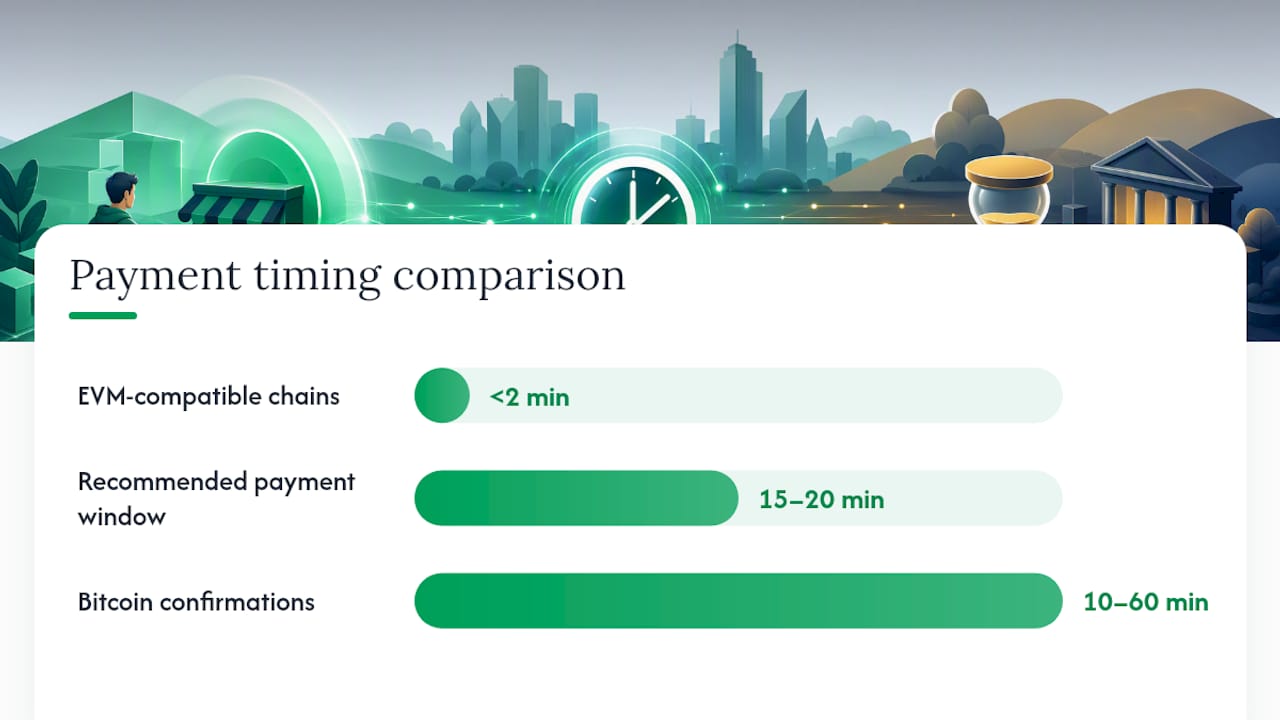
Pro Tip: Keep your crypto payment window to 15–20 minutes and display the exact amount in crypto (not just USD) prominently. Customers who have to calculate the conversion themselves abandon at a much higher rate.
Settlement timing varies by chain. Bitcoin confirmations take 10–60 minutes depending on network congestion and how many confirmations your gateway requires. EVM-compatible chains (Ethereum, Polygon, BNB Chain) typically confirm in under two minutes. Stablecoin settlements on fast chains can be near-instant. If you need same-day liquidity, choose a gateway that supports fast-chain stablecoins and auto-conversion.
What are the operational and compliance risks of no-KYC flows?
The risks are real and specific. Merchants who go in without a clear picture of them tend to discover them at the worst possible moment.
Red flags from a gateway:
- No published terms of service or AML policy. A legitimate gateway has both, even if onboarding is light.
- Sudden account closure or fund freezing with no notice or appeal process. This is the most common complaint in community threads and review sites. Public reviews on platforms like Trustpilot can surface operational issues, but treat them as signals to investigate, not verdicts.
- No transaction log or audit trail. You need records for IRS reporting regardless of what the gateway provides.
- Promises of complete anonymity for the merchant. No legitimate U.S.-facing provider can offer this without exposing itself (and potentially you) to regulatory liability.
Red flags from payer flows:
- Payments arriving from known mixer addresses or privacy coins where your gateway flags provenance issues. AML exposure doesn’t disappear just because you didn’t ask for KYC.
- Unusually large single transactions from new customers with no business context. This is exactly the pattern that triggers Suspicious Activity Report obligations for covered entities.
Mitigation steps worth implementing before you go live:
- Set transaction limits per order and per 24-hour period. This reduces exposure to large suspicious flows and gives you a defensible risk policy.
- Use velocity checks: flag or hold orders where the same wallet address sends multiple payments in a short window.
- Document your risk appetite in writing. If you’re ever in a conversation with a bank or regulator, a written policy showing you thought about AML risk is far better than no policy at all.
- For high-risk industry merchants, consider whether a KYC-light gateway is sufficient or whether you need a more structured compliance layer.
- Understand that crypto payments eliminate chargebacks from the buyer side, but chargeback risk can still appear if you also accept cards through a separate processor and a customer disputes a card transaction for an order they paid in crypto.
Banking relationships are the hidden constraint here. If your business bank account sees large, frequent crypto-to-fiat conversions, some banks will flag or close the account. This is a known friction point for crypto-accepting merchants, and it’s worth having a conversation with your bank before you scale crypto volume significantly.
Pre-onboarding checklist: questions to ask a gateway before you sign up
Don’t sign up for any gateway without getting clear answers to these questions. Some are yes/no; others require a written policy document.
Custody and settlement:
- Does the gateway take custody of my funds at any point, or do payments route directly to my wallet?
- What is the settlement currency, and can I choose between crypto, stablecoins, and fiat?
- What is the typical time from payment confirmation to funds available in my wallet?
KYC and compliance:
- What information do you require from me to onboard? Is there a volume threshold that triggers additional verification?
- Do you have a published AML policy? Can I see it before signing up?
- How do you handle payments from flagged or high-risk wallet addresses?
Operational SLAs:
- What is your uptime SLA, and how do you communicate outages?
- What is your dispute resolution process if a payment is received but not credited?
- How do you handle fraud escalation, and what is the escalation path?
Documentation for your own records:
| Document |
Why you need it |
Format |
| Transaction logs (per payment) |
IRS income reporting, reconciliation |
CSV or API export |
| Gateway terms of service |
Defines your legal relationship and liability |
PDF or URL |
| AML/compliance policy |
Supports your own risk documentation |
PDF or URL |
| Fee schedule |
Accurate cost accounting |
Written confirmation |
| Settlement wallet confirmation |
Proof funds route to your address |
Written confirmation |
Verify current product terms directly with the vendor. Review pages on platforms like G2 often lag actual policy changes by months, and a gateway that offered light onboarding last year may have introduced new KYC requirements since.
How we evaluated these options
The evaluation behind this article combined several methods, none of which involved taking a vendor’s marketing claims at face value.
- Sandbox and onboarding testing: We walked through publicly available onboarding flows for multiple gateway categories, noting what information was requested at each step and where KYC triggers appeared.
- Documentation review: We read published terms of service, AML policies, and developer documentation where available. Gateways with no published AML policy were flagged as higher-risk regardless of their marketing claims.
- Community signal review: Merchant threads (including WooCommerce community discussions) provided real-world friction points that don’t appear in vendor documentation. These were treated as signals to investigate, not conclusions.
- Vendor outreach: For gateways where documentation was ambiguous, we used available contact and demo channels to ask specific questions about custody model and KYC thresholds.
- Regulatory cross-check: Claims about U.S. legal status were checked against FinCEN guidance and IRS publications, not against other SEO articles.
Two important limits: this article is not legal advice, and gateway practices change quickly. A provider that offered light onboarding when this was written may have updated its requirements by the time you read it. Always confirm current terms directly with the vendor before committing.
Why Cryptopayr is the recommended option for this job
The case for Cryptopayr comes down to three things that matter specifically to merchants who need a no-KYC-capable integration: direct wallet settlement, breadth of coin support, and a fee structure that doesn’t punish low-volume merchants.
Most hosted gateways that advertise light onboarding either cap coin support at a handful of assets or route funds through a custodial layer that quietly introduces KYC requirements above certain volumes. For a merchant who wants to accept Bitcoin payments alongside a dozen altcoins without running their own infrastructure, that combination is hard to match.
The feature set also covers the full range of integration patterns discussed in this article:
- Hosted checkout for merchants who want a fast, low-code deployment
- API integration for merchants who need full UX control
- E-commerce plugins for WooCommerce, Shopify, and other platforms
- Payment links for service businesses and freelancers
- Auto-conversion to stablecoins for merchants who want dollar-pegged settlement without a fiat off-ramp
- White-label options for agencies and platforms building branded checkout experiences
- Mass payouts for marketplaces splitting commissions to sellers
Cryptopayr: built for merchants who need crypto payments without the friction
Merchants who’ve read this far know the real challenge: most gateways that claim “no-KYC” either cap your coin support, take custody of your funds, or quietly introduce verification requirements once your volume grows. Cryptopayr is built differently.
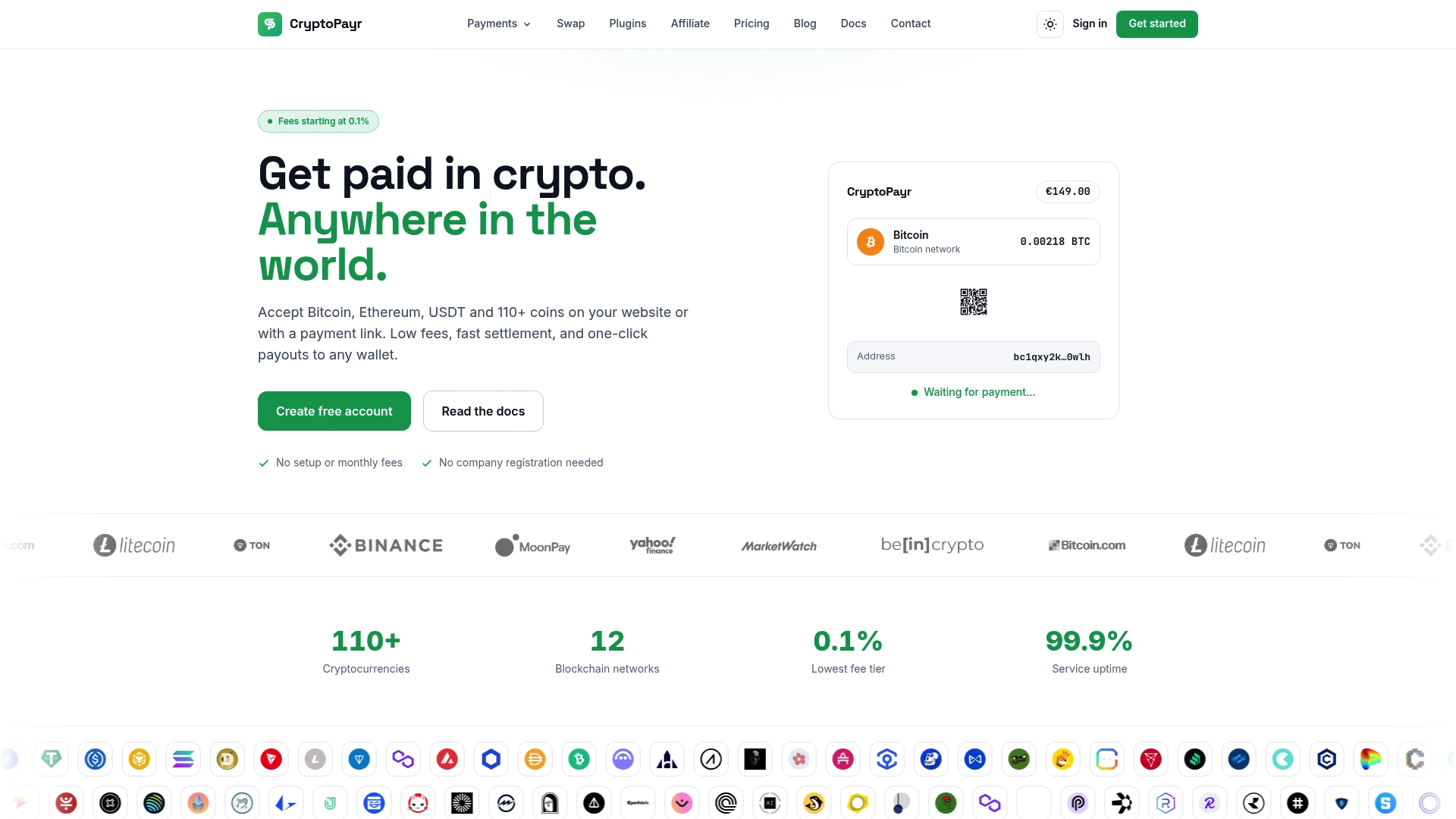
With Cryptopayr’s gateway, you get direct wallet settlement across 110+ cryptocurrencies, fees starting at 0.1%, and integration options that cover hosted checkout, API, plugins, payment links, and white-label deployments. Onboarding is straightforward, with no lengthy verification process standing between you and your first live transaction. For merchants who need to accept crypto globally without the overhead of a full custodial processor, that’s the concrete difference. Visit the gateway page to review supported coins, integration docs, and start your setup today.
Sources
- Payment gateway without kyc : r/woocommerce
This article is general information, not a substitute for advice from a qualified financial advisor. Consult a qualified financial professional about your own circumstances before acting on anything here.
Recommended