How to Sell Digital Goods for Crypto: A Seller's Guide
Learn how to sell digital goods for crypto: pick a payment model, automate delivery, handle fees, refunds and taxes, and start accepting Bitcoin and more.
CryptoPayrOct 30, 202614.00 min read
How to Sell Digital Goods for Crypto: A Seller’s Guide
To sell digital goods for crypto, you need three things: a way to quote a price and generate a payment request, a way to confirm the payment on the blockchain, and a way to deliver the file, license key or account access once it is confirmed. A crypto payment gateway handles all three, so you don’t have to run blockchain nodes or watch wallets by hand. This guide covers how to choose between a gateway and a direct wallet, how to automate delivery safely, what the fees and delays look like, and how to deal with refunds, underpayments and taxes.
Cryptopayr
cryptopayr.com
Accept Crypto for Digital Goods
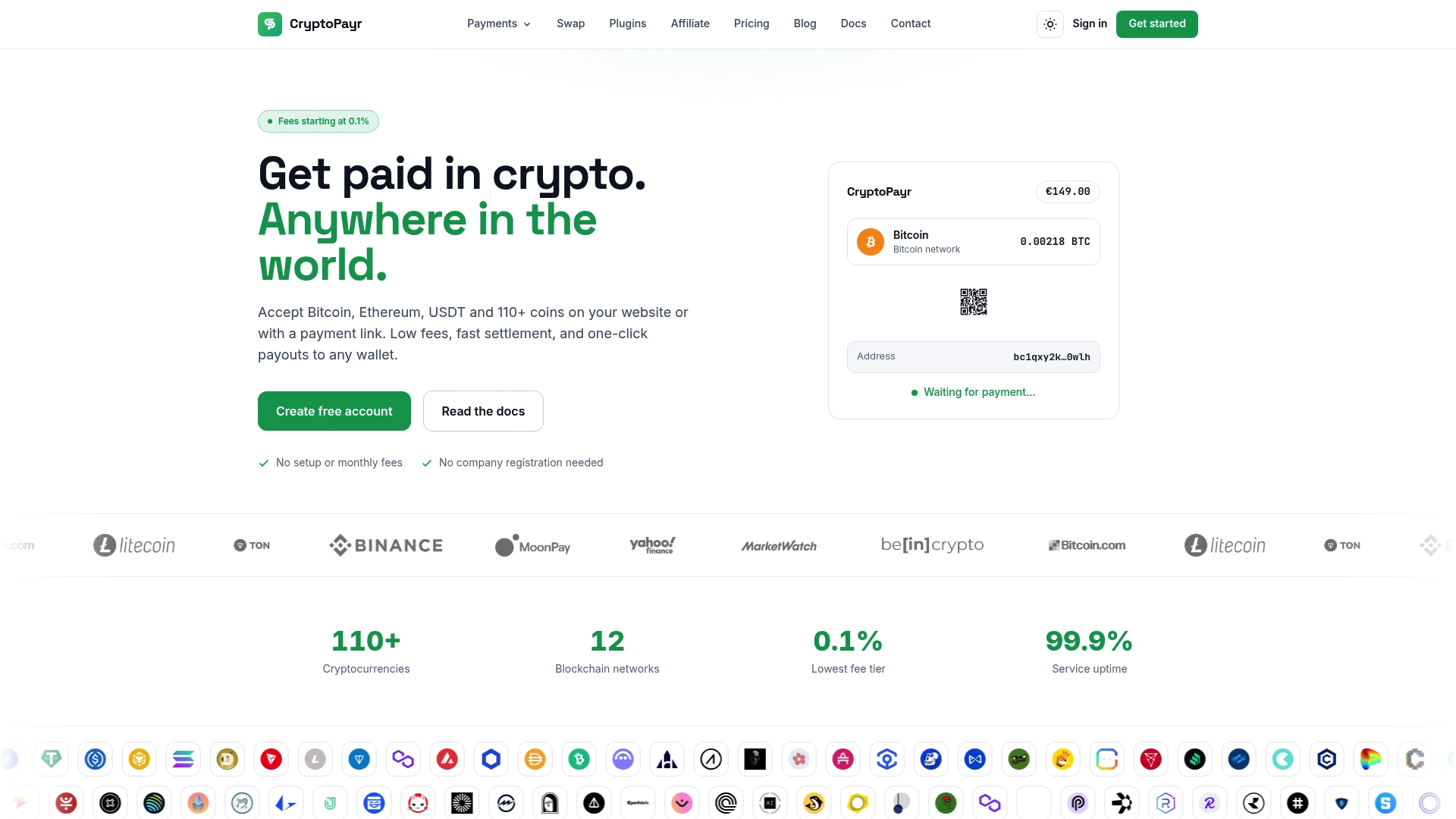
Let customers pay with over 110 cryptocurrencies through a payment gateway built for businesses, including e-commerce and digital services.
Digital goods are a good fit for crypto: there is no shipping, buyers can be anywhere, and delivery can be automatic the moment a payment confirms.
A payment processor is the simpler route (hosted checkout, plugins, address generation, optional conversion to stablecoins). A direct wallet gives more control but leaves reconciliation, key security and refunds to you.
Generate a unique payment address or invoice per order, wait for the right number of confirmations, and only then release the download or license.
Plan for underpaid and late payments, price volatility and U.S. tax treatment before your first sale, not after.
A physical product has to be packed, shipped and sometimes returned. A digital product is a file, a key or a login, and it can be delivered in seconds. Crypto payments are also settled in minutes, not days, and they don’t depend on the buyer’s country or bank. For ebooks, templates, software licenses, courses, game items, stock photos and SaaS plans, the two work well together.
There is a practical reason sellers add crypto as well. Some buyers keep a stablecoin balance and prefer to spend it directly. Others live in places where cards are declined or restricted. Offering crypto as one more option, next to cards, widens the group of people who can complete a purchase. It rarely replaces your existing checkout.
Direct wallet or payment processor?
The first decision is how the money reaches you. A CoinDesk merchant guide from June 2026 describes three operating models: processor-led acceptance, direct-wallet acceptance and a hybrid. The right one depends on which asset you want to end up holding, how much volatility you can tolerate, and how much of the operational work you want to own.
Taking payments straight to your wallet
You publish an address, the buyer sends coins, and you check your wallet. It costs no processing fee beyond the network fee the buyer pays. The trade-offs are real, though. Cobo’s merchant guide notes that direct wallets require manual matching of payments to orders, security and backups, and compliance work. You also carry the price risk and have to handle every refund yourself. For a store that sells ten items a month, that can be fine. For an automated catalog, it quickly becomes a chore.
Using a processor
A processor gives you a hosted checkout, a fresh address for every order, status tracking, plugins for common stores and the option to convert to a stable asset. The same Cobo guide lists the costs: processing fees, third-party custody during settlement and possible geographic restrictions. For most digital sellers the trade is worth it, because the order is matched to the payment automatically and your delivery logic can hang off a status change.
A hybrid setup
Many sellers split the flow. Small, frequent payments go through a processor with automatic conversion. Larger or recurring buyers can pay a wallet directly. This keeps the checkout simple while letting you hold some assets you actually want.
Direct wallet
Payment processor
Setup effort
Low to start, high to scale
Low, usually a plugin or API key
Order matching
Manual
Automatic, per-order address or invoice
Delivery automation
Requires custom code
Webhooks or plugin handles it
Price risk
You hold what you receive
Optional conversion to stablecoins
Refunds
Manual, from your own wallet
Handled through dashboard or API
Processing fee
None, only network fees
Percentage or flat fee per payment
Control of funds
Full
Depends on settlement setup
Step by step: from product page to confirmed sale
Decide what you will accept. Start with Bitcoin, Ethereum and one or two stablecoins. You can add more later. Our guide to accepting multiple cryptocurrencies explains how to decide which coins are worth listing.
Price in dollars. Keep your catalog in USD and let the gateway convert at checkout. Buyers see the exact amount in the coin they choose, and you avoid repricing every product when markets move.
Choose the integration. A hosted checkout page or payment link needs no code. A store plugin suits WordPress or an existing cart. An API suits custom apps, SaaS billing and games.
Set the settlement asset. Decide whether you receive the coin that was paid or have it converted automatically to a stablecoin.
Wire delivery to payment status. Release the product only on a confirmed status, never on the buyer’s click.
Test with a small order. Pay yourself, check the status changes, the email, the download link and your accounting record.
Write the policy. Say plainly what happens with refunds, underpayments and expired invoices.
Automating delivery without getting burned
The core rule is simple: payment confirmation triggers delivery, and confirmation means more than the buyer saying they paid. Bitcoin’s developer documentation on payment processing recommends a separate address for each payment request, tied to the order, so you can tell which payment belongs to which purchase. It also advises sending payment requests over HTTPS and keeping private keys off your web servers.
Confirmations are the other half. The same documentation says zero-confirmation payments generally should not be trusted without some risk analysis, and that high-value or fraud-prone transactions should wait for at least six confirmations. For a $9 template you might accept one confirmation, or even a fast-network payment, because the loss from a failed payment is small. For a $900 software license or a bulk game-currency purchase, wait longer. Match the confirmation threshold to the cost of being wrong.
A workable delivery flow looks like this:
The order is created and the gateway returns a payment page or address.
The order sits in a pending state. The buyer sees a clear countdown and the exact amount.
The gateway sends a webhook when the payment reaches your required confirmations.
Your server verifies the webhook’s signature and the amount, then marks the order paid.
The buyer gets the download link, key or access, ideally time-limited and tied to the order.
Because a webhook can be sent more than once, make the delivery step idempotent: the same event should never issue two licenses.
Connecting checkout to your kind of business
The plumbing changes with what you sell. Here is how it typically looks for each seller type.
No store needed. Send a payment link or invoice in your quote, in dollars, and the client pays in the coin they hold. The link shows a status page, so you know when work can begin or final files can be released.
SaaS and subscriptions
Crypto does not pull money from a wallet like a card does, so recurring billing works through invoices: a new payment request is issued each cycle and the customer pays it. That sounds like a drawback, but it helps when cards fail or customers lack one. We cover the mechanics in crypto payments for SaaS.
Games and in-app purchases
Game servers and apps usually use the API: create an invoice tied to a player ID, wait for the webhook, and credit the item or currency automatically. Keep the confirmation threshold low for small items and higher for expensive bundles.
Marketplaces
When many sellers share one checkout, you need to split each payment between the platform and the seller, and pay sellers out in bulk. That is commission splitting and mass payouts, which we describe on our page for crypto payments for marketplaces and platforms.
Fees, coins, networks and delays
There are three kinds of cost to keep apart.
Processor fee. A percentage of each payment, a flat charge, or both. On our side, fees are volume-based: the Standard tier is 2%, Growth 1.5%, Scale 1% and Enterprise 0.1%, with tiers based on monthly transaction volume. There is also a flat option at $0.10 per payment, which we describe on our gateway page. For small digital items such as a $5 download, a flat fee can be easier to model than a percentage. Compare both against your typical order value.
Network fee. Paid by the buyer to the blockchain. It varies by network and congestion, so offering cheaper networks and stablecoins to small buyers avoids killing a $5 sale with a high network fee.
Conversion spread. If you convert to stablecoins or fiat, check the rate you actually get.
Settlement speed depends on the network. Some chains confirm in seconds, others take ten minutes or more per block. If your product is instant, choose which coins to show first on the checkout page accordingly. Our post on optimizing crypto checkout covers fees and abandonment, and the supported coins page lists what you can offer.
Refunds, underpayments and volatility
This is where most first-time sellers get surprised, so write the rules down early.
Underpaid or overpaid invoices. Buyers sometimes send slightly less because of network fees deducted from their wallet, or more because of a rounding choice. Decide a tolerance, for example accept small shortfalls and flag larger ones for a top-up request. Do not release the product for a partial payment unless you chose that on purpose. Crypto.com’s merchant docs, for instance, mention late and mismatched payments as a standard case that merchants must handle.
Late payments. An invoice quotes an exchange rate for a limited window. If the buyer pays after it expires, the amount may no longer match the dollar price. Set a clear expiry, and give the buyer a way to request a fresh quote.
Refunds. Crypto transfers are irreversible, so there are no chargebacks, which protects you from card-style disputes. It also means a refund is a new payment you send. Refund to the address the payment came from or one the buyer confirms, decide whether you refund the dollar value or the coin amount, and say so in your policy. Exchange-originated payments sometimes come from a shared address, so ask the buyer for a refund address.
Volatility. If you hold what you receive, your revenue moves with the market. If you would rather not, convert to a stablecoin on settlement. The research behind the CoinDesk guide frames this as the core choice: the settlement asset you want, and the volatility you can accept.
Security. Keep keys off web servers, use HTTPS, verify webhook signatures, protect your dashboard with two-factor authentication and limit who can trigger payouts.
Tax basics for U.S. sellers
Tax rules depend on where you operate, and this is general information, not advice. For anything specific, talk to a CPA or tax attorney who works with digital assets.
In the United States, the IRS treats virtual currency as property. Under IRS Notice 2014-21, a taxpayer who receives virtual currency for goods or services includes its fair market value in U.S. dollars, measured at the time of receipt, in gross income. In practice, record the dollar value of every sale at the moment it confirms. Your gateway’s records help here. If you later sell or swap the coin you received, that can create a separate gain or loss, as the IRS describes in its 2020 material on virtual currency. Converting automatically to a stablecoin at settlement keeps that second step small.
Sales tax on digital goods varies by state, and we go through the practical steps in sales tax on crypto payments. If you sell to buyers abroad, other rules may apply. In the UK, for example, HMRC guidance says VAT is due in the normal way on goods or services sold for crypto, valued at the pound sterling value of the tokens when the transaction takes place. Check the rules of each market you sell into.
Our perspective
We see the same pattern with digital sellers. The ones who succeed with crypto don’t treat it as a novelty button. They treat it as one more payment rail with its own rules for confirmation, conversion and refunds, and they automate each of those from day one.
Three choices matter most. First, keep onboarding light: a merchant who can start accepting payments the same day, with no setup or monthly fees, is a merchant who actually tests the idea. Second, hold as little price risk as you can stomach, since most digital sellers want revenue in dollars, not a bet on a coin. Third, make delivery depend on a confirmed status and nothing else. Those three choices remove most of the headaches people associate with crypto.
We built CryptoPayr around them: no KYC for merchants, instant approval, hosted checkout, plugins and API, and settlement and reconciliation designed so that a finance person can follow the trail. We operate as a regulated MSB.
— Dustin
Start accepting crypto for your digital products
If you want the processor route, CryptoPayr lets you accept 110+ cryptocurrencies, including Bitcoin and Ethereum, through hosted checkout, payment links, plugins and an API, with optional auto-conversion to stablecoins. Fees are tiered by monthly volume, or flat at $0.10 per payment. See the plans and set up your account on the CryptoPayr homepage, or read how crypto processing works for your stack.
If you run a marketplace or want your own branded checkout, our white-label option lets you offer the gateway under your own name, with fees from 1%.
FAQ
Do I need a business license to sell digital goods for crypto?
Selling for crypto usually uses the same business registration you already have for fiat sales. Your obligations around income, sales tax and record keeping still apply, and they depend on your state and country. A tax professional can tell you what your situation requires.
Can I accept crypto for a subscription?
Yes, though not like card auto-billing. The gateway issues a new invoice every billing cycle and the customer pays it, usually after an email reminder. Some SaaS sellers find this works better than cards for customers whose cards fail or who don’t have one.
How long should I wait before delivering the product?
It depends on the order value and the network. Bitcoin’s developer guidance says high-value or higher-risk payments should wait for at least six confirmations and that unconfirmed payments carry risk. For small downloads, many sellers accept fewer confirmations or use faster networks.
What if a buyer pays the wrong amount?
Set a tolerance in advance. Small shortfalls caused by network fees can be accepted, while larger ones should keep the order pending and trigger a request for the difference. Overpayments are typically refunded or credited to the buyer’s account.
Can I avoid price swings?
Yes. Price your products in dollars and convert the payment to a stablecoin at settlement. You then hold a dollar-pegged balance rather than a volatile coin, though conversion has its own spread and processing costs.