Online Coaching Crypto Payments: How to Accept Them in 2026
How coaches and tutors can accept crypto payments from clients: payment links, stablecoins, recurring billing, records and U.S. tax basics, step by step.
CryptoPayrNov 21, 202614.00 min read
Online Coaching Crypto Payments: How to Accept Them in 2026
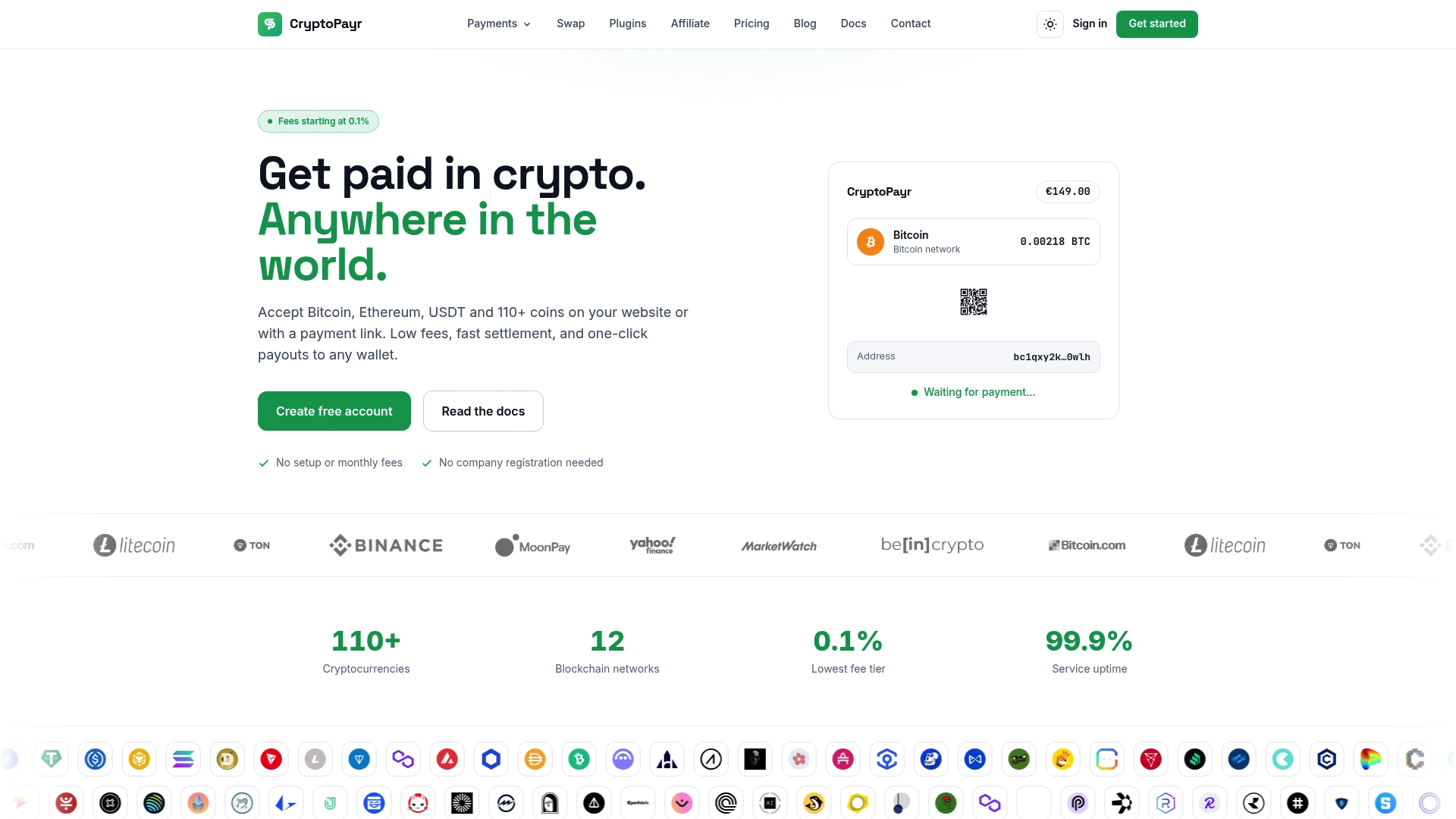
The simplest way for a coach or tutor to get paid in crypto is to send clients a payment link or hosted checkout from a crypto payment gateway. The client pays in the coin they already hold, and you receive a stablecoin or the coin of your choice, without running wallets or chasing transaction hashes. We built CryptoPayr for this: it is a no-KYC gateway with payment links, hosted checkout, recurring billing and auto-conversion to stablecoins, covering 110+ cryptocurrencies.
This guide walks through the whole routine for a coaching or tutoring business: what clients need, how a payment goes from invoice to confirmation, how to handle volatility, recurring sessions, refunds and records, and what U.S. tax rules say about income received in crypto.
Cryptopayr
cryptopayr.com
Accept Crypto Payments for Coaching
CryptoPayr helps coaching businesses accept payments in over 110 cryptocurrencies through a no-KYC payment gateway.
Online coaching is borderless. A client in Lisbon, a student in Lagos and a founder in Austin may all book the same program. Card payments across borders bring currency conversion, declined transactions and chargebacks. Crypto payments settle on a blockchain, so the payer’s location matters far less, and a confirmed transaction does not come with a card-style dispute window. The CFPB notes that blockchain transactions may be irreversible, which is a feature for a seller who delivers a session and wants the payment to stay settled, and a reason to write a clear refund policy (more on that below).
There is also a client-side reason. Many people who work in crypto, from traders to developers to founders, hold most of their savings in digital assets. If you coach that audience, accepting crypto is simply meeting them where their money is. If you tutor language, music or programming, the same option helps international families who find card payments awkward.
What your clients need to pay
A client paying in crypto needs a wallet, whether a self-custody wallet or an account at an exchange that lets them withdraw. The CFPB’s advisory says customers need a digital wallet and private keys to use virtual currency, and that losing the keys can mean losing access to funds. That is the client’s responsibility, not yours, but it shapes your checkout: some of your clients will be new to this and will need clear instructions.
The practical answer to “can they pay without a wallet?” is that someone has to hold the coin somewhere. A client who has never touched crypto should buy the coin on an exchange first. You do not need to run that process for them. What you can do is make the payment step the easy part: one link, a visible amount in dollars, a choice of coins and a QR code.
How a crypto payment works, from link to confirmation
Here is the routine, step by step, with where it usually goes wrong.
1. Set up your account
With a traditional processor, onboarding can take days of document review. With CryptoPayr there is no KYC step and approval is instant, so you can have a working payment link the same day you decide to offer crypto. There are no setup or monthly fees, which suits a solo coach who is testing demand before committing.
Where it goes wrong elsewhere: coaches often skip the gateway and paste a personal wallet address into an email. It works until a client sends the wrong network, pays a slightly different amount, or you cannot tell which transfer belongs to which client.
2. Create a payment link or hosted checkout
Price your session or package in dollars. A payment link carries that amount, and the hosted checkout shows the client the exact crypto amount at the moment they pay, in the coin they choose. You put the link in your booking confirmation, your invoice or your DMs. If you run a course site or booking page, our education payments page covers how checkout fits into a learning business, and e-commerce plugins and the API exist for sites that want it embedded.
Where it goes wrong: quoting a fixed amount of Bitcoin in your own invoice. The price moves between your quote and their payment, and you end up either shortchanged or awkwardly refunding the difference. Pricing in dollars and letting the checkout compute the crypto amount removes that.
3. The client pays
The client scrolls to their coin, scans the QR code or copies the address, and sends the exact amount from their wallet or exchange. Because the checkout is hosted, the instructions are on one screen: amount, coin, network and a countdown.
4. Confirmation
The gateway watches the blockchain, matches the transfer to your order and marks it paid once the network confirms it. Different networks confirm at different speeds, from seconds to several minutes, so tell clients up front that a session booking confirms after the network confirmation, not the moment they press send.
5. Settlement
You choose what you receive. Auto-conversion to stablecoins means the payment lands as a dollar-pegged asset rather than a volatile one. Our guide on accepting stablecoin payments in the U.S. goes into the details, and the stablecoin payments page covers USDT and USDC.
6. Reconcile
Each payment ties to an order or invoice, so your end-of-month records match what clients booked. This is the step that quietly saves the most time compared with chasing wallet transfers by hand.
Handling price swings: settle in stablecoins
The biggest worry for a coach is that a $200 session paid in a volatile coin is worth $180 by the time the money is spent. The European Supervisory Authorities’ warning says most crypto-assets are volatile and risky. Your answer is not to refuse crypto but to take the payment and settle into a stablecoin, so your revenue stays denominated in dollars.
The Bank of Italy’s Governor said in a 2025 speech that stablecoins pegged to a single fiat currency are the crypto products best suited to payments. That matches how most coaches should think: the client chooses what to pay with, you choose what to hold.
With CryptoPayr, auto-conversion to stablecoins is part of the product, so you do not have to place the trade yourself after each payment. If you ever want to move into another coin or out of crypto, the instant exchange is KYC-free, and you can check market levels on our live rates page.
What it costs
Our fees are volume-based. The listed tiers are Standard at 2%, Growth at 1.5%, Scale at 1% and Enterprise at 0.1%, set by monthly transaction volume. There is also a flat option of $0.10 per payment on our gateway page. For a coach selling $150 sessions, the flat fee is often the lower number: $0.10 on a $150 payment is well under 1%, whereas 2% of $150 is $3.00. Full details are on the pricing page.
Worked example: you run a 12-week program at $1,200 per client and sign 10 clients in a month, so $12,000 in volume.
Option
Fee on one $1,200 payment
Fee on 10 payments
Flat $0.10 per payment
$0.10
$1.00
2% (Standard tier)
$24.00
$240.00
1.5% (Growth tier)
$18.00
$180.00
High-ticket programs favor the flat fee because it does not scale with price. The percentage tiers make more sense where the flat option does not fit your setup. Check the pricing page for which option applies to you.
Recurring lessons, packages and refunds
Recurring billing
Most coaching is not one payment. It is a monthly retainer, a weekly tutoring slot or a payment plan on a premium program. Crypto has no built-in card-on-file, so recurring billing works differently: the gateway issues the invoice on schedule and the client pays it. CryptoPayr supports recurring billing, so each cycle generates a fresh payment request at the dollar amount you set, and the client pays the current crypto equivalent. Send reminders with the link inside, and make the due date clear.
Packages and multi-session bundles
For a bundle of ten lessons, charge once up front at a modest discount. One transaction means one fee and one confirmation, and the client does not have to find their wallet before every session.
Refunds
Because transfers on a blockchain are generally not reversible, a refund is a new payment from you to the client. Write the rule into your terms before the first sale: what is refundable, in what window, and in which asset (for example, refunded in the stablecoin you received, at the dollar value paid). Collect the client’s refund address at the time you need it, not in advance, and confirm it by a second channel. When you need to pay out to several people, such as associate coaches or a team of tutors, the mass payouts tool sends many payments at once.
If you run a platform of coaches
If you run a marketplace connecting students and tutors, commission splitting lets the platform keep its share and route the rest to each tutor. See our page on crypto payments for marketplaces.
Making payment instructions clear to clients
Most failed crypto payments come from confusion, not from the technology. A few habits cut that down:
Show the price in dollars first. “Session: $120” is what the client thinks in. The crypto amount is a detail on the checkout.
Use one link per payment. Do not make clients copy addresses out of a PDF.
Name the accepted coins. If you prefer stablecoins, say “USDC and USDT are the quickest”, and still let clients use others.
Tell clients what to expect. “You will get a confirmation email once the network confirms, usually within a few minutes.”
Warn about scams in your own channel. The CFPB’s complaint bulletin lists fraud, theft, hacks, phishing and social engineering among reported problems. Tell clients that you only send payment links from your official booking page or email, never in unexpected DMs.
Keep a one-paragraph FAQ. Where to buy a coin, which network to use and what to do if the payment is delayed.
This section applies to the United States. Other countries have different rules, and your situation depends on how your business is structured, so confirm the details with a CPA or tax professional.
The IRS’s digital asset FAQ says that if you provide a service and receive digital assets, the ordinary income you recognize is the fair market value of the assets, measured in U.S. dollars, when you receive them. So a session paid in crypto is income at its dollar value on the day it arrives, exactly as if the client had paid by card. The IRS has also said that convertible virtual currency received for services may be subject to self-employment tax.
Gross amounts on a Form 1099-K are not adjusted for fees, refunds or discounts, so use your own records to work out correct income and deductible expenses.
That is why a gateway helps. Each payment has a timestamp, a dollar value and an order reference, so your bookkeeper gets a clean list instead of a pile of wallet transactions. If you settle into stablecoins immediately, there is also far less price movement between receipt and conversion to track. If you later sell or swap what you hold, that is a separate event your accountant should handle.
Security basics for the coach
The CFPB’s complaint analysis underlines a simple principle: theft and unauthorized transfers can be difficult to reverse. So protect your side:
Turn on two-factor authentication on your gateway account and email.
Keep your payout wallet separate from any wallet you use day to day.
Back up your recovery phrase offline, since losing keys can mean losing access to funds.
Check the payment status in your dashboard rather than trusting a screenshot sent by a client.
Perspective
Coaches and tutors are small businesses with big audiences. They do not have a payments team, and they should not need one. The common mistake we see in the market is treating crypto as a technical project: choosing a coin, publishing a wallet address, and then doing reconciliation by hand.
Our view is that crypto should work like any other payment method. You price in dollars, the client chooses how to pay, and you get a settled amount and a record. That is why we built hosted checkout, payment links, recurring billing and stablecoin auto-conversion into one gateway, with no KYC, instant approval and no setup or monthly fees. We operate as a regulated MSB, so you are not stitching together a solution from loose parts.
Start with one program or one session type. Add a payment link, tell your audience, and see how clients respond. Scale from there.
Dustin
Start accepting crypto for your coaching
If you want to add crypto payments to your coaching or tutoring business, CryptoPayr gives you payment links, hosted checkout, recurring billing and stablecoin settlement across 110+ cryptocurrencies, with no KYC and no setup or monthly fees. You can also look at our crypto processing page for how payments are handled end to end.
FAQ
Can I accept crypto from clients without a wallet of my own?
Yes, in the sense that you do not need to manage wallet addresses by hand. With a gateway you share a payment link, and the client’s payment is matched to your order. You choose what you receive, such as a stablecoin, so you do not need to manage the conversion yourself.
Can my clients pay without a crypto wallet?
They need to hold crypto somewhere, in a self-custody wallet or in an exchange account they can send from. The CFPB says users need a digital wallet and private keys to use virtual currency. Your job is to make the checkout screen simple, with the amount in dollars, a QR code and a short guide.
How should I handle refunds on a crypto session?
Treat a refund as a new payment from you to the client, since blockchain transfers are generally not reversible. State your refund policy and the asset you will refund in before the first sale. Confirm the refund address with the client directly before you send.
Do I pay tax on coaching income received in crypto?
In the U.S., yes. The IRS says the ordinary income from services paid in digital assets is the fair market value in U.S. dollars when received. Keep dated records of every payment, and ask a CPA how it applies to your business structure.