Crypto Gateway SDK: What It Does and How to Integrate One
What a crypto gateway SDK does, the integration steps from checkout to reconciliation, and how hosted checkout, plugins and an API get you live sooner.
CryptoPayrNov 23, 202611.00 min read
Crypto Gateway SDK: What It Does and How to Integrate One
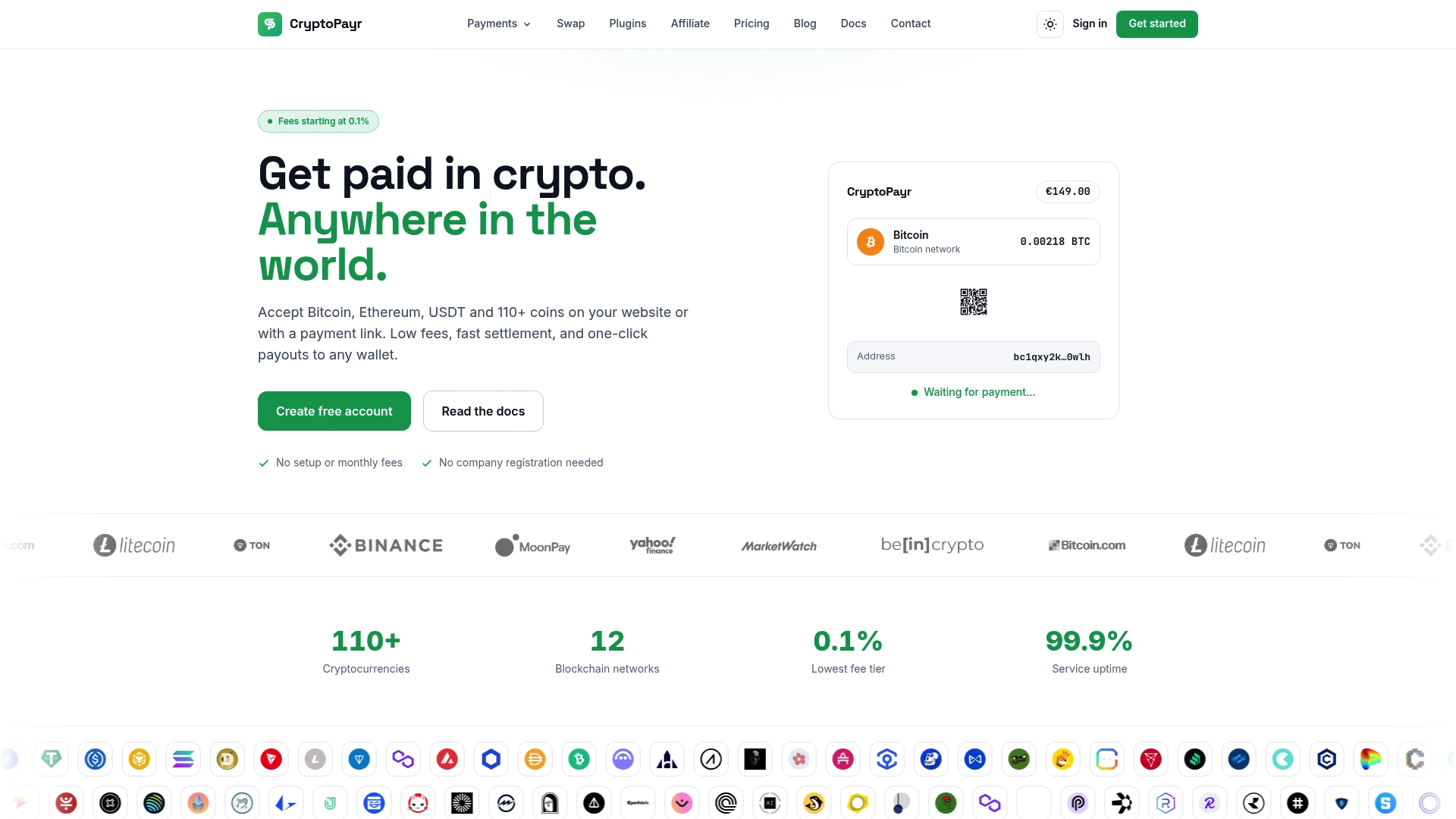
A crypto gateway SDK is a code library that wraps a gateway’s API, so your app can create a payment, show it to the customer and learn when it is paid without you writing every HTTP call by hand. Most merchants do not need to build much of it. With CryptoPayr you can start from a hosted checkout, an e-commerce plugin or payment links, and move to the API when your product needs custom logic. All of it works without KYC and with 110+ cryptocurrencies.
This guide is for e-commerce stores, freelancers, SaaS teams, game server operators and marketplaces. It explains what an SDK covers, the integration steps and where each one goes wrong.
Cryptopayr
cryptopayr.com
Add Crypto Payments With Less Custom Code
CryptoPayr helps businesses accept over 110 cryptocurrencies, with hosted checkout, payment links and integration options for different needs.
An SDK is a convenience layer over an API. The hard parts are payment states, confirmations, webhooks and reconciliation, not the first API call.
Pick the lightest integration that fits: payment links for invoices, plugins for stores, hosted checkout for fast launches, API for custom billing, payouts and splits.
Treat a payment as complete only after your server has verified a confirmed status, never because the customer’s browser says so.
Gateway fees run in tiers by monthly volume, from 2% down to 0.1%, plus a flat $0.10 per-payment option on CryptoPayr.
Settle into stablecoins automatically if you want invoices in dollars without holding price risk.
A gateway sits between your customer’s wallet and your business. It generates a payment address or request, watches the blockchain, decides when the payment counts as received, and tells your system. An API exposes those functions as web requests. An SDK packages them for a language such as Python, Node.js or PHP, so you call a function like “create invoice” instead of building requests, headers and error handling yourself.
Three jobs make up nearly every integration:
Creating a payment: amount, currency, an order reference and where to send the customer afterward.
Presenting it: a hosted page, an embedded form or a link, showing the address, amount and QR code.
Reacting to status changes: pending, detected, confirmed, expired, underpaid, overpaid.
The third job is where most projects stall. Blockchains are not card networks. There is no instant authorization, so your code has to live with payments that arrive late, short or twice.
Which integration fits your business
Before picking an SDK, decide how much code you need. The lighter the integration, the fewer moving parts you maintain.
Checkout and order status handled inside your store
Team that wants to launch this week
Hosted checkout
The payment page is hosted for you
SaaS or gaming operator
API with recurring billing
Subscriptions, in-game purchases and automatic fulfillment
Marketplace
API with commission splitting and payouts
Sellers are paid their share automatically
CryptoPayr offers each of these routes: hosted checkout, e-commerce plugins, payment links, API, recurring billing, mass payouts and marketplace commission splitting. Starting with the lightest one that meets your need gets you accepting payments sooner, and the same account carries you to the API later.
The integration routine, step by step
1. Create an account and choose settlement
Decide what you want to end up holding. Some merchants keep the coin they were paid in. Most price in dollars and prefer a stable asset. CryptoPayr supports auto-conversion to stablecoins, which removes price movement between the sale and your books. Onboarding is designed to be user-friendly with no KYC and instant approval, so this step does not hold up development.
Where it goes wrong: choosing settlement late. If finance later wants stablecoins, every historical order has to be reconciled against a different asset.
2. Create the payment from your server
Your backend should create each payment, never the browser. The amount, order ID and currency come from your database, so a customer cannot edit the price in their own request. Store the gateway’s payment ID against your order the moment you receive it.
Where it goes wrong: pricing in a volatile coin. Price your goods in dollars and let the gateway quote the crypto amount for each payment. Quote windows are short for exactly this reason.
3. Show the payment
The simplest option is to redirect the buyer to a hosted checkout. It already handles the address, QR code, countdown and coin selection, so you skip building and maintaining that screen. An embedded flow gives more control but means you own the edge cases, such as a customer switching networks halfway.
Under the hood, wallets commonly read a payment request from a link or QR code. For Bitcoin, the bitcoin: URI scheme in BIP21 puts the address and amount in one string so the spender does not copy two separate values. A gateway generates these for you across the many coins it supports.
Where it goes wrong: letting buyers pay a different amount or on a different network than the one shown. A clear hosted page reduces this.
4. Listen for status changes with webhooks
A webhook is a message your server receives when a payment changes state. It is faster and more reliable than polling. Three habits keep it safe:
Verify the signature. Gateways typically sign webhook payloads with a shared secret. Reject anything that fails the check.
Make handlers idempotent. The same event can arrive more than once. Fulfilling an order twice costs you real money.
Answer quickly. Acknowledge the message first and do slow work, such as sending licenses or emails, in a background job.
Where it goes wrong: trusting the redirect back to your site. A buyer can reach your “thank you” page without paying. Only a verified server-side status should release goods.
5. Handle the awkward payment states
Plan for each case before launch:
Underpaid: the customer sent too little, often because a wallet deducted network fees from the amount. Decide whether to request the difference or refund.
Overpaid: decide on a credit or a refund rule, and write it in your terms.
Expired: the quote window closed. Let the buyer restart without creating a duplicate order.
Late: funds arrive after expiry. Match them to the order by payment ID, not by guessing.
6. Reconcile and book it
Every payment needs a trail from order to payment ID to transaction to settlement. Export or pull settlement data on a schedule and match it to your orders. CryptoPayr is built around streamlined settlement and reconciliation, which matters most once you process more than a few payments a day. For a deeper look at where money lands, see where funds actually settle with a gateway versus an exchange.
7. Test, then go live
Run the whole path with small real payments: a normal payment, an underpayment, an expired quote and a repeated webhook. Confirm that an order is never fulfilled twice and that an unpaid order is never fulfilled.
Use cases beyond the store checkout
SaaS and recurring billing
Crypto payments are push payments: the customer sends them, you cannot pull them. Subscription billing therefore means issuing an invoice each cycle and reminding the customer. CryptoPayr supports recurring billing, so renewals do not need a hand-built scheduler.
Gaming and in-game purchases
Game servers need fulfillment to fire the moment payment confirms, with no staff involved. That is a webhook job: verified status in, item granted, idempotent. Use the order reference to carry the player ID.
Marketplaces and platforms
Splitting one buyer payment among several sellers is a ledger problem as much as a payment one. CryptoPayr includes marketplace commission splitting and mass payouts, so you can pay sellers in bulk rather than sending hundreds of manual transfers. The marketplace page shows how this fits together, and the white-label option lets you present the whole flow under your own brand.
Freelancers and agencies
If you invoice clients, payment links give you a request you can paste into an email or message. No SDK, no server, and the client can pay with the coin they already hold.
What it costs
Fees are the other half of the build-or-buy decision. CryptoPayr publishes tiered fees that fall as monthly volume rises: Standard at 2%, Growth at 1.5%, Scale at 1% and Enterprise at 0.1%. There is also a flat fee of $0.10 per payment, and white-label fees start from 1%. The owner’s description also states there are no setup or monthly fees. Because the flat fee does not grow with order size, it can suit larger tickets, while the percentage tiers suit many small ones. Work out which is cheaper with your average order value. The full breakdown is on the pricing page, and the guide to what you’ll actually pay in gateway fees shows how to compare.
Compliance basics for merchants
In the US, FinCEN’s 2019 guidance explains how its rules apply to business models involving convertible virtual currencies, including who counts as a money transmitter. Its page is FinCEN guidance FIN-2019-G001. CryptoPayr operates as a regulated MSB, so the payment processing itself sits with a regulated entity. Your own tax and bookkeeping duties still apply to crypto you receive, so keep order-level records and talk to your accountant about how your jurisdiction treats them.
A short pre-launch checklist
Prices set in dollars, crypto quoted per payment.
Payments created server-side only.
Webhook signatures verified, handlers idempotent.
Fulfillment released only on a verified confirmed status.
Rules written for underpaid, overpaid, expired and late payments.
Settlement asset chosen and reconciliation scheduled.
Checkout tested with real small payments.
If you want fewer abandoned carts once you are live, the guide to optimizing crypto checkout covers fixes for fees and drop-off.
Start with the integration you need
CryptoPayr gives you crypto processing through hosted checkout, plugins, payment links and an API, with 110+ cryptocurrencies including Bitcoin and Ethereum and no KYC onboarding. Open an account at cryptopayr.com, take your first payment through the hosted checkout or a payment link, then add API calls for the parts of your product that need them.
If you run a store, a plugin gets you running fastest. If you run a platform, the API and splitting tools are where the time savings are.
Our perspective
Most teams ask for an SDK when what they really want is a payment flow that works on a Friday night with nobody watching. The SDK is the easy part. The hard part is what happens after the customer clicks pay: a short payment, a late one, a repeated webhook, a seller who needs their share.
That is why we built CryptoPayr around the whole path: hosted checkout, plugins, payment links, API, auto-conversion to stablecoins, reconciliation, recurring billing, commission splitting and payouts. You choose how deep to go, and you are not asked for KYC or a long onboarding to begin.
Our advice is to ship the lightest integration first, learn from real orders, and add API logic only where your product needs it.
Dustin
FAQ
Do I need an SDK to accept crypto payments?
Not necessarily. Payment links, plugins and hosted checkout let you accept payments with little or no code. An SDK or the API becomes useful when you want to create payments from your own backend, trigger fulfillment or automate billing.
Can I accept Bitcoin and Ethereum without KYC on my side?
Yes. CryptoPayr supports 110+ cryptocurrencies, including Bitcoin and Ethereum, with onboarding that does not require KYC. Your own tax and recordkeeping obligations still apply, so keep clean order records.
How do I know a payment is really confirmed?
Wait for a signed webhook, or query the payment status from your server, and release goods only on a confirmed status. Never rely on the buyer being redirected to a success page, because that page can be reached without paying.
How do I avoid price swings between the sale and my payout?
Price your goods in dollars and use auto-conversion to stablecoins, which CryptoPayr offers. The payment is then settled in a stable asset instead of the coin the buyer chose.
Can a marketplace pay multiple sellers from one payment?
Yes. CryptoPayr includes marketplace commission splitting and mass payouts, so your platform can take its commission and pay sellers in bulk without manual transfers.